Eating Out in Japan with a Baby or Toddler: High Chairs, Zashiki Seating and Kids' Menus
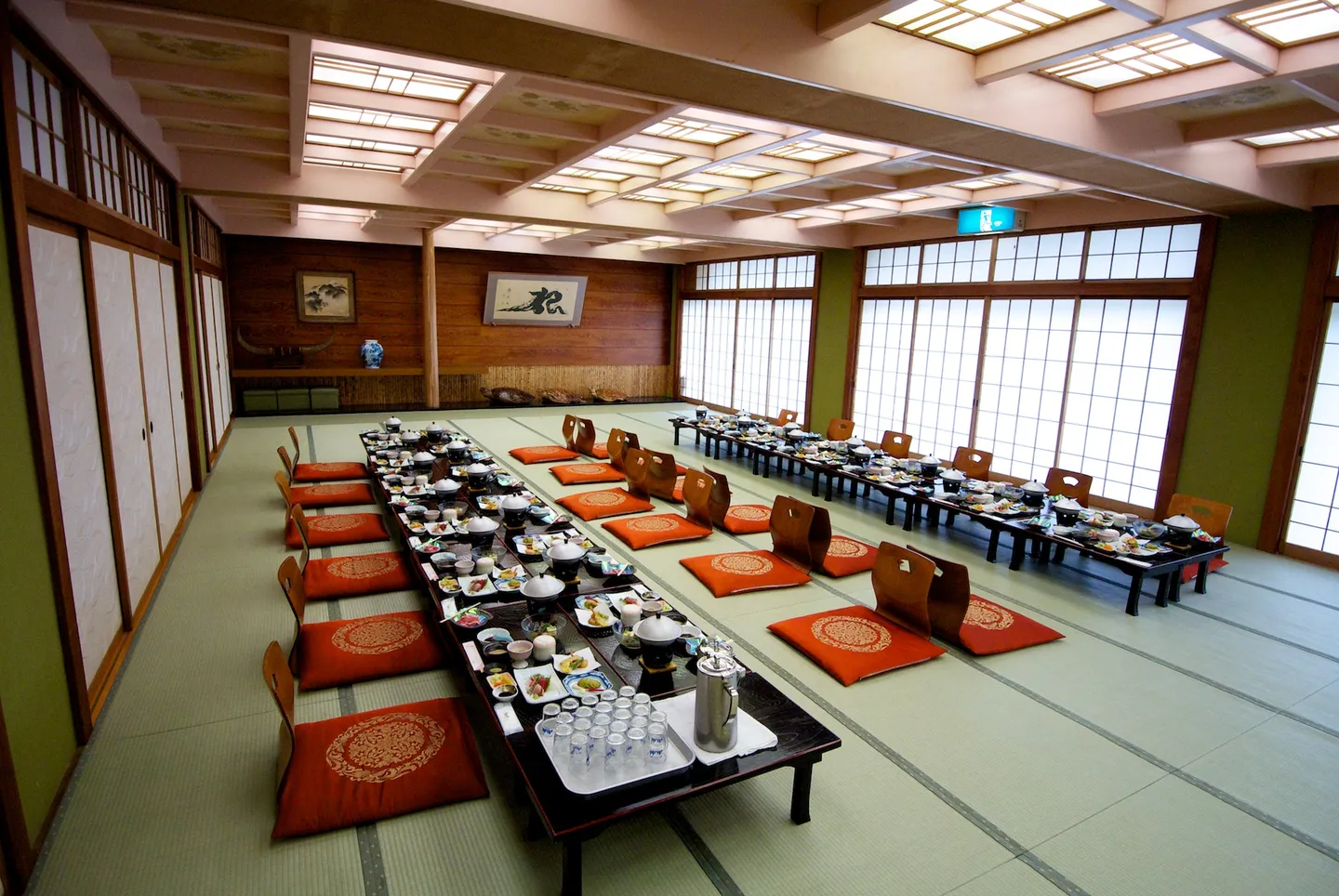
"a dining room of Hotel 'Akane' in Yugawara" by Koichi Oda, CC BY-SA 2.0, via Wikimedia Commons
This page contains affiliate links. If you book through them, we may earn a commission at no extra cost to you. How this works
- Many casual restaurants in Japan welcome children, and family restaurant chains such as Gusto, Royal Host, Denny's, Sushiro and Hama Sushi list kids' chairs, kids' menus or baby food on their own sites. What each one offers is different, and it can differ by store.
- Tatami seating (zashiki) and private rooms let a crawling baby move around or a sleepy one lie down. Tabelog's English site and Hot Pepper Gourmet's Japanese site let you search for them.
- Bringing your own baby food, wheeling the stroller to the table and diaper changing all depend on the restaurant, so ask before you go. We've included the Japanese phrases.
You’re hungry, the baby is getting fussy, and the restaurant in front of you has a menu you can’t read and a door you’re not sure you’re allowed through with a stroller. It’s very tempting to give up and grab something from a convenience store again. Some nights that’s the right call. But you don’t have to eat every meal standing up in a hotel room.
What a place has for kids matters most: a kids’ chair, tatami seating where a baby can roll around, a menu a toddler will actually eat. Once you know where that information is published and what to ask, eating out gets a lot easier. So we went through the official pages of the big family restaurant and conveyor-belt sushi chains, JNTO’s guidance, Japan’s smoking rules and the search filters on restaurant booking sites. Here’s what we found.
Are Japanese restaurants child-friendly?
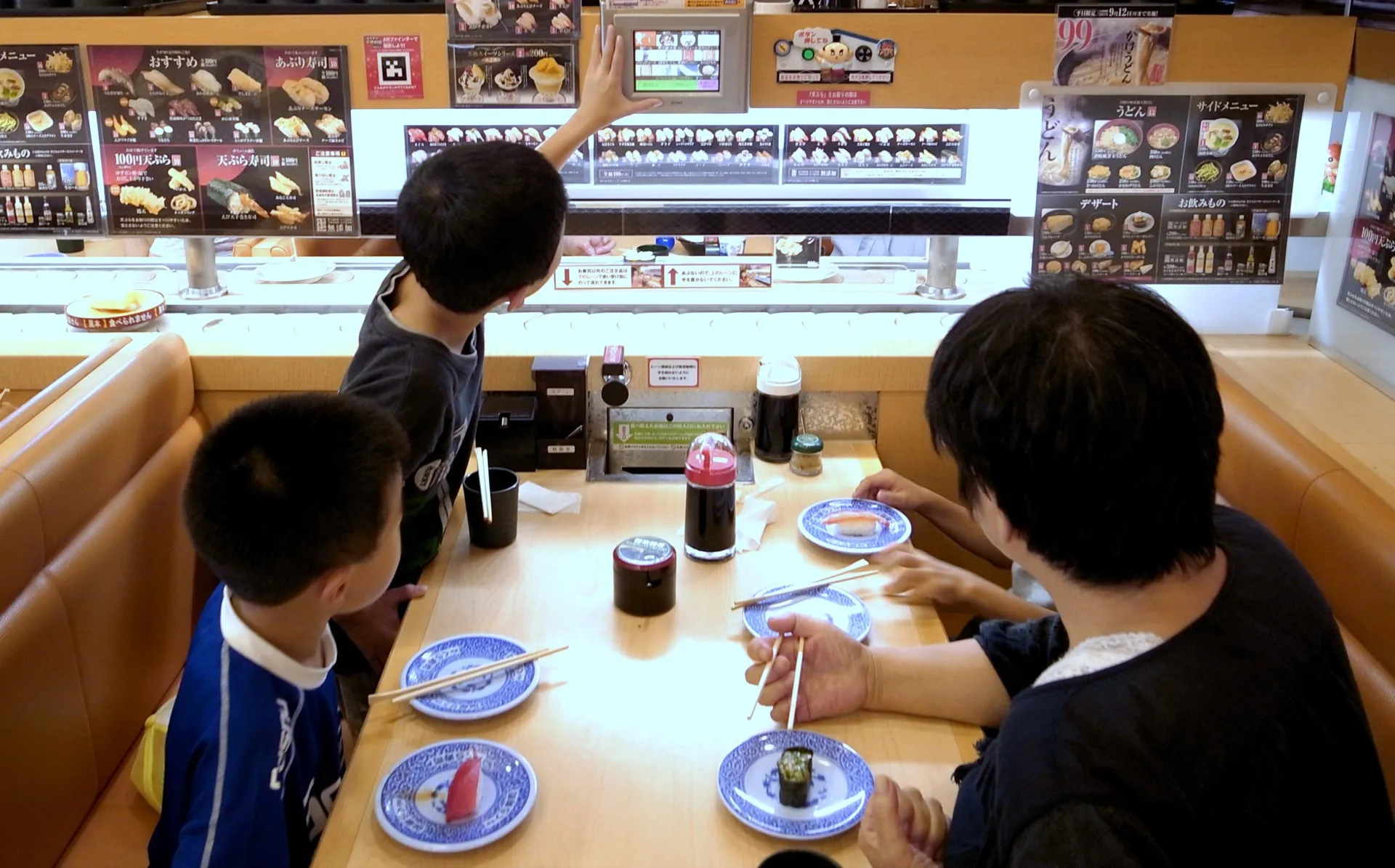
"回転寿司 2011" by Tamaki Sono, CC BY 2.0, via Wikimedia Commons, cropped
Mostly, yes. JNTO, Japan’s national tourism organization, says that most restaurants that aren’t upscale or formal are generally welcoming to children [1].
The easiest places to start are family restaurants, which Japanese people often shorten to fami-resu (ファミレス). JNTO names Saizeriya, Gusto, Denny’s, Sushiro and Hama Sushi as examples of casual family chains, and notes that family restaurants often have character items, toys and coloring sets for kids [1]. Conveyor-belt sushi (kaitenzushi, 回転寿司) is a relaxed option too. JNTO points out that it is less strict about etiquette than high-end sushi [2].
Chains are handy because they publish their services. But even chains say the details can change from store to store. Denny’s and Royal Host both note that menus, tableware or prices may differ by location [8] [6]. Small independent restaurants, counter-only places and izakaya (居酒屋, Japanese pubs) each set their own rules on children, so it’s worth asking before you go in.
What about cigarette smoke?
Since April 1, 2020, when Japan’s revised Health Promotion Act came fully into force, restaurants are in principle non-smoking indoors [15] [16]. There are exceptions, though [16]:
- Smoking-only rooms, where you can smoke but not eat.
- Heated-tobacco rooms, where eating is allowed.
- Smoking-allowed rooms in small existing restaurants: places that were open on April 1, 2020, with capital of 50 million yen or less and a seating area of 100 m² or less.
Under-20s, including staff, are not allowed into smoking areas, and places with a smoking room must display a set sign [16]. If the sign says the whole place is a smoking area, children can’t go in. If a place only has a separate smoking room, children just can’t enter that room. Some chains go further: Denny’s says all its stores have been fully non-smoking since April 1, 2020, including heated tobacco and e-cigarettes [9], and Sushiro says all seats at all its stores are non-smoking [10]. On Hot Pepper Gourmet’s Japanese site you can also filter for 禁煙席あり (non-smoking seats) [20].
Which chains list high chairs, kids’ menus and changing tables?
We checked each chain’s own Japanese pages in November 2026. “Not stated” means we couldn’t find it on the official site. It doesn’t mean the chain doesn’t have it, so ask at the store.
| Chain | Kids' chair | Kids' menu | Changing table | Baby food | Source |
|---|---|---|---|---|---|
| Gusto (family restaurant) | Yes (except some stores) | Yes, elementary age and under | Yes (except some stores) | Bringing your own is OK (except some stores) | [4] |
| Saizeriya (family restaurant) | Not stated | Not stated | Not stated | Not stated | [5] |
| Royal Host (family restaurant) | Not stated | Yes, elementary age and under | Not stated | Sells Wakodo baby food, 7+ and 9+ months | [7] |
| Denny's (family restaurant) | Not stated | Yes, all day | Not stated | Sells a rice porridge for about 7–8 months | [8] |
| Sushiro (conveyor-belt sushi) | Yes | Kids' tab on the touch panel | Changing sheets | Not stated | [10] [11] |
| Hama Sushi (conveyor-belt sushi) | Booster seats at all stores | Yes, "Hamakko set" (3+) | Not stated | Not stated | [12] [13] |
Notes:
- Gusto lists kids’ chairs, changing tables and permission to bring your own baby food, each “except at some stores.” Its kids’ menu comes with a kids’ drink bar, and some sets include a capsule-toy coin. Gusto also has a low-allergen menu made without the nine major allergens as ingredients [4]. The page doesn’t say whether traces from the kitchen are possible, so ask staff. It doesn’t say whether staff will warm baby food.
- Saizeriya has kids’ cups at the self-service water station and unbreakable kids’ cups at the drink counter [5].
- Royal Host has a “Baby Corner” with plates for infants and kids’ aprons. Its two Wakodo baby foods, a pumpkin gratin from 7 months and a flounder risotto from 9 months, cost 253 yen each including tax and are served warm in a dish. A toy comes with a kids’ menu order. The kids’ drink bar is for ages 4 through elementary school, and free for age 3 and under [7].
- Denny’s sells a shirasu (whitebait) rice porridge for babies around 7 to 8 months, at 330 yen including tax. The kids’ drink bar is free for children 3 and under [8].
- Sushiro’s FAQ says kids’ chairs and diaper tables “are installed” but doesn’t say whether every store has them [10]. Its kids’ page also lists kids’ bowls and plates for sharing, straws, leaving out green onion if you ask before ordering, and thin rolls cut into 8 pieces instead of 4 [11].
- Hama Sushi says every store has booster seats and you just ask a staff member. The Hamakko kids’ sets (319 to 506 yen including tax) come with a drink and a capsule-toy coin, and are meant for age 3 and up, though anyone can order one [12] [13].
- Kura Sushi’s store pages show a list of service icons (a ramp, a multipurpose toilet, smartphone ordering and so on), but none for kids’ chairs, changing tables or baby food [14].
Prices are from the chains’ sites in November 2026 and may differ by store [6] [8].
Kids’ tableware is the item most chains don’t mention. Royal Host and Saizeriya mention plates or cups for kids; elsewhere, ask staff.
What are zashiki, horigotatsu and private rooms?
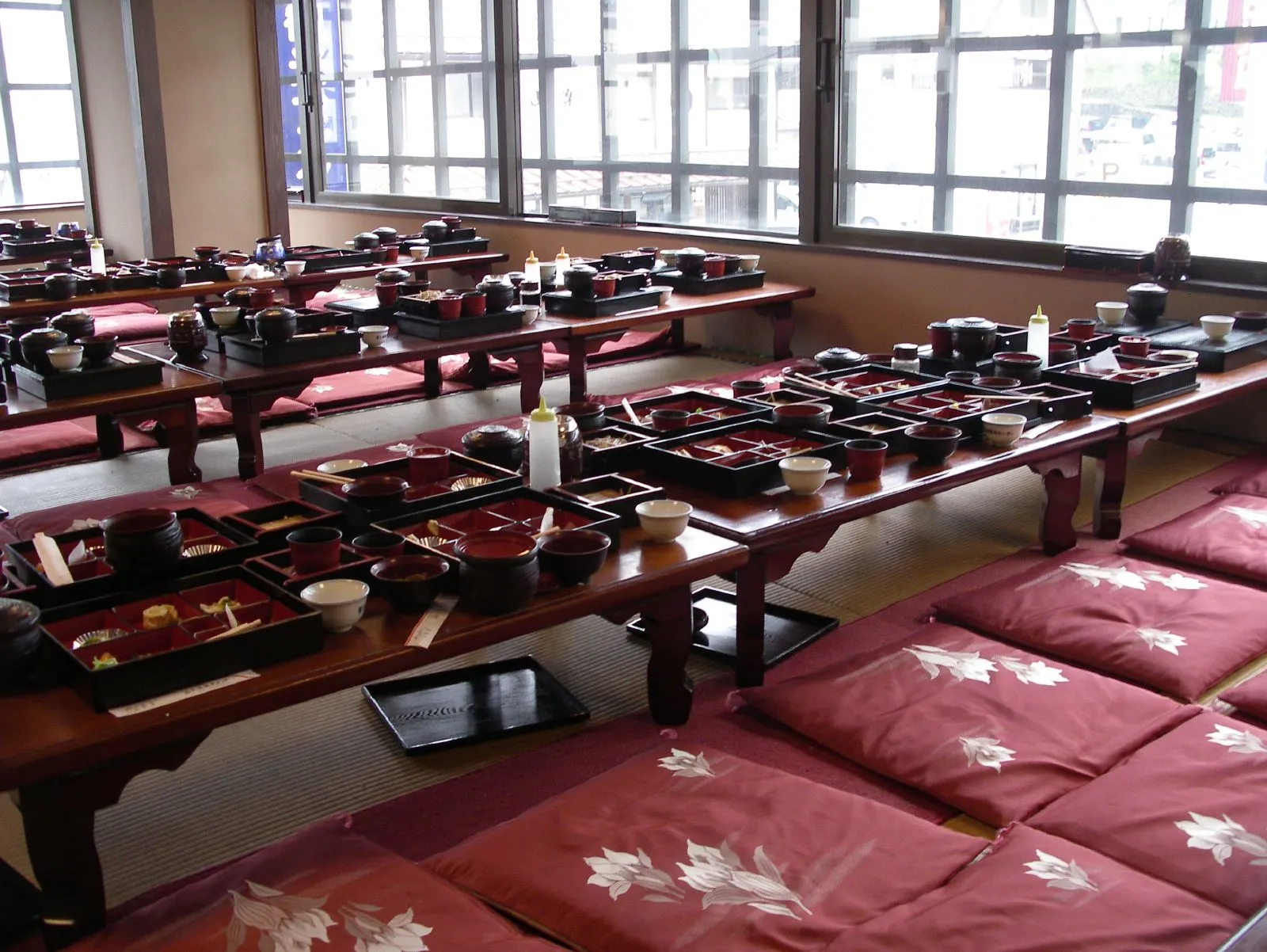
"A Tipical Reasaurant 01" by Shadowgate, CC BY 2.0, via Wikimedia Commons
A lot of Japanese restaurants have more than one kind of seating, and with a baby or toddler the choice can make a big difference.
- Zashiki (座敷): usually tatami-mat seating where you take your shoes off and sit on cushions at a low table.
- Koagari (小上がり): a raised tatami area, often next to the regular seating. You usually take your shoes off here too.
- Horigotatsu (掘りごたつ): typically a low table over a recess in the floor, so adults can sit with their legs down, much like sitting on a bench.
- Private room (koshitsu, 個室): a separate room or a screened-off area. It may be a tatami room or have regular tables and chairs.
Zashiki or a koagari can be easier with small children. A crawling baby has somewhere to move, a sleepy one can lie down on a blanket, and nobody has to balance on a tall chair. A private room means you worry less about noise. The trade-off is that a baby who can pull up to standing can reach everything on a low table, so slide hot dishes and teapots to the middle.
Shoes off. JNTO says some restaurants ask you to take off your shoes. There is usually a shoe rack, you may be given slippers, and signs or other diners will show you what to do [3] [2]. Slip-on shoes for the whole family make this much quicker. Where the stroller goes is up to each restaurant, so ask staff when you arrive.
How do you find restaurants with tatami seating or private rooms?
Two big Japanese restaurant sites let you filter for these:
- Tabelog (English site) shows search conditions called “Children welcome,” “Tatami room” and “Private room (Includes semi-private)” [17] [18].
- Hot Pepper Gourmet (Japanese site) has conditions including お子様連れ (okosama-zure, with children), 座敷あり (zashiki), 掘りごたつ (horigotatsu) and 個室あり (private rooms) [20]. We couldn’t find an English version, so a browser translation tool helps here.
A filter tells you what the restaurant listed. It’s not a promise that the seat will be free when you arrive. Tabelog’s English help says requests such as seating must be confirmed with the restaurant [19], so it’s worth asking when you book.
Can you bring baby food, and will they warm it?
This one really does depend on the restaurant. Of the chains we checked, only Gusto says on its site that you can bring your own baby food, and even then “except at some stores” [4]. The others don’t say either way. None of them says it will warm baby food you bring. The only warm baby food we found was what Royal Host sells on its own menu [7].
Some easy ways around this:
- Order baby food at the restaurant. Royal Host and Denny’s both sell baby food on their kids’ menus [7] [8].
- Buy it on the way. JNTO says baby food is easy to find at most convenience stores [1].
- Warm it before you sit down. JNTO notes that nursing rooms in department stores, stations and malls may have hot water and microwaves for baby food [1]. Our guide to nursing rooms in Japan covers what they usually have.
- Eat where the baby can eat too. JNTO mentions that some department stores, such as Sogo Yokohama and Isetan Shinjuku, have baby feeding areas with high chairs [1].
Japanese phrases to show or say
These are ready to use as they are. Show the screen, or read them out.
離乳食を持ち込んでもいいですか?Rinyūshoku o mochikonde mo ii desu ka? (“Is it OK if we bring our own baby food?”)
子ども用の椅子はありますか?Kodomo-yō no isu wa arimasu ka? (“Do you have a kids’ chair?”)
子ども用の食器をいただけますか?Kodomo-yō no shokki o itadakemasu ka? (“Could we have some kids’ plates and cutlery?”)
座敷は空いていますか?Zashiki wa aite imasu ka? (“Is there a tatami seat free?”)
辛くない料理はありますか?Karakunai ryōri wa arimasu ka? (“Do you have any dishes that aren’t spicy?”)
ベビーカーはどこに置けばいいですか?Bebīkā wa doko ni okeba ii desu ka? (“Where should we leave the stroller?”)
Asking for something not spicy can save an order.
What about strollers, diaper changes and busy times?
Strollers. None of the chains we checked says on its site whether you can bring a stroller to the table, so it’s up to each restaurant [4] [10]. Ask at the entrance with the phrase above. A carrier for the baby is handy at small places with tight aisles.
Diaper changes. Gusto and Sushiro list changing tables [4] [10]. For everywhere else, plan to change in a department store, mall or station before or after the meal. See our guides to nursing rooms and station toilets with baby seats.
Waiting. A queue is hard on a hungry toddler. Sushiro and Hama Sushi let you skip some of it with their apps. Sushiro takes seat reservations only through the Sushiro app (not at its Sakurazuka store or its Sushiro To Go takeout shops), and it doesn’t take phone bookings [10]. Hama Sushi doesn’t take seat reservations, but its official app offers queue tickets and time-slot booking [12]. Setting the app up at the hotel, before anyone is hungry, is a lot less stressful than doing it at the door.
Before you go: what to check and say when you book
When you book, or when you walk in, it helps to say up front:
- How many children, and their ages. You can type the ages into the booking notes.
- Whether you need a kids’ chair.
- Whether you’d like zashiki or a private room.
- That you have a stroller, and ask where to leave it.
- Whether you can bring baby food, if you plan to.
If you book online through Tabelog’s English site, you’ll need an account and a payment method, and there’s a system fee of 440 yen per person when the booking is confirmed (as of November 2026). Seating requests still have to be confirmed with the restaurant [19].
A short message you can add to the booking notes or show at the door:
子ども連れです。子ども用の椅子と座敷をお願いできますか。Kodomo-zure desu. Kodomo-yō no isu to zashiki o onegai dekimasu ka? (“We’re coming with children. Could we have a kids’ chair and tatami seating?”)
A few customs to know, from JNTO [3]:
- Be on time, or cancel early. Small restaurants prepare food for the bookings they have. If a nap runs long, call or cancel through the booking site as soon as you can.
- At izakaya, a small starter (otoshi, お通し) is often served automatically and charged as a table charge.
- Tipping isn’t customary.
Quick checklist
- Pick a few family restaurants or conveyor-belt sushi places near your hotel, and check each chain’s site for kids’ chairs and changing tables.
- Install the Sushiro or Hama Sushi app if you plan to go.
- Filter Tabelog (English) for “Children welcome” and “Tatami room,” or Hot Pepper Gourmet (Japanese) for お子様連れ and 座敷あり.
- Carry a pouch of baby food from a convenience store, a bib and a spoon.
- Save the phrases above on your phone.
- Know where the nearest nursing room is for diaper changes.
Questions parents ask
- Do Japanese restaurants have high chairs?
- Some casual chains say they do. Gusto lists kids' chairs (except at some stores), Sushiro says it has kids' chairs, and Hama Sushi says every store has booster seats. Other chains we checked don't say either way on their sites, and small independent restaurants vary, so ask when you book or at the door.
- Can I bring my own baby food into a Japanese restaurant?
- It depends on the restaurant. Gusto says it's fine except at some stores. Most other chains we checked don't mention it, so ask before you start feeding. Royal Host and Denny's sell baby food on their kids' menus.
- Is smoking allowed in Japanese restaurants?
- Since April 2020, restaurants in Japan are in principle non-smoking indoors, but the law has exceptions, including some small existing restaurants. Under-20s may not enter smoking areas, and venues with smoking rooms must display a sign. Denny's and Sushiro say all their stores are fully non-smoking.
- What is zashiki seating?
- Zashiki (座敷) is usually tatami-mat seating where you take your shoes off and sit on cushions at a low table. It can be easier with a crawling baby. You can filter for it on Tabelog's English site ('Tatami room') or Hot Pepper Gourmet's Japanese site (座敷あり).
- Top 5 Tips for Traveling to Japan with Kids (Traveling With Children) — Japan National Tourism Organization (JNTO)
- Japanese Manners Do's and Don'ts — Japan National Tourism Organization (JNTO)
- Japanese Customs and Etiquette (Responsible Travel Guide) — Japan National Tourism Organization (JNTO)
- お子さま連れのランチやディナーも安心でハッピー! | ガスト — Skylark Holdings (Gusto)
- サイゼリヤの利用方法(設備編) — Saizeriya
- キッズメニュー | ロイヤルホスト — Royal Host
- おこさまメニュー | デニーズ — Denny's Japan
- 全店禁煙のお知らせ | デニーズ — Denny's Japan
- よくあるご質問 | スシロー — Akindo Sushiro
- お子さま連れのお出かけに『こどもスシロー』 | スシロー — Akindo Sushiro
- よくあるご質問 | はま寿司 — Hama Sushi (Zensho)
- はまっこセット | はま寿司 — Hama Sushi (Zensho)
- くら寿司 新鎌ヶ谷駅前店(店舗ページの例) — Kura Sushi
- 受動喫煙対策 — Ministry of Health, Labour and Welfare, Japan
- 改正法のポイント | なくそう!望まない受動喫煙。 — Ministry of Health, Labour and Welfare, Japan
- [Child-Friendly & Tatami Rooms] Best Restaurants in Tokyo | Tabelog — Tabelog (Kakaku.com)
- [Private Tatami Rooms] Best Restaurants in Tokyo | Tabelog — Tabelog (Kakaku.com)
- FAQ | Tabelog (English) — Tabelog (Kakaku.com)
- 東京のグルメ・レストラン予約 | ホットペッパーグルメ — Hot Pepper Gourmet (Recruit)