Public Toilets and Baby Seats in Japanese Stations: How to Find a Changing Table
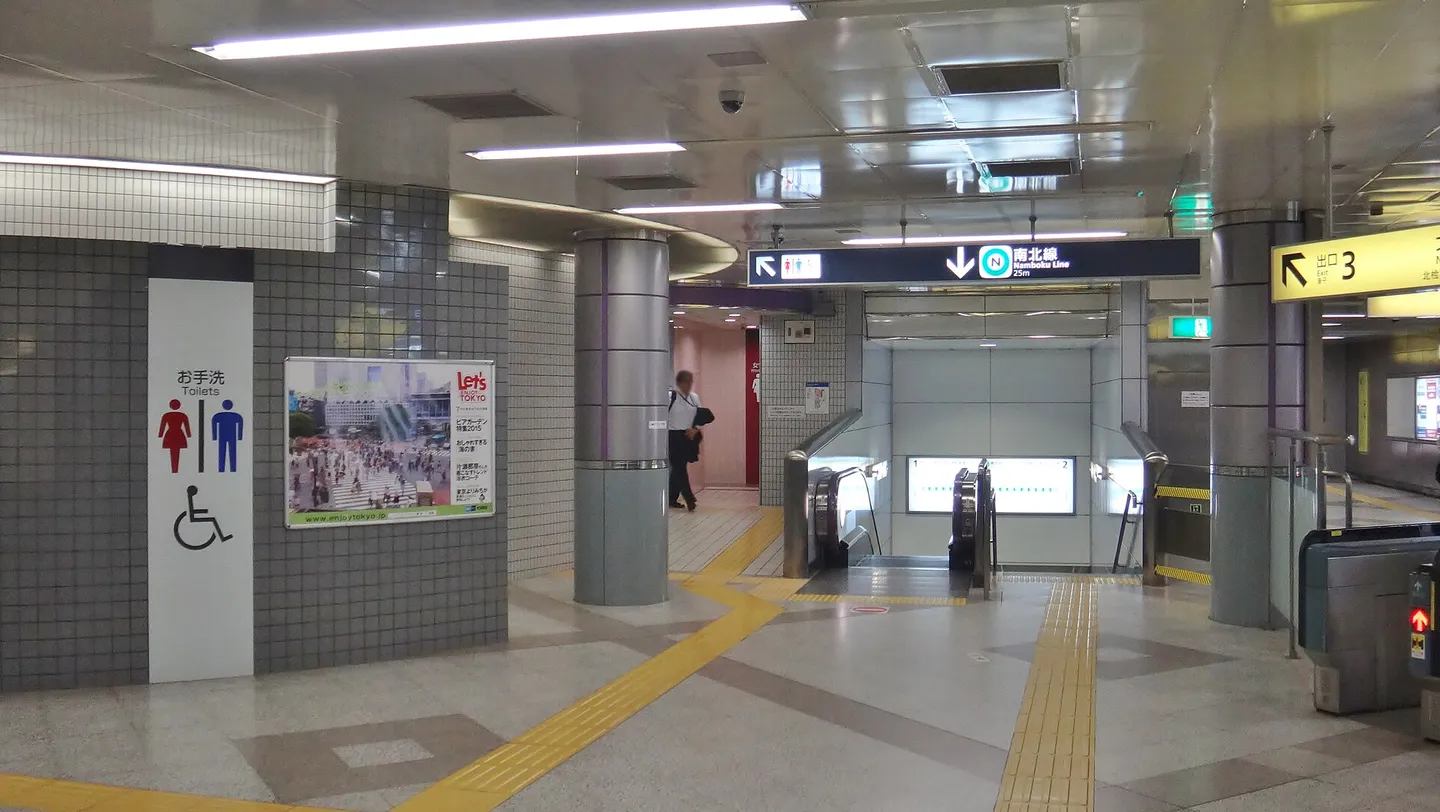
© DAJF / Wikimedia Commons, CC BY-SA 4.0
This page contains affiliate links. If you book through them, we may earn a commission at no extra cost to you. How this works
- Japan's national guideline sets diaper changing tables and baby chairs in station toilets as a standard to aim for, not a legal must, so what you find differs by station.
- The big rail companies we checked publish station maps or barrier-free pages that show baby facilities in some form, and a few of them are in English.
- Changing tables and baby chairs are made for set ages, and Japan's consumer agencies have warned about falls, so read the label and don't step or look away.
You’re changing trains, the baby needs a fresh diaper now, and the station is a maze of signs in a language you don’t read. That moment is stressful for anyone, and it’s even harder when you’re tired and carrying a stroller and bags.
So we went through Japan’s national barrier-free guideline, Tokyo’s toilet handbook, the rail companies’ own station pages, and the safety notices from Japan’s consumer agencies. This guide covers what you can expect in a station toilet, how to check a station before you arrive, the Japanese words on the signs, and what the official advice says about using changing tables and baby chairs safely.
Do Japanese station toilets have baby changing tables?
Japan’s national guideline expects them, but we can’t promise you’ll find one at every station, and here’s why.
Japan’s Ministry of Land, Infrastructure, Transport and Tourism (MLIT) publishes a barrier-free guideline for stations and other passenger facilities. The latest edition is from September 2025. It sorts its recommendations into three tiers: the legal minimum, the “standard” level, and the “desirable” level [1]. Baby facilities are in the standard tier, not the legal minimum [1]. In other words, they are what the government expects stations to aim for, not something every station must have. We also didn’t find any official figure for how many stations have them.
Here’s what the guideline asks for [1]:
- Standard level: at least one “stall with facilities for people with infants”. The guideline describes this as a stall big enough to enter with a stroller, with a baby chair, a diaper changing table, a fold-down board for changing clothes and so on. It also asks for a baby chair in at least one regular stall (in both the men’s and the women’s toilets when they’re separate), with a sign on that stall’s door, and a diaper changing table.
- Desirable level: stalls with infant facilities in both the men’s and the women’s toilets, or a shared all-gender one, and changing tables placed outside the wheelchair-accessible toilet so that parents don’t all queue for it.
- Large terminal stations: the guideline says these need an area that brings infant facilities together.
- Signs: when a regular toilet has a changing table or a baby chair, the guideline asks for a sign near the toilet entrance and on the outside of the stall door.
The guideline gives some station examples of baby-facility stalls inside the regular toilets: JR Central’s Nagoya and Shinagawa stations, and Ichigaya station on the Toei Shinjuku Line [1]. Tokyo’s toilet handbook adds more: baby chairs in every stall and changing tables both inside a wider stall and outside the stalls at Tokyo Metro’s Hibiya Line Ueno station; a baby chair next to the washbasin at Toei Asakusa Line Takaracho station; and stroller-size booths in both the men’s and women’s toilets at Tokyu’s Shibuya station [4]. These are examples printed in official documents. Stations get renovated, so check the current layout on the rail company’s page.
How do you find a toilet with baby facilities in a station?
The most reliable way is the rail company’s own station page. The rail companies we checked publish a station map (駅構内図, eki kōnaizu) and, for most of them, a barrier-free page for each station. How much they tell you about baby facilities differs a lot from company to company. Here’s what we found on each company’s official site in November 2026.
| Rail company | Where to look | English version? | What it shows for babies | Source |
|---|---|---|---|---|
| JR East | Each station's 駅構内図・バリアフリー情報 (station map and barrier-free information) page, plus a separate page listing stations with baby rest rooms | We didn't find an English version of the station map page | Map legend shows トイレ (toilet), バリアフリートイレ (barrier-free toilet) and ベビー休憩室 (baby rest room). No separate changing-table or baby-chair icon. Baby rest rooms inside the gates are listed with their equipment | [5] [6] |
| JR Central | The バリアフリー (barrier-free) and 駅構内図 (station map) tabs on each major station page | English "Maps of station layouts" for 34 stations, but the legend only says "Toilets" | The Japanese barrier-free page has a toilet table with a ベビーシート対応 column, split into inside and outside the ticket gates | [7] [8] |
| JR West | The ベビーケアルーム(授乳室) (baby care room / nursing room) list on JR Odekake-net | No English link on that page | Baby care rooms by station, all inside the ticket gates. Equipment differs; baby chairs at some stations only | [9] |
| Osaka Metro | Each station page: 駅構内図 (station map), 駅構内図(PDF) and 構内設備・施設 (facilities) | Yes, English station pages. The map PDF is the same Japanese file | Facility icons only for "Toilet" and "Multi-function Toilet". On the Umeda map PDF, the multifunction toilet label includes a baby pictogram | [12] [13] [14] |
| Tokyo Metro | Each station's バリアフリー設備 (barrier-free facilities) page | Yes: "Barrier-Free Facilities" | "Facilities for Infants or Small Children", inside or outside the gate, with where they are | [10] [11] |
A few tips for reading these pages:
- Tokyo Metro was the most straightforward in English of the sites we checked. In English, go to Route/Station Information, pick the station, and open “Barrier-Free Facilities”. The toilet section says whether there are facilities for infants or small children, inside or outside the gate, and where [11] [10]. Tables are split by line, so look at the line you’ll be on.
- For JR Central, use the Japanese page. The English maps mark toilets but don’t separate out baby facilities [8]. The Japanese barrier-free page has the table, and it tells you to check the station map for the exact location [7]. You can try your browser’s translate feature on the table.
- For JR East, look for the baby rest room. The station map legend shows ベビー休憩室 (baby rest room) and barrier-free toilets, but not changing tables or baby chairs on their own [5]. The station page also links to a live view of whether the main toilets are free [5].
- For Osaka Metro, the multifunction toilet is the one marked for babies. On the Umeda map, the regular toilets show only the men’s and women’s pictograms, so the map can’t tell you whether they have baby chairs or changing tables [14]. We only checked Umeda’s map, so look at the map for your own station.
- Other operators: we didn’t check every rail company. On any operator’s site, look for a page called バリアフリー (barrier-free) or 駅構内図 (station map) under the station’s name.
There is also an English-language database that covers stations from many operators, called RakuRaku Odekake-net. Its toilet section shows toilets, wheelchair-accessible toilets, ostomate facilities and “Crib” (a baby bed), inside or outside the gates. It has no baby-chair item [15], and we couldn’t confirm when the page was last updated. It can help you get a rough idea, but check the rail company’s own page for the current facilities.
Inside or outside the ticket gates?
This matters more than you might think. A changing table on the other side of the ticket gates isn’t much help if you’ve already exited. JR Central and Tokyo Metro list facilities as inside or outside the gates [7] [10]. JR West’s baby care rooms are all inside the gates, and you may need an admission ticket to reach them [9]. If you’re changing trains, the facilities inside the gates are usually the ones you want.
How to ask station staff
If you can’t find it, ask at the ticket gate or the station office. These lines are ready to show on your phone or read out:
おむつ交換台のあるトイレはどこですか。Omutsu kōkandai no aru toire wa doko desu ka? (“Where is a toilet with a diaper changing table?”)
ベビーチェアのあるトイレはありますか。Bebī chea no aru toire wa arimasu ka? (“Is there a toilet with a baby chair?”)
改札の中ですか、外ですか。Kaisatsu no naka desu ka, soto desu ka? (“Is it inside or outside the ticket gates?”)
Some of JR West’s baby care rooms are opened by staff over an intercom, or you ask at the station to use them [9].
Which Japanese words should you look for?
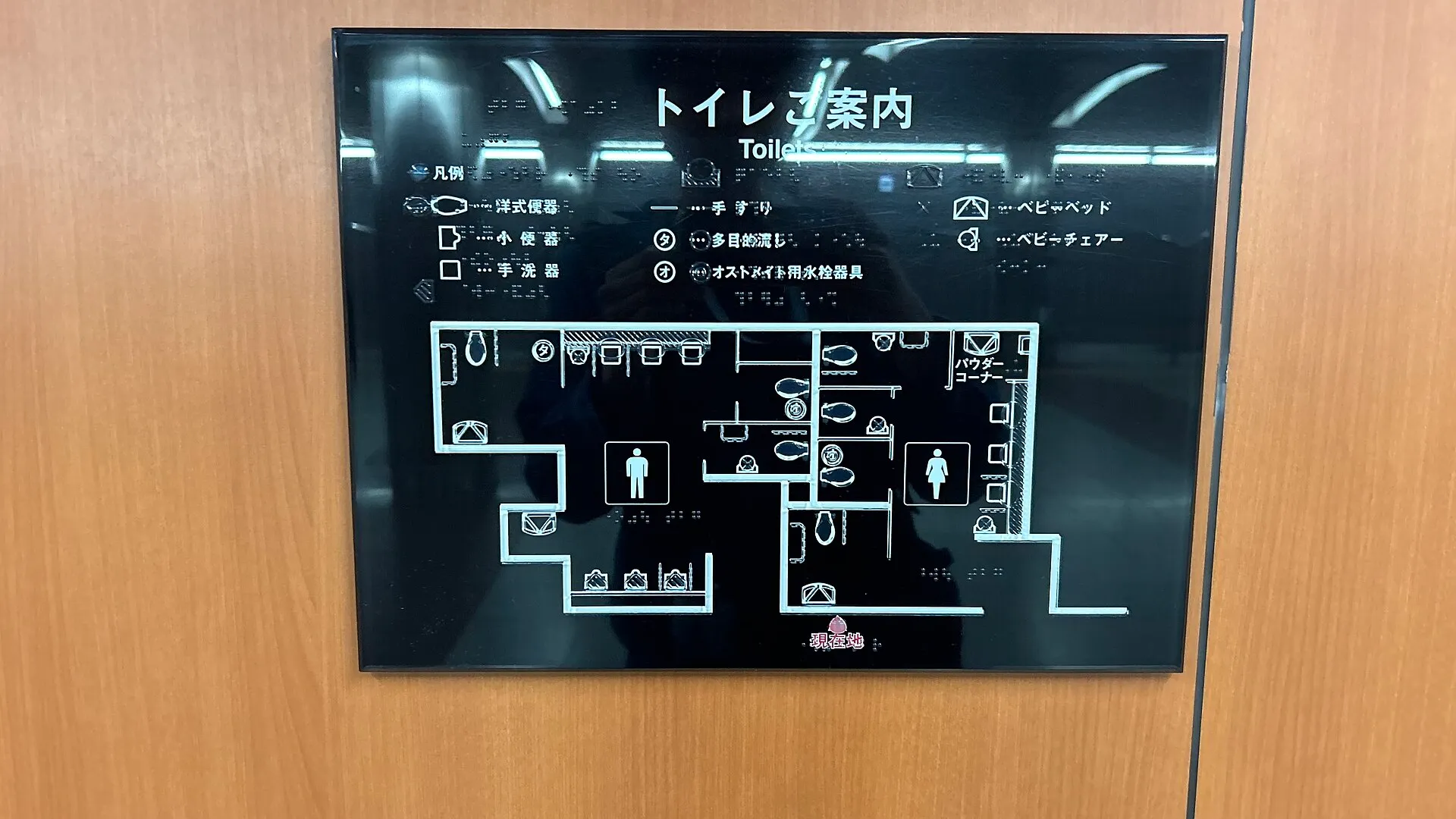
Station maps and signs mix several names for the same kinds of toilets. Japan has also been changing what it calls them. The national government now uses バリアフリートイレ (barrier-free toilet) as the umbrella term for what used to be called 多機能トイレ (multifunction toilet) or 多目的トイレ (multipurpose toilet) [2]. The guideline asks operators to stop using those older names and to name toilets by their equipment and who needs them instead [1]. So you’ll see all of these for a while.
| Japanese | Reading (guide only) | English | What it is | Source |
|---|---|---|---|---|
| 駅構内図 | eki kōnaizu | Station map | The map of the station on the rail company's site and on boards in the station | [7] |
| 改札内 / 改札外 | kaisatsu-nai / kaisatsu-gai | Inside / outside the ticket gates | Whether you need a ticket to reach it | [7] [10] |
| お手洗い / トイレ | o-tearai / toire | Toilet, restroom | The regular toilets | [12] |
| 多機能トイレ | takinō toire | Multifunction toilet | Older name for the large accessible toilet | [2] |
| 多目的トイレ | tamokuteki toire | Multipurpose toilet | Older name for the large accessible toilet | [2] |
| バリアフリートイレ | bariafurī toire | Barrier-free toilet | The government's current umbrella term for the toilets above | [2] |
| だれでもトイレ | daredemo toire | Toilet for everyone | Tokyo's older term for a toilet usable by wheelchair users, older people, pregnant women, people with infants and others | [4] |
| おむつ交換台 | omutsu kōkandai | Diaper changing table | The label of the official pictogram for a baby changing facility | [4] |
| ベビーシート | bebī shīto | Baby sheet (not a car seat) | Used by JR Central in its toilet tables; Combi Wiz sells a compact changing table under this name | [7] [18] |
| ベビーチェア | bebī chea | Baby chair | A small seat in a stall where your baby sits while you use the toilet | [4] |
| ベビーキープ | bebī kīpu | Baby Keep | A product name for a toilet-stall baby chair, made by Combi Wiz | [19] |
| 乳幼児用設備 | nyūyōji-yō setsubi | Facilities for infants | Tokyo Metro's heading for baby facilities in its toilet listings | [10] |
| ベビー休憩室 | bebī kyūkeishitsu | Baby rest room | JR East's room for feeding and changing | [6] |
| ベビーケアルーム / 授乳室 | bebī kea rūmu / junyūshitsu | Baby care room / nursing room | JR West's room for feeding and changing | [9] |
Note: the readings are a rough guide we wrote to help you recognize or say the word. They are not from an official source.
The baby chairs made by Combi Wiz carry labels in four languages, including English [19], and its changing tables have warning stickers in Japanese, English, Chinese and Korean [17]. Not every station uses this maker, though.
Multipurpose toilet or a regular stall with a baby chair: which should you use?
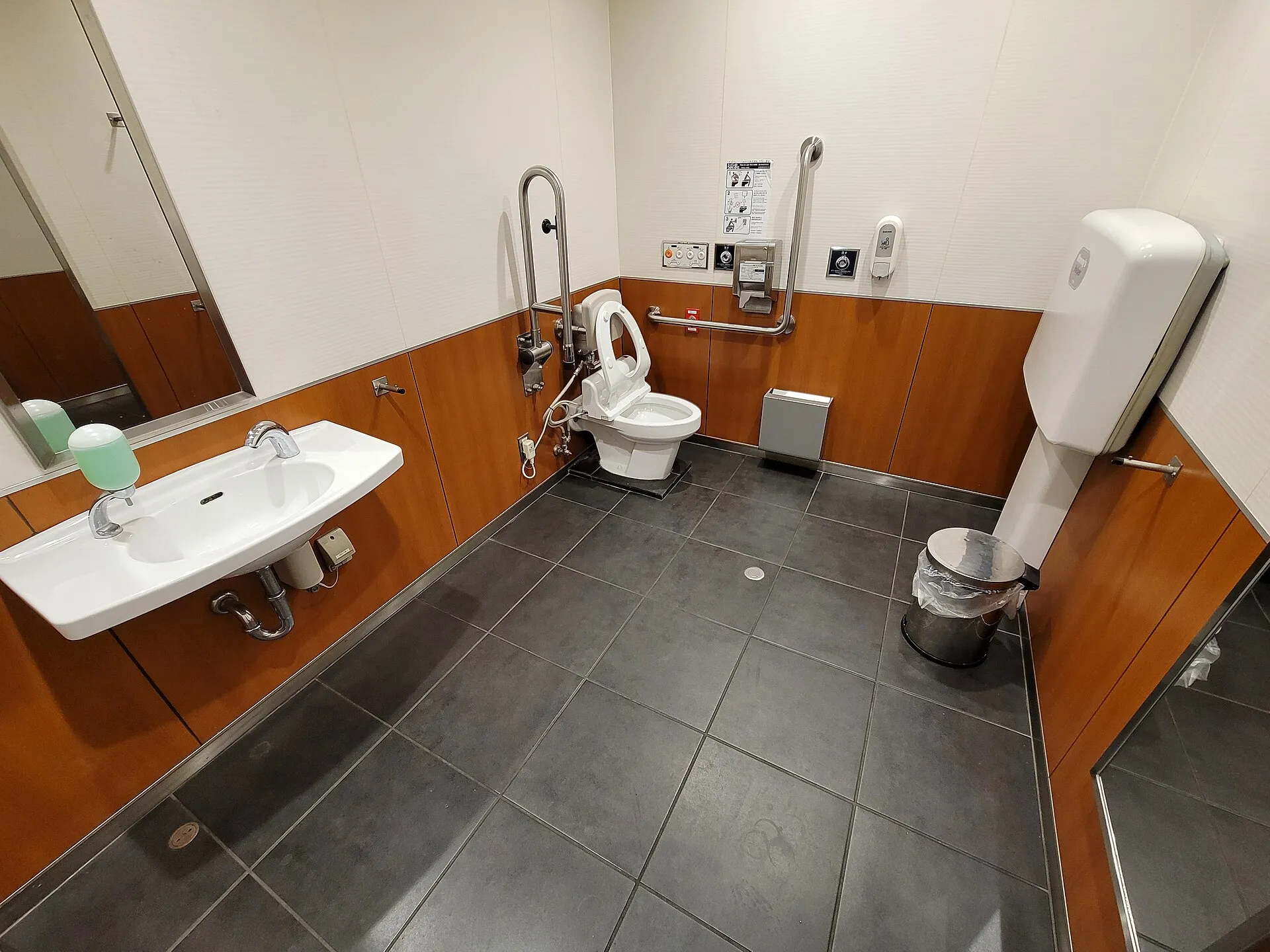
Photo by Makibao1023, CC BY-SA 4.0, via Wikimedia Commons
For years, baby facilities were often concentrated in the large accessible toilet [1]. According to MLIT, that toilet got crowded with parents with babies and other users, so wheelchair users, who can only use that toilet, couldn’t always get in [1]. Tokyo found the same problem: in a fiscal 2021 Tokyo survey of 486 people reached through disability organizations, 72.4% of respondents had had to wait for a multipurpose toilet, or couldn’t use one, because it was occupied [4].
The response is to spread things out. The national guideline and Tokyo’s handbook both move baby chairs and changing tables into the regular toilets, so the large toilet stays free for people who have no other option [1] [4]. Since April 2021, Japan’s Barrier-Free Act has made promoting proper use of barrier-free toilets a duty of the government, local authorities, facility operators and the public [3]. MLIT also runs a campaign on proper use. The 2025–26 edition ran from December 3, 2025 to January 8, 2026, with bilingual Japanese and English posters asking people who don’t need the large toilet to use the regular ones [2].
So what does that mean for you? The campaign doesn’t single out parents with babies [2], and Tokyo’s ordinance includes people with infants among the users of its “toilet for everyone” [4]. We found no rule that bars parents with babies from using it. Tokyo has since moved away from the “anyone can use it” labelling, though, and now asks for signs that show each toilet’s equipment instead [4]. But if there’s a regular stall with a baby chair, or a changing table in the regular toilets, using those leaves the large toilet free for someone who can’t use anything else. If you have a stroller and twins, or a toddler in full meltdown, the large toilet may be the realistic choice, and people with infants are among the users Tokyo’s definition includes.
Can dads change diapers in the men’s toilet?
Sometimes, but not everywhere. The national guideline says it’s desirable to have baby-facility stalls in both the men’s and women’s toilets, or an all-gender one, and it asks for a baby chair in the men’s toilet as well as the women’s when they’re separate [1]. Tokyo’s handbook recommends changing tables in stalls of both [4]. Whether the station in front of you has done this depends on the station. Some of JR West’s baby care rooms are inside the women’s toilet [9], so a dad on his own should check the station’s page before relying on one. If the station page shows a barrier-free toilet with a baby pictogram or changing table, that is another option to check.
How do you use fold-down changing tables and baby chairs safely?
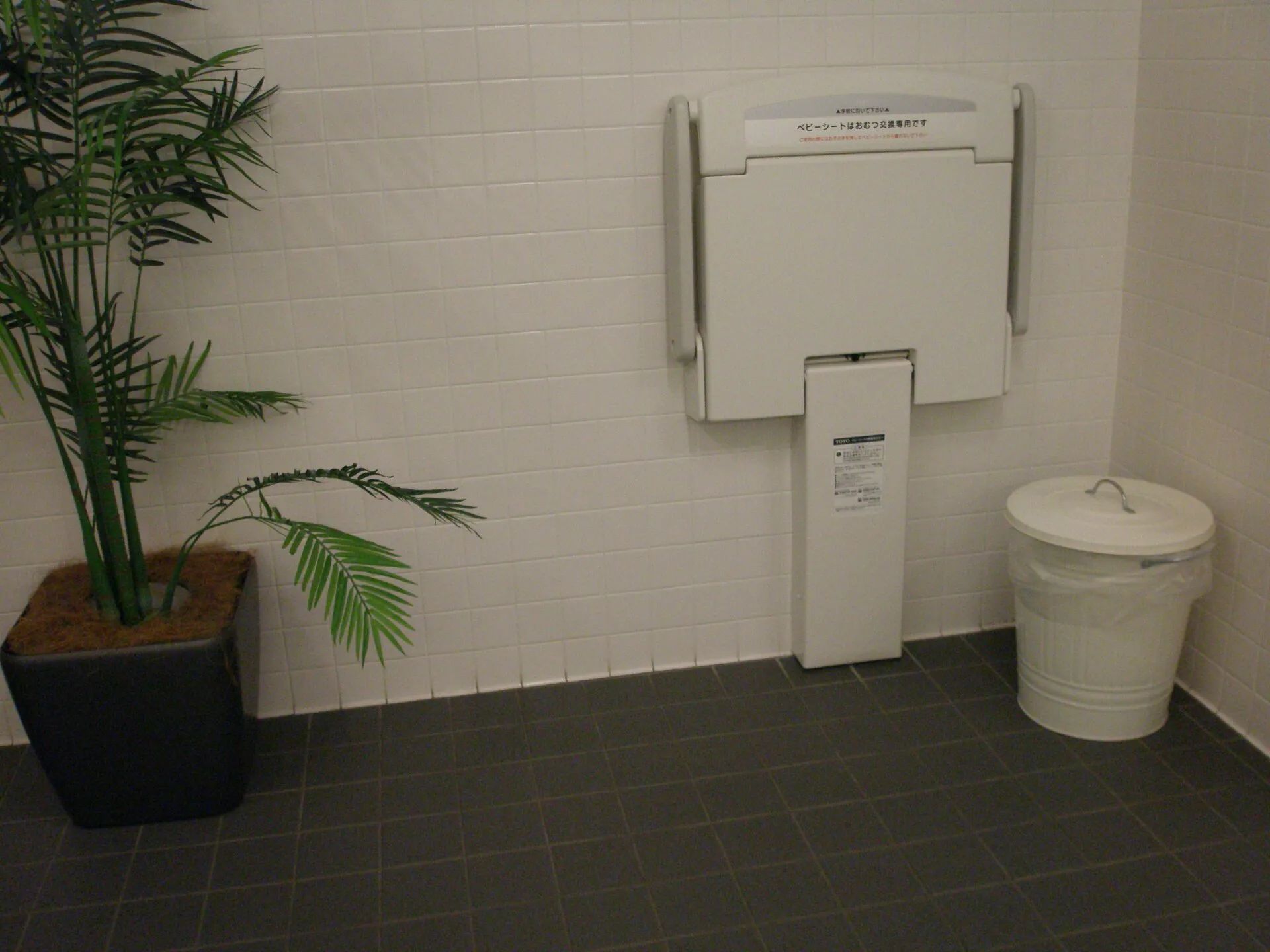
"ベビーシートは おむつ交換専用です" by くーさん, CC BY 2.0, via Wikimedia Commons
Check the age range printed on the table or chair. Fold-down changing tables and toilet-stall baby chairs are made for a set age range, and the range differs by model. Here are examples from Combi Wiz, a maker of these units for public toilets. The model in your station may be a different one, so read the label on the unit you’re using.
| Product | Type | Age range | Weight limit | Source |
|---|---|---|---|---|
| 横型おむつ交換台 OK21 | Horizontal fold-down changing table | 1 month to 2.5 years (30 months) | 15 kg | [16] [17] |
| ベビーシート MS-F52 | Compact changing table for small toilets | 1 month to 1.5 years (18 months) | Not stated | [18] |
| ベビーキープ・フィット F72 | Baby chair in a toilet stall | 5 months to 2.5 years (30 months) | 15 kg | [19] [21] |
| ベビーキープ・スリム W62 | Wall-mounted baby chair | 5 months to 2.5 years (30 months) | Not stated on the product page | [20] |
Note the compact table: it’s made for babies up to 18 months [18]. If you have a big toddler, a small fold-down board may not be the right place, and the label will tell you.
What the maker says about changing tables. Combi Wiz’s manual for its horizontal changing table warns that children can move unexpectedly, so take care to prevent falls. It says not to stand the child on the table, and to fasten the belt at the chest. It also says the belt only stops the child sliding sideways and does not prevent falls [17].
What the maker says about baby chairs. Combi Wiz’s F72 baby chair has a fixed guard shaped to be hard to climb out of, its product pages don’t mention a belt, and its baby chairs are meant for babies from about 5 months [19] [20]. Its manual tells facilities to keep footholds out of a child’s reach, because a child could stand up, climb out and fall [21]. We didn’t find a public safety notice from Japan’s consumer agencies about toilet-stall baby chairs specifically.
What Japan’s consumer agencies found about changing tables. Japan’s National Consumer Affairs Center (NCAC) collected reports from hospitals of 58 falls from changing tables involving children aged 0 to 3, between December 2010 and December 2019. In 71% of them the child hit their head, and 9 children were admitted to hospital [22]. Falls began around the age when babies start rolling over and pulling up to stand [22], and the most common age was 6 to 8 months [23].
Among parents in the NCAC’s survey whose child had fallen or nearly fallen (380 of the 1,000 surveyed), 74% didn’t use the belt even when there was one, and 86% had stepped away or looked away while their child was on the table, more than half of them for only about 1 to 3 seconds [22]. The most common reasons for looking away were getting things in or out of a bag and throwing something away [23]. That’s exactly the moment when you’re juggling a bag in a cramped stall.
The official advice for parents (from the NCAC and the Consumer Affairs Agency) [22] [23]:
- Get the diaper, wipes and anything else ready before you put your baby on the table.
- If there’s a belt, always use it.
- Lift your baby down as soon as you’ve finished.
- Don’t step away or look away while you tidy up or throw things away. Do those after your baby is off the table.
- If your child falls and hits their head, see a doctor.
Japan’s government has also asked facility managers to post fall warnings and inspect changing tables, in 2007 (the Ministry of Economy, Trade and Industry) and 2010 (the Consumer Affairs Agency) [23]. Combi Wiz also tells facilities to inspect its baby chairs and not to leave broken ones in place [21], so if a unit looks broken, it’s worth letting the station staff know.
The national guideline also lists, as desirable, placing the baby chair within reach of a parent sitting on the toilet, and adding a second lock out of a child’s reach when the chair is close to the door lock [1]. Not every stall will be set up like this, so it’s worth a quick look before you sit down.
Where else can you change a diaper near a station?
If the station’s toilets don’t work for you, there are a few other options:
- Baby rooms inside the station. JR East lists stations with baby rest rooms inside the ticket gates, such as Tokyo, Ueno, Omiya and Sendai, with their equipment [6]. JR West lists its baby care rooms, with equipment such as a changing table, a sink and hot water at many of them [9]. Equipment differs by station.
- Department stores and shopping malls. JNTO notes that nursing rooms can be found in department stores, stations and malls. One example it gives is Mitsukoshi Ginza, which has changing tables you can use standing up [24]. JNTO also mentions an app called Mama Papa for finding nursing rooms [24].
Before you go: a quick checklist
The night before a travel day
- Look up your transfer station and your destination station on the rail company’s site (see the first table).
- Note whether the baby facilities are inside or outside the ticket gates.
- Screenshot the station map, in case you lose signal underground.
In the station
- Look for a stall door sign or a sign near the toilet entrance showing a baby chair or changing table.
- If you can’t find one, show staff one of the phrases above.
- Consider a regular stall with a baby chair before the large barrier-free toilet.
At the changing table or baby chair
- Check the age range on the label.
- Get everything ready first, use the belt if there is one, and don’t step or look away.
- Lift your baby down before you pack up or throw anything away.
- If your child falls and hits their head, follow the official advice and talk to a doctor.
Questions parents ask
- Does every train station in Japan have a baby changing table?
- We can't say that. Japan's national guideline lists changing tables and baby chairs as a standard for station toilets, but that tier is not the legal minimum, and we found no official count of how many stations have them. Check the rail company's station page before you go.
- Are there changing tables in men's toilets in Japan?
- Sometimes. The national guideline says it is desirable to have baby-facility stalls in both the men's and women's toilets, or an all-gender one, and Tokyo's handbook recommends changing tables in both. Whether a given station has one depends on the station, so check its barrier-free page or the multipurpose toilet.
- Can I use the multipurpose (barrier-free) toilet with a baby?
- Tokyo's ordinance lists people with infants among the users of its 'toilet for everyone'. At the same time, the national government asks people who don't need the large toilet to use the regular ones, because wheelchair users may have no other option. If a regular stall with a baby chair or a changing table nearby works for you, that leaves the large toilet free.
- What does ベビーシート mean on a Japanese station page?
- It is not a car seat. JR Central uses ベビーシート対応 as a column in its station toilet tables, and the maker Combi Wiz sells a compact fold-down changing table under the name ベビーシート. JR Central's page doesn't define the term, so if you need a baby chair in particular, ask at the station.
- 公共交通機関の旅客施設に関する移動等円滑化整備ガイドライン バリアフリー整備ガイドライン 旅客施設編(令和7年9月) — Ministry of Land, Infrastructure, Transport and Tourism (MLIT), Japan
- 必要としている方がいます!〜「高齢者障害者等用施設等の適正利用推進キャンペーン」を実施します〜 — Ministry of Land, Infrastructure, Transport and Tourism (MLIT), Japan
- 利用者の多様な特性に配慮したトイレ整備のあり方と適正利用の推進に関する今後の取組方針をとりまとめ(令和3年3月12日) — Ministry of Land, Infrastructure, Transport and Tourism (MLIT), Japan
- 変わります とうきょうのトイレ ひとりひとりのために(ユニバーサルデザインのトイレづくりハンドブック、テキスト版) — Tokyo Metropolitan Government, Bureau of Social Welfare
- JR東日本:駅構内図・バリアフリー情報(東京駅) — JR East
- 赤ちゃんとご一緒のお客さま向け施設のご案内 — JR East
- 名古屋駅|JR東海(バリアフリー / 駅構内図) — JR Central
- Maps of station layouts | Central Japan Railway Company — JR Central
- ベビーケアルーム(授乳室)| JRおでかけネット — JR West
- バリアフリー設備 | 上野駅 | 東京メトロ — Tokyo Metro
- Barrier-Free Facilities | Ueno Station | Tokyo Metro — Tokyo Metro
- 梅田|Osaka Metro(駅情報) — Osaka Metro
- Umeda | Osaka Metro — Osaka Metro
- 駅構内図 梅田駅 UMEDA(御堂筋線)PDF — Osaka Metro
- Detailed Station or terminal information | RakuRaku Odekake-net — Foundation for Promoting Personal Mobility and Ecological Transportation (Eco-Mo Foundation)
- Combi 横型おむつ交換台OK21F — Combi Wiz
- Combi 横型おむつ交換台OK21 取扱説明書・点検マニュアル — Combi Wiz
- Combi ベビーシートMS-F52 — Combi Wiz
- Combi ベビーキープ・フィットF72 — Combi Wiz
- Combi ベビーキープ・スリムW62 — Combi Wiz
- Combi ベビーキープ・フィットF72 取扱説明書・点検マニュアル — Combi Wiz
- おむつ交換台からの子どもの転落に注意!−頭部損傷リスクが高く、入院する事例が寄せられています− — National Consumer Affairs Center of Japan
- 令和3年版消費者白書 第1部第1章第2節(3) — Consumer Affairs Agency, Japan
- Top 5 Tips for Traveling to Japan with Kids — JNTO (Travel Japan)