Nursing Rooms in Japan: How to Find a Place to Feed and Change Your Baby
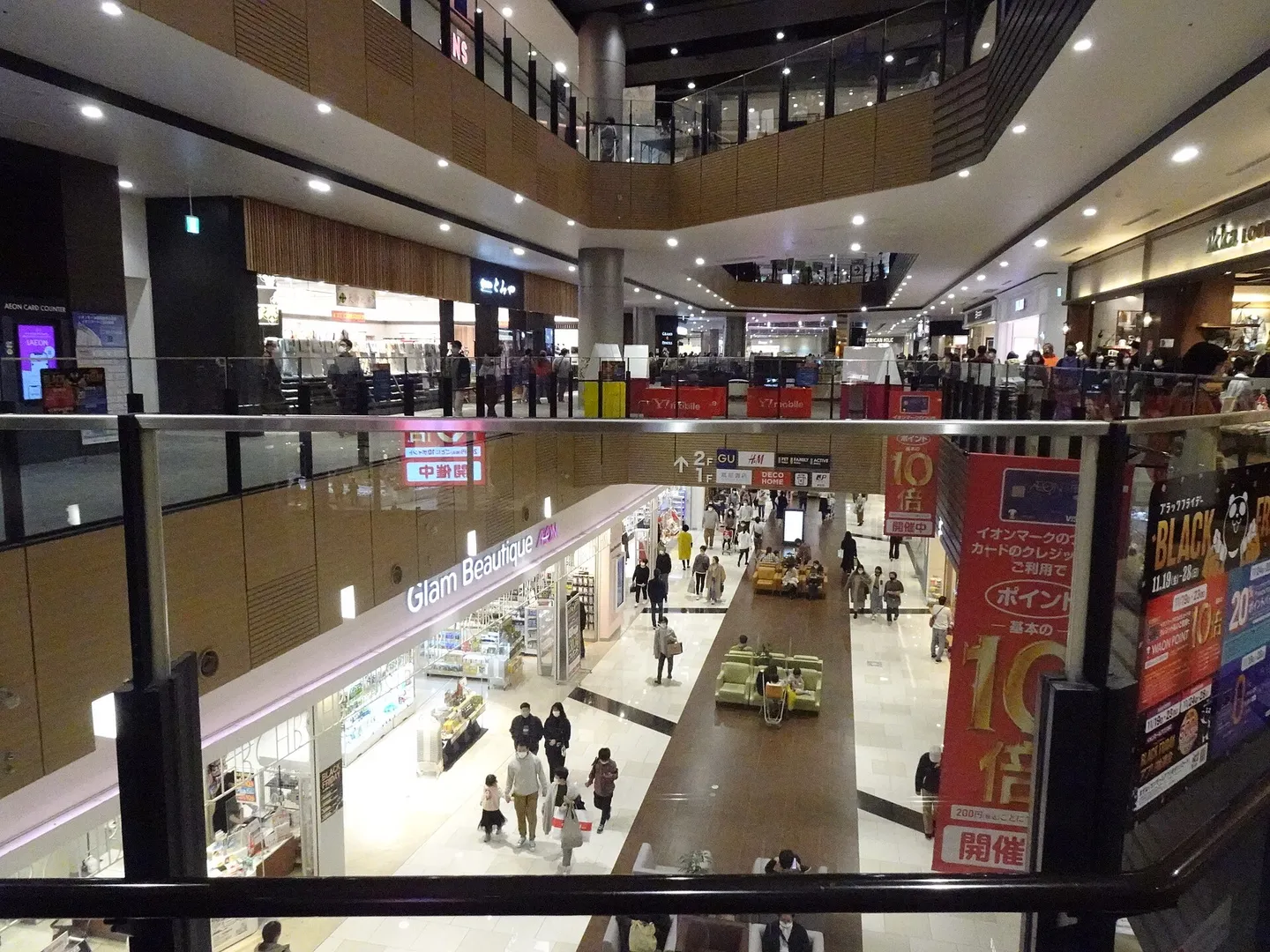
"AEON-Mall-Makuhari-Shintoshin 13 2021-11" by RuinDig (Yuki Uchida), CC BY 4.0, via Wikimedia Commons
This page contains affiliate links. If you book through them, we may earn a commission at no extra cost to you. How this works
- Department stores, station buildings, shopping malls and airports in Japan often have a nursing room or baby room, but what's inside, and whether dads can go in, differs from place to place.
- Some cities and wards also register public and private spaces where you can nurse and change diapers, such as Tokyo's 'Akachan Furatto' and the 'Akachan no Eki' (Baby Station) schemes, each with its own sign and map.
- Official facility pages, city maps and apps like Mama Papa Map and mamaro GO help you find one; our chart shows the Japanese words on the signs, including which rooms are for women only.
Your baby is hungry, the diaper has given up, and you’re standing in a crowded shopping street wondering where on earth to go. It’s one of the most stressful small moments of traveling with a baby, and it tends to happen at the worst time.
The good news is that Japan has a lot of places built for exactly this. The tricky part is that they go by different names, they’re set up differently, and the rules on who can go in vary. So we went through official pages from department stores, a shopping mall, airports, rail companies and city governments, plus the national sign standard, and put together what you need to find one and know what to expect when you open the door.
What is a nursing room in Japan, and what’s inside?
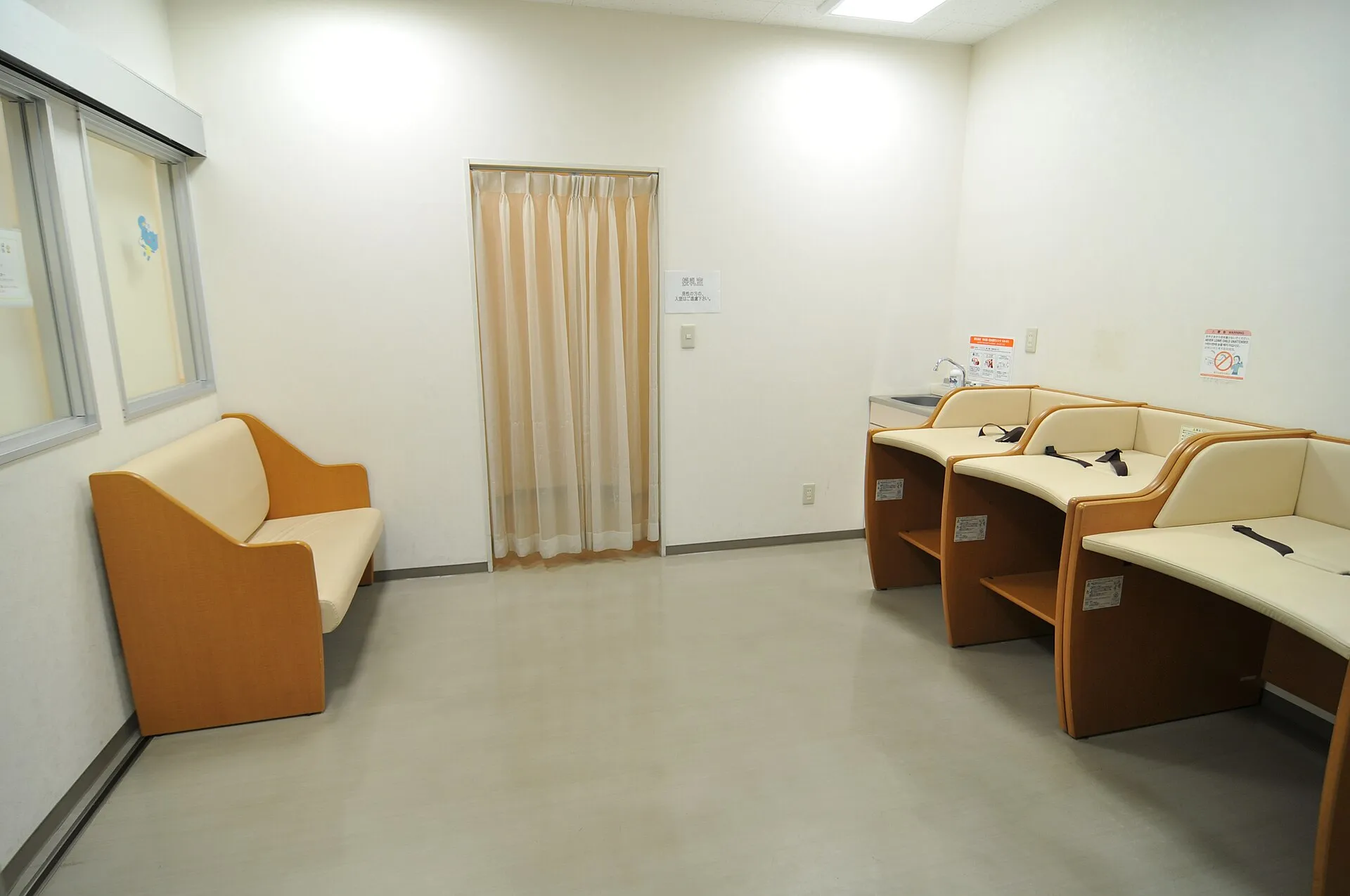
A nursing room in Japan is usually called a 授乳室 (junyūshitsu, “nursing room”). Bigger spaces that also have changing tables and a place to make up formula are often called a ベビー休憩室 (bebī kyūkeishitsu, “baby rest room”), ベビールーム (bebī rūmu, “baby room”) or something similar. JNTO, Japan’s national tourism organization, notes that nursing rooms are found in department stores, train stations and shopping malls [1], and the airports we checked have them too [11] [13].
What’s inside depends on the place. Some have curtained nursing corners, some have small rooms or booths, and the extras (hot water for formula, a microwave for baby food, a toddler toilet) vary [7] [8] [9] [10]. Even stores from the same company use different names and list different things: one Daimaru store calls its space a “baby rest room” (ベビー休憩室), another a “Baby Salon” (ベビーサロン) [7] [9].
Here are four examples from the facilities’ own pages, so you can see the range. They are examples, not a ranking, and any of them can change.
| Place | Where | What the official page lists | Can dads use it? | Source |
|---|---|---|---|---|
| Daimaru Tokyo (department store, Tokyo) | 9F baby rest room (ベビー休憩室) | 3 curtained nursing corners, 4 changing beds, room for strollers, purified hot water for formula | Not stated | [7] |
| Matsuzakaya Nagoya (department store) | Main building 5F, 10:00–19:00 | 4 nursing rooms (1 is a family nursing room), formula area with water heater, baby food area with microwave, 5 changing tables, parent-and-child toilet, crawling area | Nursing rooms: women only, except the family room. Formula, baby food and changing areas: yes | [8] |
| Daimaru Umeda (department store, Osaka) | 7F East, "Baby Salon" | Nursing room, microwave, hot water dispenser for formula, drinks vending machine | Not stated | [9] |
| Mitsui Outlet Park Shiga Ryuo (outlet mall) | 3 baby rooms: South Mall 1F (next to the information center), South Mall 2F, North Mall 3F | Diaper changing, hot water for formula; no microwave in the baby rooms (use the food court microwave for baby food); extra changing corners next to toilets | Not stated | [10] |
A few things worth knowing from these pages:
- “Nursing corner” can mean a curtain, not a door. Daimaru Tokyo describes curtained corners [7]. If you need a room that locks, look for that on the facility page, or use an app filter (see below).
- Baby rooms have their own hours. Matsuzakaya Nagoya lists its baby room hours as 10:00 to 19:00 [8]. Plan an evening feed somewhere else.
- Some ask you to keep it short. Matsuzakaya Nagoya asks families using its family nursing room not to stay for a long time or use it for anything other than feeding [8].
- Changing tables are often elsewhere too. Daimaru Tokyo lists changing tables in the women’s, men’s and multipurpose toilets on most floors, not only in the baby room [7]. For toilets and changing tables in stations, see our guide to public toilets and baby seats in Japanese stations.
Can dads go into a nursing room in Japan?
Sometimes, and it’s worth checking before you send a dad off alone with a hungry baby. The pattern we saw on official pages is that the nursing booth itself is often for women, while the rest of the room is open to men:
- Haneda and Narita airports let men into the baby rooms but not the nursing booths, and some Haneda rooms are women only [11] [13].
- Matsuzakaya Nagoya keeps its nursing rooms for women but has one family nursing room, and men can use the formula, baby food and changing areas [8].
- Tokyo’s “Akachan Furatto” spaces (below) must be usable by men to be registered [2].
- Several of the pages we read don’t say either way [7] [9] [10].
The sign on the door is the quickest clue. Japan’s standard pictograms include separate signs for a “Baby feeding room (for women)” and a “Baby feeding room (for men and women)” [20], though not every building uses them. If in doubt, ask at the information desk. The words are in the chart further down.
What are “Akachan no Eki” and “Akachan Furatto”?
Outside big stores and stations, some local governments, including the ones below, run their own schemes. They register spaces, often in public buildings but also in shops and businesses, where you can stop in to nurse or change a diaper. Each one has its own name, sign, rules and map.
Tokyo: Akachan Furatto (赤ちゃん・ふらっと). This is the Tokyo Metropolitan Government’s name for registered spaces for nursing and diaper changes. Tokyo encourages them in public facilities such as parks and children’s centers and in other places families go, and both public bodies and private businesses can register [2]. To be registered, a space must have a private nursing area, a changing bed or table and hot water for formula (or another way to provide it), and it must be usable by men [2]. Look for the round Akachan Furatto mark at the entrance or on a window. As of October 28, 2026, there were 1,642 registered sites. The list is published as an Excel/CSV file, and you can search a map on the Tokyo government’s “Tokyo Kosodate Switch” site [2].
Cities and wards: Akachan no Eki (赤ちゃんの駅, “Baby Station”). Itabashi in Tokyo, Osaka City and Okayama City are three examples of places that register public and private spaces under this name [3] [5] [6]. The basic idea is the same, but the details are not:
| Itabashi (Tokyo) | Osaka City | Okayama City | |
|---|---|---|---|
| How many | 192 | Not stated | Not stated |
| What to look for | "Akachan no Eki" flag or sticker (the logo includes the words BABY STATION) | "Akachan no Eki" mark | "Akachan no Eki" sticker |
| How to use it | Speak to the counter, during the facility's opening hours | Speak to the staff; may be unavailable at times | Follow the facility staff's instructions |
| Nursing space | Screened by a curtain or partition | A dedicated space, or just a curtained or screened corner | Differs by site |
| Hot water for formula | Boiled tap water is part of the criteria; ask staff | Generally not provided | Some sites only; formula not provided |
| Diapers | Not stated | Spare diapers generally not provided; take used diapers home | Not provided; take used diapers home |
| Where to find them | Dokonavi Itabashi map and a PDF list | Mobile search page (with current location) and a LINE account | PDF lists by ward and a map |
| Source | [3] [4] | [5] | [6] |
A few details from the official pages: Itabashi says its scheme is aimed at parents of children roughly 0 to 3 [3], and its criteria say that if a space can’t be used, the staff should point you to another one nearby [4]. Osaka City reminds parents not to step away from a baby on a changing bed [5]. Okayama City started registering sites with neighboring Kurashiki in April 2011, and its sites include department stores, supermarkets and restaurants as well as public buildings [6].
What this means for you. Bring your own diapers and a bag for used ones, and don’t count on hot water unless the city’s page says it’s there [5] [6]. If you’re traveling somewhere else, search the city’s name plus 赤ちゃんの駅 (akachan no eki). The name and rules can differ from city to city, so read that city’s page.
Since you’ll usually need to speak to someone, here’s a line you can show or say at the counter:
赤ちゃんの駅を使わせてください。Akachan no eki o tsukawasete kudasai. (“May I use the Baby Station, please?”)
What about stations and airports?
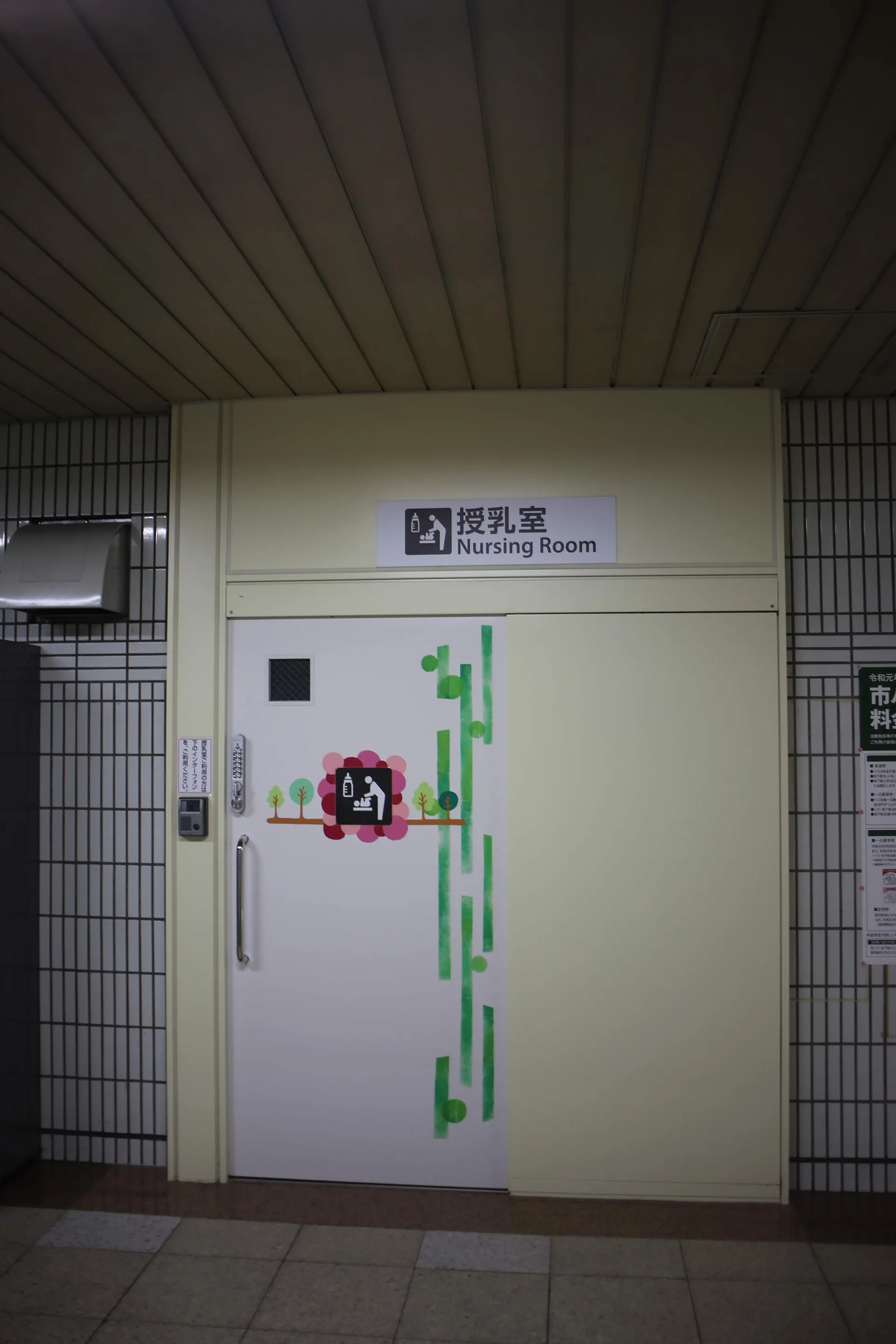
Photo by 円周率3パーセント, CC BY-SA 4.0, via Wikimedia Commons
Train stations. JR East and JR West both publish lists of stations with baby rooms inside the ticket gates and what each one has, and the equipment differs from station to station [14] [15]. Because JR West’s rooms are inside the gates, you may need a ticket or a platform ticket to reach them, and some are opened by intercom or by asking staff [15]. We go through station toilets, changing tables and these rail company pages in detail in our station toilets and baby seats guide.
Airports. Both of Tokyo’s airports have baby rooms in every terminal:
| Airport | How many / where | What's inside | Dads | How to find them | Source |
|---|---|---|---|---|---|
| Haneda (HND) | Terminal 1: 14, Terminal 2: 12, Terminal 3: 19. Listed by terminal, floor and area (before or after security) | Nursing booths, baby seats, washbasins, hot water. Microwave for baby food in some T1/T2 rooms and at the T3 1F information counter | Allowed except in the nursing booth; some rooms are women only | Official "Baby Nurseries" page (also in English) with links to floor guides, or ask an information counter | [11] [12] |
| Narita (NRT) | Terminals 1, 2 and 3 (numbers not stated) | Nursing booth, changing table, washbasin, hot water | Allowed except in the nursing booth | Official floor map with location search | [13] |
Haneda’s FAQ lists the hours as 5:00 a.m. to 1:00 a.m. for domestic flights (written as 5:00–25:00) and 24 hours for international flights [12].
Haneda’s list separating rooms before and after security is useful [11]. If you want to feed right before boarding, check that the room you’re aiming for is on the right side of the security line. For other airports, check the airport’s own website for a baby room page, or ask at an information counter when you arrive.
Theme parks. If you’re going to Tokyo Disneyland or Tokyo DisneySea, our Tokyo Disney Resort with a baby guide covers the parks’ own baby facilities.
Which apps and maps can help you find a nursing room?
No single map covers everything, so it helps to know which tool does what.
| Tool | Run by | What it does | Keep in mind | Source |
|---|---|---|---|---|
| Mama Papa Map (ママパパマップ) | Kodomoto Inc. | Website and iOS/Android app. Search near your location, by station or prefecture, or by facility name. Filters such as lockable private rooms. Icons show nursing rooms and changing tables | Information, ratings and photos are added by users. The terms say the information isn't guaranteed to be complete or current | [16] [17] [1] |
| mamaro GO | Trim Inc. | Map app showing nursing rooms, changing tables and Trim's private "mamaro" baby-care pods; the pod icon color shows if one is free | Users can add and share places | [18] |
| Google Maps | Type a keyword and a place, for example "nursing room near Shinjuku Station" or 授乳室 plus a station name | Google's help page describes keyword search in general, not nursing rooms. Results may be incomplete | [19] | |
| City maps | Local governments | Tokyo Kosodate Switch (Akachan Furatto), Dokonavi Itabashi, Osaka City's mobile map and LINE, Okayama's map | Rules and names differ by city; Osaka City's page had no English guidance | [2] [3] [5] [6] |
JNTO mentions Mama Papa Map as a way to find nursing rooms [1]. Mama Papa Map’s own page also notes that nursing rooms and changing tables can change a lot with renovations, and asks users to report updates [16]. So treat any app as a starting point, and if a room is a key part of your plan (say, the one feed before a long train ride), check the facility’s own page too.
A practical way to combine them: search the app for what’s near you, then open the facility’s official page (department store, station or airport) to confirm the floor, hours and whether dads can go in. The department store pages we checked were titled お子様連れのお客様へ or お子様連れのお客様に (“for customers with children”) [7] [8] [9], which is a useful phrase to search for.
Which Japanese words and signs should you know?
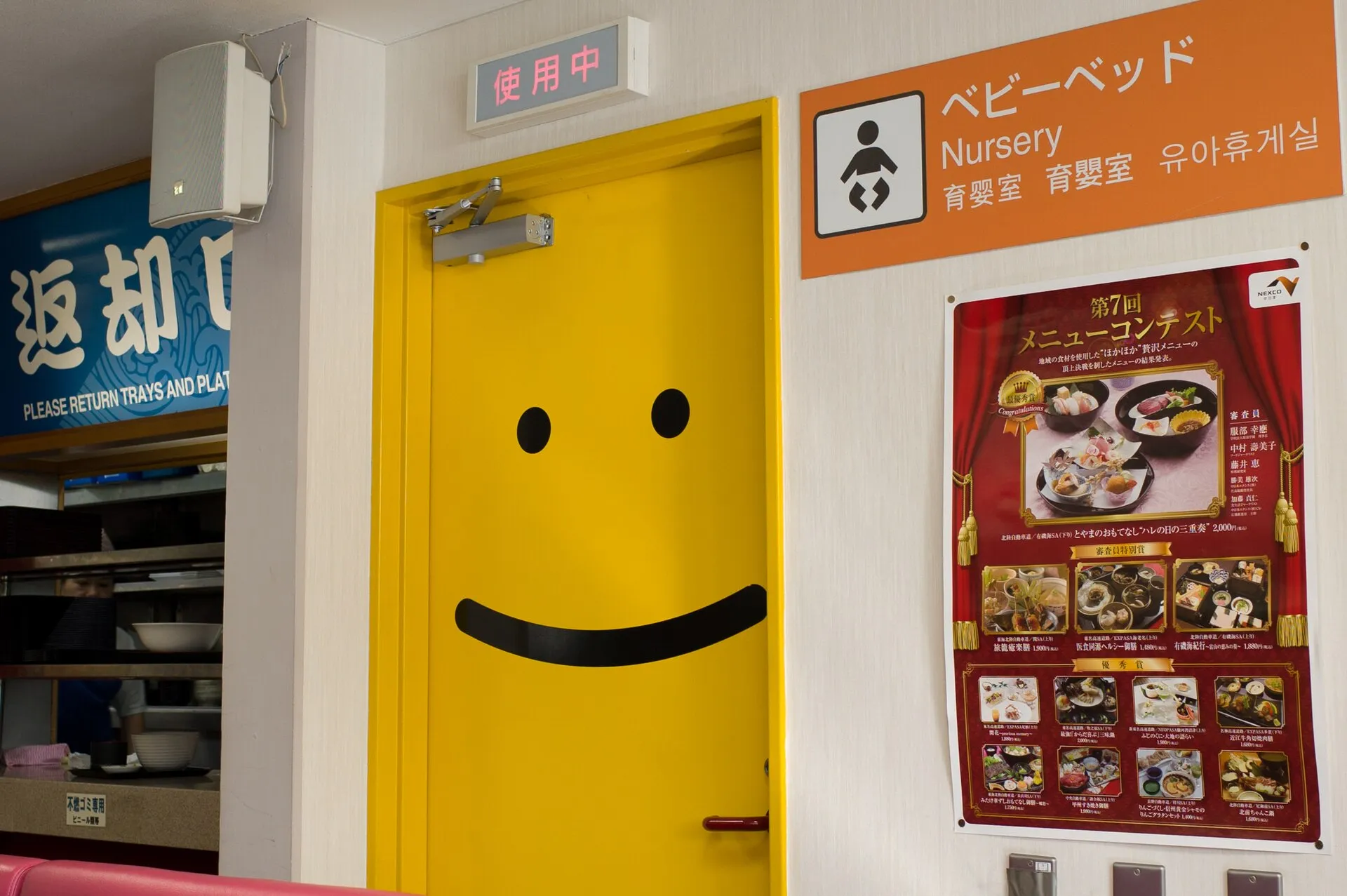
"おむつ交換所ぬぼぼ 使用中" by nubobo, CC BY 2.0, via Wikimedia Commons
Some signs have English, and Japan’s standard pictograms come with English names [20]. But you can’t count on English for the detail that matters (women only? in use?), so here’s what to look for in Japanese.
| Japanese | Reading (guide only) | What it means | Source |
|---|---|---|---|
| 授乳室 | junyūshitsu | Nursing room | [20] |
| 授乳室(女性用) | junyūshitsu (josei-yō) | Baby feeding room (for women), the national standard sign | [20] |
| 授乳室(男女共用) | junyūshitsu (danjo kyōyō) | Baby feeding room (for men and women), the national standard sign | [20] |
| 女性専用 | josei sen'yō | Women only | [11] |
| ファミリー授乳室 | famirī junyūshitsu | Family nursing room (one store's name for a room the whole family can enter) | [8] |
| ベビーケアルーム | bebī kea rūmu | Baby care room (national standard sign) | [20] |
| ベビー休憩室 | bebī kyūkeishitsu | Baby rest room | [7] |
| ベビールーム | bebī rūmu | Baby room | [11] |
| ベビーサロン | bebī saron | Baby salon (one store's name for its baby room) | [9] |
| おむつ交換台 | omutsu kōkandai | Diaper changing table | [20] |
| ベビーシート | bebī shīto | Used for a fold-down changing table or seat; check the picture on the sign | [7] |
| ベビーチェア | bebī chea | Baby chair (a seat to strap your baby in while you use the toilet) | [20] |
| 授乳ブース | junyū būsu | Nursing booth | [11] |
| 給湯 / 調乳用のお湯 | kyūtō / chōnyū-yō no oyu | Hot water / hot water for making formula | [11] [7] |
| 電子レンジ | denshi renji | Microwave | [9] |
| 赤ちゃんの駅 | akachan no eki | "Baby Station", a city-registered nursing and changing space | [3] |
| 赤ちゃん・ふらっと | akachan furatto | Tokyo's registered nursing and changing spaces | [2] |
Note: the readings are a rough pronunciation guide we wrote ourselves. The pictogram names follow the English names in the national standard.
A few lines you can show at an information desk:
授乳室はどこですか。Junyūshitsu wa doko desu ka? (“Where is the nursing room?”)
男性も入れますか。Dansei mo hairemasu ka? (“Can men go in too?”)
おむつ交換台はありますか。Omutsu kōkandai wa arimasu ka? (“Is there a diaper changing table?”)
ミルク用のお湯はありますか。Miruku-yō no oyu wa arimasu ka? (“Is there hot water for formula?”)
If you’re relying on a facility’s hot water for formula, talk to your pediatrician before the trip about how to prepare it safely while traveling. For buying formula in Japan, see our guide to buying baby formula in Japan.
How can you plan your day around feeds?
None of this needs to be planned to the minute, but a little looking ahead makes the day calmer. Some ideas, based on what the official pages say:
- Bookmark two or three spots for the day. A department store near where you’re sightseeing, the baby room at the station you’ll pass through, and one backup from an app. Note the floor.
- Check the hours. Store baby rooms have set hours (Matsuzakaya Nagoya’s is open 10:00 to 19:00) [8], and in Itabashi, for example, an Akachan no Eki can only be used during the facility’s opening hours [3].
- Check the ticket gates. Many station baby rooms are inside the gates [15] [14]. It’s often easiest to feed just before or just after your train, while you’re already inside.
- Carry your own basics. Diapers, wipes, a bag for used diapers, and whatever you need to make a feed. City spaces in Osaka and Okayama don’t provide diapers or formula [5] [6].
- Decide in advance who goes where. If the nursing booths are women only, the other parent can take the diaper change or wait outside with the stroller and the older kids.
Quick checklist
Before you go out
- Save the official baby room pages for the stores, stations and airport on today’s route.
- Install Mama Papa Map or mamaro GO as a backup, and remember that the information is added by users.
- Pack diapers, a bag for used ones, and your own feeding supplies.
When you’re looking
- Look for 授乳室, ベビー休憩室, ベビールーム or a “Baby Station” (赤ちゃんの駅) or Akachan Furatto sign.
- Check whether the sign says 女性用 / 女性専用 (women only) or 男女共用 (for men and women).
- At an Akachan no Eki, speak to the staff first.
At the airport
- Check whether the baby room is before or after security, and on which floor.
Questions parents ask
- Can dads use nursing rooms in Japan?
- It depends on the place. At Haneda and Narita airports, men can use the baby rooms except for the nursing booths, and some of Haneda's rooms are for women only. One department store we checked keeps its nursing rooms for women but has a family nursing room and lets men use the changing and formula areas. Tokyo's Akachan Furatto spaces must be usable by men. Look for 男女共用 (for men and women) or 女性専用 (women only) on the sign, and check the facility's page.
- Is there hot water for formula in Japanese nursing rooms?
- Often, but not always. The department stores and airports we checked list hot water for formula, while Osaka City says its registered Akachan no Eki generally don't provide hot water. Check the facility's own page before you rely on it, and talk to your pediatrician about how to prepare formula while traveling.
- Do I have to ask staff to use an Akachan no Eki?
- Usually, yes. Itabashi and Osaka City both say to speak to the staff, and Itabashi says you can only use it during the facility's opening hours.
- Top 5 Tips for Traveling to Japan with Kids: Your Stress-Free Family Trip Guide — Japan National Tourism Organization (JNTO)
- 赤ちゃん・ふらっと事業(東京都内の授乳室・おむつ替えスペース) — Tokyo Metropolitan Government, Bureau of Social Welfare
- 赤ちゃんの駅|板橋区公式ホームページ — Itabashi City (Tokyo)
- 板橋区「赤ちゃんの駅」認定基準(PDF) — Itabashi City (Tokyo)
- 大阪市 赤ちゃんの駅マップ — Osaka City
- 赤ちゃんの駅・移動式赤ちゃんの駅|岡山市 — Okayama City
- お子様連れのお客様に [サービスガイド]【大丸東京店】 — Daimaru Tokyo
- お子様連れのお客様へ [サービスガイド]【松坂屋名古屋店】 — Matsuzakaya Nagoya
- お子様連れのお客様へ [サービスガイド]【大丸梅田店】 — Daimaru Umeda (Osaka)
- お子さま連れのお客さま | 三井アウトレットパーク 滋賀竜王 — Mitsui Fudosan Commercial Management (Mitsui Shopping Park)
- ベビールーム(英語版 Baby Nurseries)| 羽田空港旅客ターミナル — Japan Airport Terminal Co. (Haneda Airport)
- よくあるご質問|お子様連れのお客様 | 羽田空港旅客ターミナル — Japan Airport Terminal Co. (Haneda Airport)
- ベビールーム | 成田国際空港 — Narita International Airport Corporation
- 赤ちゃんとご一緒のお客さま向け施設のご案内 — JR East
- ベビーケアルーム(授乳室)| JRおでかけネット — JR West
- 授乳室検索アプリのママパパマップ — Kodomoto Inc.
- 世田谷区が公開しているオープンデータの活用事例 — Setagaya City (Tokyo)
- Trim株式会社 製品ページ(mamaro GO / mamaro) — Trim Inc.
- Google マップで場所を検索する - パソコン - マップ ヘルプ — Google
- JIS Z8210 案内用図記号 公共・一般施設(PDF) — Ministry of Land, Infrastructure, Transport and Tourism (MLIT), Japan