Buying Baby Formula in Japan: Brands, Formats and How to Read the Label
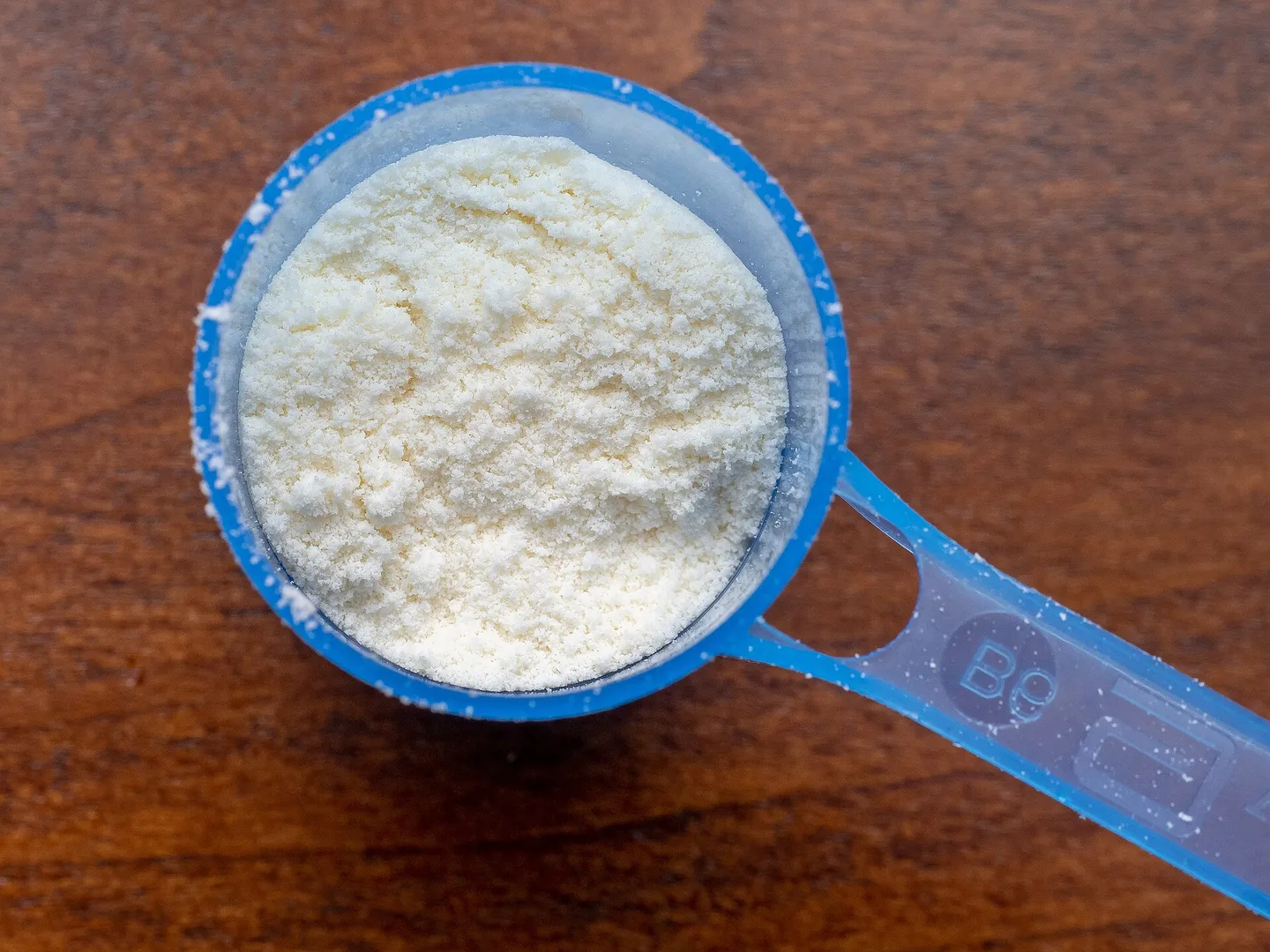
"Baby Formula Powder" by Ajay Suresh, CC BY 2.0, via Wikimedia Commons
This page contains affiliate links. If you book through them, we may earn a commission at no extra cost to you. How this works
- Four Japanese formula makers (Meiji, Morinaga, Yukijirushi Beanstalk and Glico's Icreo) sell formula as powder, pressed cubes or ready-to-feed liquid. Our table gives pack sizes and the ages each maker states.
- Morinaga names baby specialty stores, drugstores and mass retailers as where its formula is sold, but stock differs from store to store, so don't wait until the last can.
- Japanese formula may differ from the one you use at home. Before switching brands or types, talk to your pediatrician.
Running low on formula in a country where you can’t read the cans is a special kind of stress, especially at the end of a long day with a hungry baby. Japan’s big makers each sell several formulas in several formats, and the hard part is knowing which can is which.
So we went through the official pages of four Japanese formula makers and the Japanese government’s own guidance, and put what they say into tables you can save to your phone. This article helps you recognize products and read the label. It can’t tell you which formula is right for your baby. Before switching brands or types, talk to your pediatrician.
Which baby formula brands are sold in Japan?
The four makers we checked are Meiji (明治), Morinaga Milk (森永乳業), Yukijirushi Beanstalk (雪印ビーンスターク) and Ezaki Glico (江崎グリコ), whose baby range is called Icreo (アイクレオ). Each sells two kinds of product, and it helps to know the difference before you look at a shelf.
- Infant formula (ikuji-yō miruku, 育児用ミルク). The makers label these for babies from 0 months to about 1 year [11] [15] [19].
- Follow-up milk (forōappu miruku, フォローアップミルク). A separate product, labeled from age 1. Morinaga says its Chilmil can also be used from about 9 months [10] [8] [18].
The difference matters. Japan’s Consumer Affairs Agency (CAA) keeps a list of approved infant formulas, and none of the follow-up milks in our tables are on it [31]. Infant formula and follow-up milk from the same maker can look alike on the shelf, so check the age on the pack before you pay.
Infant formula (labeled from 0 months)
| Product (Japanese / romaji) | Maker | Format | Pack sizes (maker's page) | Age on maker's page | Source |
|---|---|---|---|---|---|
| 明治ほほえみ / Meiji Hohoemi | Meiji | Powder (can) | 780 g can; 2-can pack | Not stated (Meiji points to Meiji Step "from age 1") | [1] [2] |
| 明治ほほえみ らくらくキューブ / Hohoemi Raku Raku Cube | Meiji | Cubes (pressed powder) | 27 g bags, in boxes of 60, 30, 20 or 4 bags; one cube makes 40 ml | Not stated | [1] [4] |
| 明治ほほえみ らくらくミルク / Hohoemi Raku Raku Milk | Meiji | Liquid (steel can) | 240 ml; single, 3-pack, 5-pack | Not stated | [1] [6] |
| 森永はぐくみ / Morinaga Hagukumi | Morinaga Milk | Powder (can, refill bags, sticks) | 800 g can; 300 g can; Eco Raku Pack 400 g x 2 bags; sticks 13 g x 10 | 0 months to about 1 year | [11] |
| 森永E赤ちゃん / Morinaga E Akachan | Morinaga Milk | Powder (can, refill bags, sticks) | 800 g can; 300 g can; Eco Raku Pack 400 g x 2 bags; sticks 13 g x 10 | 0 months to about 1 year | [12] |
| ビーンスターク すこやかM1 / Beanstalk Sukoyaka M1 | Yukijirushi Beanstalk | Powder (can, sticks) | 800 g can; 300 g can; sticks 13 g x 7; mini sticks 6.5 g x 24 | 0 months to about the first birthday | [16] [15] |
| 液体ミルク すこやかM1 / Sukoyaka M1 liquid | Yukijirushi Beanstalk | Liquid (can) | 200 ml; single or 6-pack | 0 months to about the first birthday | [17] [15] |
| アイクレオ バランスミルク / Icreo Balance Milk | Ezaki Glico | Powder (can, sticks) | 800 g can; 320 g can; sticks 12.7 g x 10 | 0 months to about 1 year | [19] |
| アイクレオ 赤ちゃんミルク / Icreo Akachan Milk | Ezaki Glico | Liquid (carton) | 125 ml carton | 0 months to about 1 year | [20] [21] |
A few notes on this table:
- Meiji Hohoemi’s age range. We could not find an age range on Meiji’s pages for Hohoemi. Meiji’s site simply points to Meiji Step “from age 1” [1] [3]. All three Hohoemi formats are on the CAA’s list of approved infant formulas [31].
- Morinaga E Akachan is described by Morinaga as a “peptide” formula, with all of the protein partly broken down in advance [12]. Morinaga’s page does not present it as a formula for allergies, and neither do we.
- Other brands. The CAA’s list of approved infant formulas (updated September 16, 2026) also includes powders we didn’t cover in detail: Yukijirushi Megmilk Pyua (雪印メグミルク ぴゅあ) and Wakodo Lebens Milk Hai Hai (和光堂レーベンスミルク はいはい) [31].
Milks labeled from age 1 (or about 9 months)
| Product (Japanese / romaji) | Maker | Format | Pack sizes (maker's page) | Age on maker's page | Source |
|---|---|---|---|---|---|
| 明治ステップ / Meiji Step | Meiji | Powder (can), cubes, liquid (can) | 780 g can; cubes in 28 g bags; 240 ml can | 1 to 3 years | [7] [8] [9] |
| 森永チルミル / Morinaga Chilmil | Morinaga Milk | Powder (can, refill bags, sticks) | 800 g can; Eco Raku Pack 400 g x 2 bags; sticks 14 g x 10 | About 1 to 3 years; Morinaga says usable from about 9 months | [13] [10] |
| ビーンスターク つよいこ / Beanstalk Tsuyoiko | Yukijirushi Beanstalk | Powder (can, sticks) | 800 g can; sticks 14 g x 8 | 1 to about 3 years | [18] |
| アイクレオ グローアップミルク / Icreo Grow-up Milk | Ezaki Glico | Powder (can, sticks) | 820 g can; sticks 13.6 g x 10 | From the first birthday | [22] |
What about prices? Of the product pages we checked, only Yukijirushi Beanstalk’s show suggested retail prices. As of November 4, 2026, Sukoyaka M1 powder in the 800 g can was listed at ¥3,269 and the 200 ml liquid can at ¥278, both before tax [16] [17]. Meiji, Morinaga and Glico show no prices on the pages we checked [2] [11] [21]. Shop prices are set by each store.
Specialized formulas. Japan does have formulas for babies with specific medical needs, such as cow’s milk allergy (for example Meiji Milfy HP, Meiji Elemental Formula and Morinaga New MA-1) [7] [10]. They sit in a separate government category from ordinary infant formula [31]. We can’t tell you whether any of them matches what your baby uses at home. If your baby is on a specialized formula, plan with your pediatrician before you go, and pack enough for the whole trip if you can.
Powder, cubes or liquid: what’s the difference?
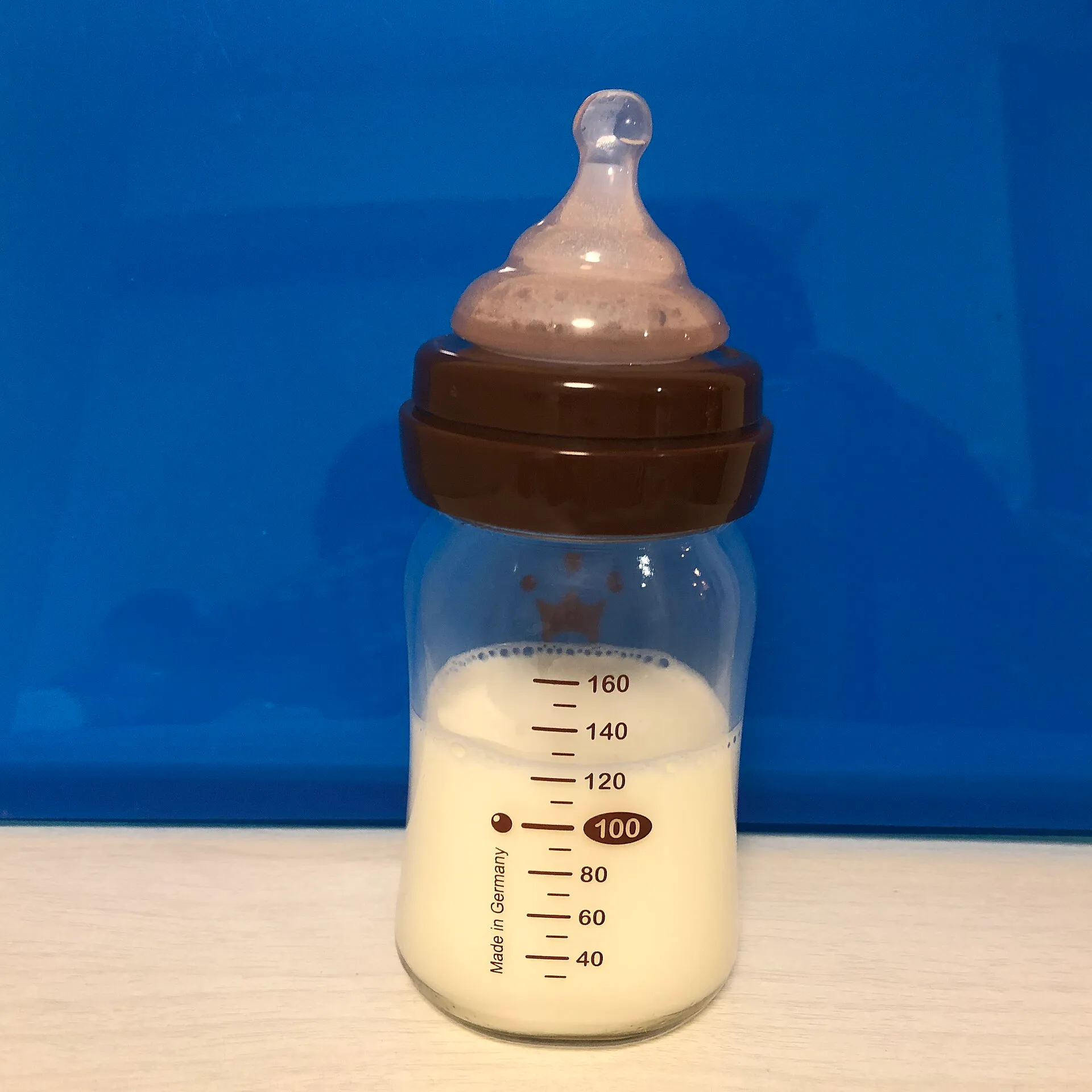
"Glass of baby bottle with milk teteo160" by Miya, CC BY-SA 4.0, via Wikimedia Commons
Japanese formula comes in three formats. Which is easiest on a trip depends on your day. Which is right for your baby is a question for your pediatrician.
Powder in a can, refill bag or stick (粉ミルク, kona miruku). The classic format. Cans range from about 300 g to 820 g in our tables, and most makers also sell single-feed sticks (スティック, sutikku) [16] [11] [19]. Sticks are handy for a day out because you don’t carry the can.
Each can comes with its own scoop and its own mixing table [3] [16]. Use the scoop and the instructions that come with the product in your hand.
Cubes (キューブ, kyūbu). Meiji’s Raku Raku Cube is powder pressed into blocks, so there’s nothing to measure: Meiji says one cube makes 40 ml [4]. Meiji Step also comes as cubes [7]. Meiji says to use the rest of an opened bag within one week [4].
Ready-to-feed liquid (液体ミルク, ekitai miruku). Sold in cans or cartons and stored at room temperature [5] [20] [17]. The CAA explains that liquid formula needs no mixing and no warming, and that its nutrition is the same as powder made up as directed [27]. For a long train ride or a night when the hotel kettle feels very far away, that can make life simpler.
Liquid formula is fairly new in Japan. Standards for it were created on August 8, 2018 [28] [29]. The first products were approved in March 2019 [28], and Meiji’s went on sale nationwide in late April 2019 [30].
What do the makers and the government say about using each format?
We’re not going to rephrase preparation steps into our own rules. Here is where to find them, and the main points the official sources make.
- Powder and cubes. Follow the instructions on the can or box and on the maker’s official page [26]. Meiji’s and Beanstalk’s instructions say to use water that has been boiled once and is at least 70°C, then cool the milk to about body temperature before feeding [3] [4] [16]. Japan’s health ministry (MHLW) publishes a Japanese version of the WHO/FAO guidelines on safe preparation, which says water should be kept at 70°C or above and that made-up formula not used within 2 hours should be thrown away [32].
- Opened cans of powder. The CAA says to use them as soon as possible (within about a month), and to keep them dry and cool, not in the fridge [26].
- Liquid. The CAA says to check the instructions (such as shaking before opening), not to dilute it, to pour cartons and cans into a clean container, to use it straight away, and not to give leftovers [27]. Beanstalk says not to feed straight from its can [17]. Meiji sells an attachment for feeding from its can, sold separately [1] [5].
- Storing liquid. Room temperature is fine, but the CAA and the makers say to keep it out of direct sun, away from heat, and out of hot cars [27] [5] [17]. The CAA says not to use a pack that is damaged or swollen [27].
- Shelf life differs by pack. The CAA gives about 6 months for cartons and about 1 year for cans as a general guide [27]. Glico’s carton is 10 months from manufacture [21], and Meiji now states 24 months for its can, on cans shipped from December 2026 [5]. The simplest rule: read the date printed on the pack you buy.
If anything here is unclear for your baby, talk to your pediatrician or a pharmacist.
Where can you buy formula in Japan?
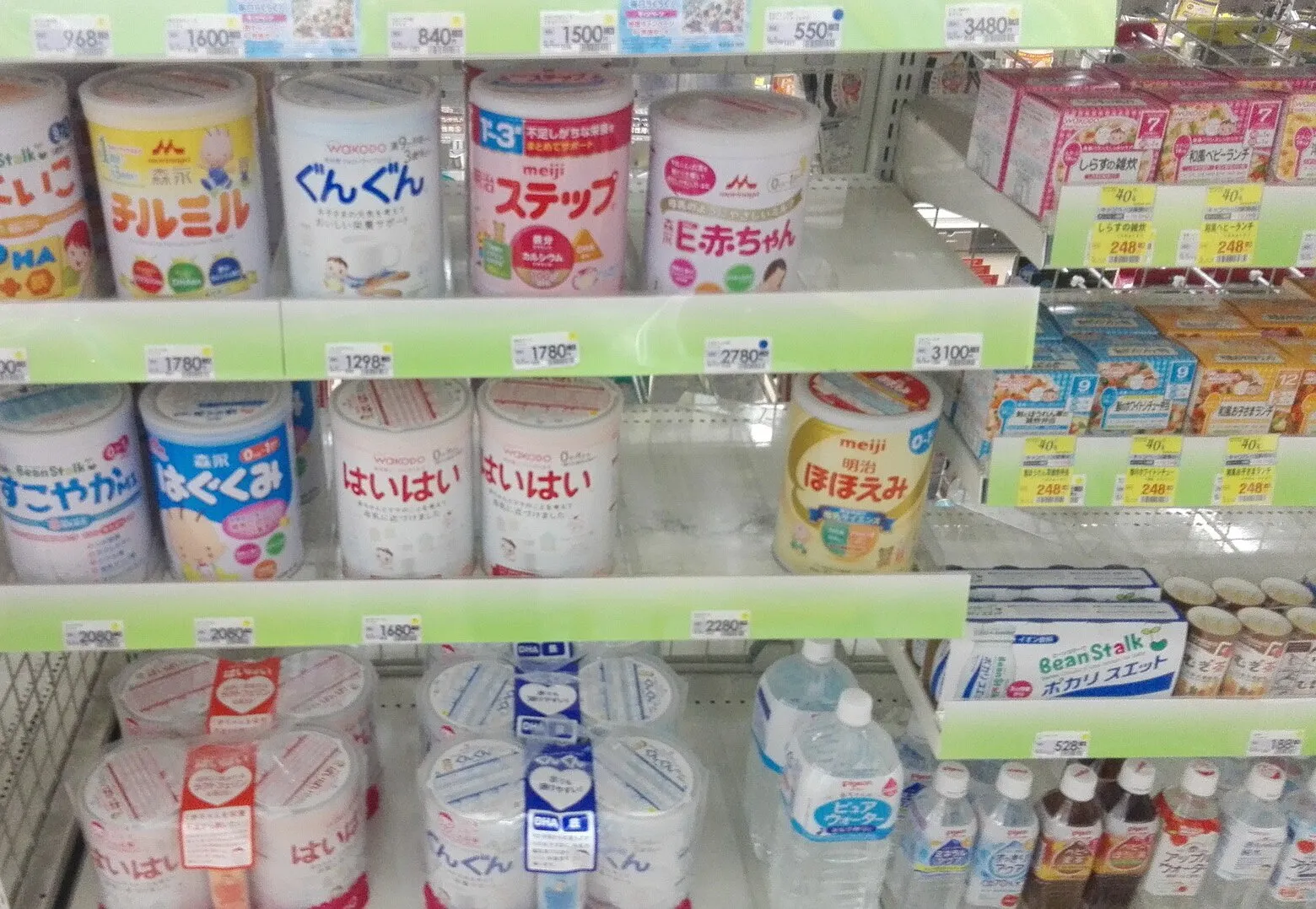
"Milk Powder" by Mr.ちゅらさん, CC BY-SA 4.0, via Wikimedia Commons, cropped
Morinaga names baby specialty stores, drugstores and mass retailers as the main places its formula is sold [14]. In Japanese, a drugstore is ドラッグストア (doraggusutoa). Which shops carry which products differs from shop to shop, and we didn’t check individual drugstore chains.
Akachan Honpo (アカチャンホンポ), a baby-goods chain, lists both powder and liquid formula on its official site [34] [35]. It has an official store finder and a separate finder for tax-free stores, both in Japanese [36]. Its online product pages don’t show stock at each store [34].
What stock and hours are like differs by store. Don’t assume a shop will have your product, or be open late. So:
- Restock when you’re down to a few days’ supply, not the last feed.
- If you depend on one product, look up the nearest baby store in advance with the store finder.
- Take a photo of the front of your current can (or the Japanese name from the table above) to show staff.
What can you say at the store?
These are ready to show on your phone or read out.
粉ミルクはどこですか。Kona miruku wa doko desu ka? (“Where is the powdered formula?”)
液体ミルクはありますか。Ekitai miruku wa arimasu ka? (“Do you have liquid formula?”)
0か月から使えるミルクはどれですか。Zero-kagetsu kara tsukaeru miruku wa dore desu ka? (“Which formula is for babies from 0 months?”)
この商品は在庫がありますか。Kono shōhin wa zaiko ga arimasu ka? (“Do you have this product in stock?”)
Showing staff a photo of the can you’re looking for can make the question quicker.
How do you read a Japanese formula label?
You don’t need to read every word. These are the ones that tell you what’s in your hand.
| Japanese | Reading (guide only) | English meaning | Where you see it | Source |
|---|---|---|---|---|
| 育児用ミルク | ikuji-yō miruku | Infant formula (the makers' everyday name) | Product pages, front of pack | [11] |
| フォローアップミルク | forōappu miruku | Follow-up milk (a separate product, labeled from age 1) | Product pages, pack | [9] [10] |
| 0か月~1歳頃 | zero-kagetsu kara issai goro | 0 months to about 1 year | Front of pack (age range) | [11] |
| 1歳~3歳 | issai kara sansai | Ages 1 to 3 | Front of follow-up milk | [8] |
| 種類別 | shuruibetsu | Product type (a legal category) | Label panel | [2] |
| 調製粉乳 | chōsei funnyū | Formula powder (product type) | After 種類別 on powder | [2] [26] |
| 調製液状乳 | chōsei ekijōnyū | Liquid formula (product type) | After 種類別 on liquid | [6] [21] |
| 乳児用調製粉乳 | nyūji-yō chōsei funnyū | Infant formula powder (approved category) | Near the approval mark | [23] [24] |
| 乳児用調製液状乳 | nyūji-yō chōsei ekijōnyū | Infant liquid formula (approved category) | Near the approval mark | [23] [24] |
| 消費者庁許可 特別用途食品 | shōhisha-chō kyoka tokubetsu yōto shokuhin | Approved by the Consumer Affairs Agency: Food for Special Dietary Uses | Approval mark on infant formula | [15] [25] |
| 内容量 | naiyōryō | Net contents (g or ml) | Label panel | [2] |
| 13.5%調乳液100mlあたり | — | Per 100 ml of milk made at 13.5% (the maker's standard strength) | Nutrition panel | [2] |
| 乳成分 / 大豆 | nyū seibun / daizu | Milk / soy (allergens) | Allergen line | [2] [11] |
| 賞味期限 | shōmi kigen | Best before date | Can base or pack | [21] |
| 常温保存 | jōon hozon | Store at room temperature | Liquid formula | [6] |
Note: the readings are a rough guide we wrote to help you say or recognize the word. They are not from an official source.
A few things worth knowing:
The approval mark. In Japan, a product sold as a breast-milk substitute for babies needs approval from the CAA as a Food for Special Dietary Uses (tokubetsu yōto shokuhin, 特別用途食品), and approved products carry the approval mark [23] [25] [26]. The category for infant formula, 乳児用調製乳 (nyūji-yō chōsei nyū), covers two types: powder and liquid [23] [24]. On Beanstalk’s product page, the text next to the mark reads 消費者庁許可 特別用途食品, with the category 乳児用調製乳 [15]. Follow-up milks are not on the approved infant formula list [31], so don’t expect the mark on them.
Nutrition is per 100 ml of made-up milk, at the strength the maker sets. On Meiji’s pages, that’s 13.5% for Hohoemi and 14.0% for Step [2] [8]. These numbers explain the panel. They are not instructions, and they differ between products.
Allergens. The formulas we checked list milk (乳成分), and many also list soy (大豆): Morinaga Hagukumi, Beanstalk Sukoyaka M1 and Icreo Balance Milk all do, while Meiji Hohoemi lists milk only [11] [16] [19] [2]. If your baby has an allergy, our chart of Japanese allergen labels can help with the words, and your pediatrician should help with the decision.
Can you switch to a Japanese formula?
Some things to bring up with your pediatrician before the trip:
- Whether to bring enough of your usual formula for the whole trip, or plan for a Japanese one.
- If a Japanese formula is an option, what to look out for when your baby first tries it. The government leaflets and Glico and Beanstalk all mention starting with small amounts [26] [20] [17].
- If your baby uses a specialized formula, whether there is any Japanese product to consider, or whether to bring a full supply.
Check the water before you mix. The CAA has reported young children harmed when formula was made by mistake with sake, salt water or disinfectant water stored in bottles or electric kettles [33]. In a hotel room or rental apartment, it’s worth checking (including by smell) what is in a kettle or bottle before you use it, and keeping the water for formula in its own container [33]. For hot water, kettles and sterilizing in Japanese hotels, see our guide to hot water, microwaves and bottle sterilizing.
Quick checklist
Before you leave home
- Talk to your pediatrician about formula on the trip, including what to do if you run out.
- Pack enough of your usual formula for at least the first few days.
- Save the tables above to your phone.
At the store
- Check the age on the pack and compare it with the tables above (infant formula vs. follow-up milk).
- Look for the 特別用途食品 approval mark on infant formula.
- Use the scoop and instructions that come with that product.
- Check the best before date (賞味期限), especially on liquid formula.
Back at your room
- Check what’s in the kettle or bottle before you mix.
- Follow the label and the maker’s page for preparation.
Questions parents ask
- Can I buy my usual brand of baby formula in Japan?
- We only checked four Japanese makers' own pages, which describe products made for Japan. If your baby needs a particular formula, plan to bring enough from home, and talk to your pediatrician before switching brands or types.
- Is liquid baby formula sold in Japan?
- Yes. Meiji, Yukijirushi Beanstalk and Glico all list ready-to-feed liquid formula on their official pages. Stock differs by store, so check before you rely on it.
- What is follow-up milk (forōappu miruku) in Japan?
- It's a separate product from infant formula, labeled by the makers from age 1 (Morinaga says its Chilmil can be used from about 9 months). Follow-up milks are not on Japan's government list of approved infant formulas. Ask your pediatrician which suits your child.
- How do I make up Japanese powdered formula?
- Follow the instructions and scoop on that can, and the maker's official page. Japan's health ministry also publishes guidance on safe preparation. If you have questions, talk to your pediatrician or a pharmacist.
- 商品情報|明治ほほえみ|株式会社 明治 — Meiji
- 明治ほほえみ 780g(大缶)|商品情報|株式会社 明治 — Meiji
- 明治ほほえみ(粉)の使い方|株式会社 明治 — Meiji
- 明治ほほえみ らくらくキューブの使い方|株式会社 明治 — Meiji
- 明治ほほえみ らくらくミルクの特徴|株式会社 明治 — Meiji
- 明治ほほえみ らくらくミルク 240ml|商品情報|株式会社 明治 — Meiji
- 粉ミルク|商品情報|株式会社 明治 — Meiji
- 明治ステップ 780g(大缶)|商品情報|株式会社 明治 — Meiji
- 明治ステップ|株式会社 明治 — Meiji
- 商品情報|妊娠・育児情報サイト「はぐくみ」|森永乳業株式会社 — Morinaga Milk
- はぐくみ|商品情報|森永乳業株式会社 — Morinaga Milk
- E赤ちゃん|商品情報|森永乳業株式会社 — Morinaga Milk
- チルミル|商品情報|森永乳業株式会社 — Morinaga Milk
- 「森永はぐくみ」「森永 E 赤ちゃん」「森永チルミル」シリーズ リニューアル発売(2024年11月19日) — Morinaga Milk
- 乳児用ミルク すこやかM1|ビーンスターク — Yukijirushi Beanstalk
- すこやかM1(粉ミルク)|ビーンスターク — Yukijirushi Beanstalk
- 液体ミルク すこやかM1|ビーンスターク — Yukijirushi Beanstalk
- つよいこ|ビーンスターク — Yukijirushi Beanstalk
- アイクレオ バランスミルク|ICREO/アイクレオ — Ezaki Glico
- アイクレオ 赤ちゃんミルク|ICREO/アイクレオ — Ezaki Glico
- アイクレオ赤ちゃんミルク|江崎グリコ — Ezaki Glico
- アイクレオ グローアップミルク|ICREO/アイクレオ — Ezaki Glico
- 特別用途食品について — Consumer Affairs Agency, Japan
- 特別用途食品とは — Consumer Affairs Agency, Japan
- とくべつようとしょくひん(特別用途食品ってなに?) — Consumer Affairs Agency, Japan
- 乳児用調製粉乳ってなに? — Consumer Affairs Agency, Japan
- 乳児用液体ミルクってなに? — Consumer Affairs Agency, Japan
- 乳児用液体ミルク(乳児用調製液状乳)の許可区分創設の経緯等について — Consumer Affairs Agency, Japan
- 乳及び乳製品の成分規格等に関する省令及び食品、添加物等の規格基準の一部改正について(平成30年8月8日) — Ministry of Health, Labour and Welfare, Japan
- 乳児用液体ミルク「明治ほほえみ らくらくミルク」2019年4月下旬より全国にて発売 — Meiji
- 特別用途食品 許可品一覧(令和8年9月16日更新) — Consumer Affairs Agency, Japan
- 乳児用調製粉乳の安全な調乳、保存及び取扱いに関するガイドラインについて — Ministry of Health, Labour and Welfare, Japan
- Vol.652 お酒などによる誤った調乳での事故に注意 — Consumer Affairs Agency, Japan
- 粉ミルク・液体ミルク|商品を探す|アカチャンホンポ — Akachan Honpo
- 粉ミルク・液体ミルク|出産準備リスト|アカチャンホンポ — Akachan Honpo
- お店を探す|アカチャンホンポ — Akachan Honpo