Reading Allergen Labels in Japanese Supermarkets: A Japanese–English Chart
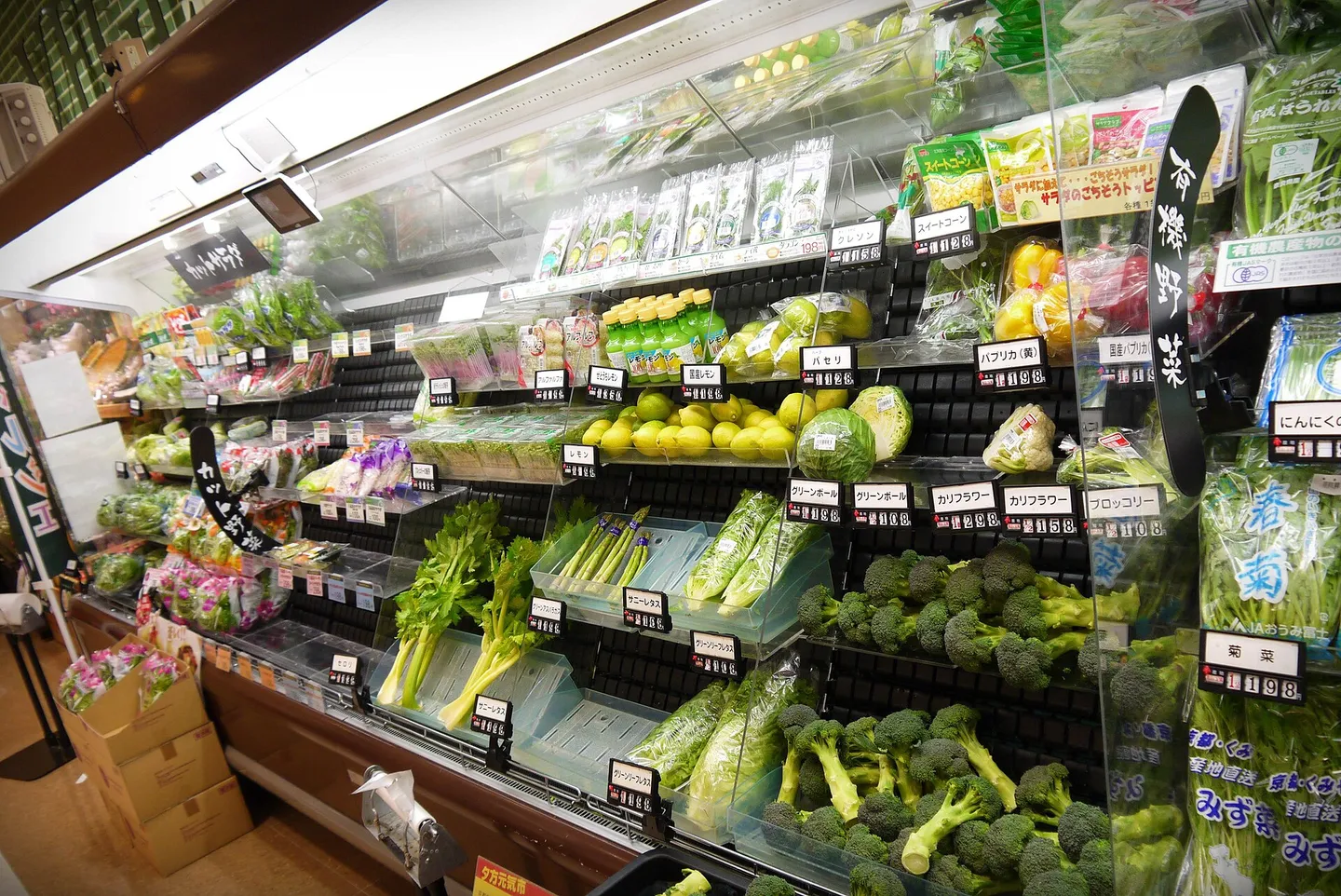
"野菜売り場 2013" by ChingHua Chung, CC BY 2.0, via Wikimedia Commons
This page contains affiliate links. If you book through them, we may earn a commission at no extra cost to you. How this works
- Japanese packaged food must name 9 allergens and is only asked to name 20 more, so a missing name does not always mean the food is free of it.
- Our chart gives each allergen in Japanese as it appears on labels, with a reading, the official English name and whether labeling is required.
- Restaurants and unpackaged deli food have no labeling duty, so ask staff, and talk to your child's doctor or allergist before you travel.
If your child has a food allergy, a Japanese supermarket can feel like a wall of text you can’t read. Your translation app helps, but you still need to know where to look and which words matter. That’s a lot to carry on top of jet lag and a hungry toddler.
So we went through the Japanese government’s own labeling rules and its English materials for visitors, and turned them into a chart you can save or print. This article explains how the labels work. It cannot tell you what your child can safely eat. That decision belongs to you and your child’s doctor or allergist.
How does allergen labeling work in Japan?
Allergen labeling in Japan is set by the Food Labeling Act and the Food Labeling Standards, which the Consumer Affairs Agency (CAA) runs [1] [3].
- Specified ingredients (tokutei genzairyō, 特定原材料): 9 items that must be labeled.
- Items equivalent to specified ingredients (tokutei genzairyō ni junzuru mono, 特定原材料に準ずるもの): 20 items that makers are recommended to label, but don’t have to.
That makes 29 items in total [2]. The second tier is the part to keep in mind. Recommended items may be missing from a label even when the food contains them, so a missing name does not mean the food is free of that allergen [11] [13].
What the rules cover. Labeling applies to packaged processed food and to additives. Even very small packs cannot leave out allergen information [3]. It does not apply to food sold without a package (loose or by weight), food served in restaurants or delivered, or alcoholic drinks [3] [13]. More on that below.
Some allergens from home are not on the list. Japan’s list is not the same as the lists used in other countries. For example, mustard, celery, lupin, hazelnut, Brazil nut and pecan are not among Japan’s 29 items [13] [3]. If your child reacts to something outside the 29, you can’t rely on the allergen note at all. Read the full ingredient list, and ask.
The list changed recently
The CAA reviews the list using a national survey of allergy doctors, carried out roughly every three years [1] [2]. Recent changes:
- Walnut became a required item on March 9, 2023 [1] [6]. The transition period for old labels ended on March 31, 2025 [7].
- Macadamia nut was added to the recommended list, and matsutake mushroom was removed, on March 28, 2024 [1] [5].
- Cashew nut moved from recommended to required on April 1, 2026 [1] [4]. There is a transition period: food made, processed or imported by March 31, 2028 may still carry the old label [8]. Until then, some packs on the shelf may not list cashew.
- Pistachio was added to the recommended list on April 1, 2026. Makers are asked to add it as soon as they can, with no fixed deadline [4].
The chart: Japanese allergen names, readings and English
The English names below follow the CAA’s English leaflet for visitors and its English communication sheet [13] [14]. The item lists are from the CAA’s April 2026 overview and handbook [2] [3].
The “also on labels as” column matters because the same allergen can be written in kanji, hiragana, katakana or as part of a longer word. The CAA keeps a fixed list of accepted alternative spellings (daitai hyōki, 代替表記), plus examples of longer words that already show the allergen (kakudai hyōki, 拡大表記), such as 小麦粉 (wheat flour) or 牛乳 (cow’s milk) [3] [2]. We’ve put both in one column. The longer words are examples only, so you may see others.
| Japanese | Also on labels as (examples) | Reading (guide only) | English (CAA) | Labeling |
|---|---|---|---|---|
| えび | 海老, エビ, えび天ぷら, サクラエビ | ebi | Shrimp | Required |
| カシューナッツ | — | kashū nattsu | Cashew nut | Required from Apr 2026 (older labels allowed until Mar 2028) |
| かに | 蟹, カニ, 上海がに, カニシューマイ, マツバガニ | kani | Crab | Required |
| くるみ | クルミ, くるみパン, くるみケーキ | kurumi | Walnut | Required |
| 小麦 | こむぎ, コムギ, 小麦粉, こむぎ胚芽 | komugi | Wheat | Required |
| そば | ソバ, そばがき, そば粉 | soba | Buckwheat | Required |
| 卵 | 玉子, たまご, タマゴ, エッグ, 鶏卵, あひる卵, うずら卵, 厚焼玉子, ハムエッグ | tamago | Egg | Required |
| 乳 (乳成分, 乳由来) | ミルク, バター, バターオイル, チーズ, アイスクリーム, 牛乳, 生乳, 乳糖, 脱脂粉乳, 乳たんぱく, プロセスチーズ | nyū (nyū seibun, nyū yurai) | Milk | Required |
| 落花生 | ピーナッツ, ピーナッツバター, ピーナッツクリーム | rakkasei (pīnattsu) | Peanut | Required |
| Japanese | Also on labels as (examples) | Reading (guide only) | English (CAA) | Labeling |
|---|---|---|---|---|
| アーモンド | アーモンドオイル | āmondo | Almond | Recommended |
| あわび | アワビ, 煮あわび | awabi | Abalone | Recommended |
| いか | イカ, いかフライ, イカ墨 | ika | Squid | Recommended |
| いくら | イクラ, すじこ, スジコ, いくら醤油漬け, 塩すじこ | ikura (sujiko) | Salmon roe | Recommended |
| オレンジ | オレンジソース, オレンジジュース | orenji | Orange | Recommended |
| キウイフルーツ | キウイ, キウィ, キーウィ, キウイジャム | kiui furūtsu | Kiwi fruit | Recommended |
| 牛肉 | 牛, ビーフ, 牛すじ, 牛脂, ビーフコロッケ | gyūniku | Beef | Recommended |
| ごま | ゴマ, 胡麻, ごま油, 練りごま, すりゴマ | goma | Sesame | Recommended |
| さけ | 鮭, サケ, サーモン, しゃけ, シャケ, スモークサーモン | sake (shake, sāmon) | Salmon | Recommended |
| さば | 鯖, サバ, さば節, さば寿司 | saba | Mackerel | Recommended |
| 大豆 | だいず, ダイズ, 大豆油, 大豆たんぱく, 脱脂大豆 | daizu | Soybean | Recommended |
| 鶏肉 | 鶏, 鳥, とり, チキン, 焼き鳥, 鶏ガラスープ, チキンブイヨン | toriniku | Chicken | Recommended |
| バナナ | ばなな, バナナジュース | banana | Banana | Recommended |
| ピスタチオ | ピスタチオナッツ | pisutachio | Pistachio | Recommended from Apr 2026 |
| 豚肉 | 豚, ポーク, ぶた肉, ポークウインナー, 豚ミンチ | butaniku | Pork | Recommended |
| マカダミアナッツ | マカデミアナッツ | makadamia nattsu | Macadamia nut | Recommended |
| もも | モモ, 桃, ピーチ, 黄桃, 白桃 | momo | Peach | Recommended |
| やまいも | 山芋, ヤマイモ, 山いも, 千切りやまいも | yamaimo | Wild yam | Recommended |
| りんご | リンゴ, アップル, アップルパイ, リンゴ酢 | ringo | Apple | Recommended |
| ゼラチン | 板ゼラチン, 粉ゼラチン | zerachin | Gelatin | Recommended |
Note: the readings are a rough guide to pronunciation, written by us to help you say or recognize the word. They are not from an official source. The Japanese and English names are from the CAA.
To print or save: a screenshot of the two tables works offline. Before you go, also download the CAA’s own English materials (see the section on restaurants below). They include a sheet you can show to staff.
Where is the allergen information on a Japanese package?
On the back or side of a package, look for the box headed 原材料名 (genzairyō-mei, “ingredients”). Allergens appear there, and in the 添加物 (tenkabutsu, “additives”) part [3] [2]. Additives come after the ingredients, either in their own 添加物 field or after a slash (/) in the same field [3].
A label uses one of two styles, never a mix of both [3] [2]:
- After each ingredient, in brackets (the default). For example, マヨネーズ(卵を含む) means “mayonnaise (contains egg)” [3] [13].
- One combined note at the end of the ingredients. For example, (一部に小麦・卵・乳成分を含む) means “contains, in part, wheat, egg, milk” [3] [13].
The CAA’s English leaflet for visitors walks through both styles using a potato salad label [13].
| Japanese | Reading (guide only) | What it means | Source |
|---|---|---|---|
| 原材料名 | genzairyō-mei | Ingredients (the main box) | [3] |
| 添加物 | tenkabutsu | Additives (own field, or after a / in the ingredients) | [3] |
| 〇〇を含む | … o fukumu | Contains 〇〇 | [3] |
| 一部に〇〇・〇〇を含む | ichibu ni … o fukumu | Contains, in part, 〇〇 and 〇〇 (combined note at the end) | [3] |
| 乳成分を含む | nyū seibun o fukumu | Contains milk components (how milk is written for ingredients) | [3] |
| 〇〇由来 / 乳由来 | … yurai / nyū yurai | Derived from 〇〇 / derived from milk (used for additives) | [3] |
| 本品製造工場では〇〇を含む製品を生産しています | — | This factory also makes products containing 〇〇 (voluntary note) | [3] |
| アレルゲン(29品目対象) | arerugen (nijūkyū hinmoku taishō) | Allergens (this label covers all 29 items) — voluntary | [3] |
Small details that can trip you up
These are labeling rules from the CAA’s handbook for food makers. They explain what you’ll see on a label. They are not a guide to what is safe for your child.
- An allergen may be named only once. With the bracket style, if several ingredients contain the same allergen, the label can name it after just one of them [3]. The CAA describes a case where milk appeared only once, as 乳糖 (lactose), and milk in a later ingredient was not named again [3]. So the first mention does not tell you which other ingredients contain it. If that matters for your child, ask the maker.
- Milk has its own wording. For ingredients it is 乳成分を含む (“contains milk components”); for additives it is 乳由来 (“derived from milk”). Other additives use the same 由来 pattern, such as 乳化剤(卵由来), “emulsifier (derived from egg)” [3].
- The character 乳 doesn’t always mean milk. 乳化剤 (emulsifier), 乳酸 (lactic acid) and 乳酸菌 (lactic acid bacteria) contain 乳, but they are not counted as milk names under the labeling rules [3]. Whether any of these suits your child is a question for your doctor.
- Butter and cheese may appear without 乳. Words like バター (butter), チーズ (cheese) and アイスクリーム (ice cream) are accepted milk names on their own. Because names like ココナッツミルク (coconut milk) and カカオバター (cocoa butter) contain no dairy, the CAA asks makers to add 乳成分を含む where possible, but it isn’t required [3].
- Egg white and yolk still say egg. 卵白 (egg white) and 卵黄 (egg yolk) must still carry (卵を含む) [3].
- No vague group words. Words like 穀類 (grains), 肉類 (meat) or 果実類 (fruit) can’t stand in for an allergen name [3]. One narrow exception: a few ingredients made from mixed, unsorted catch, such as fish sauce (魚醤) or fish extract (魚介エキス), may say (魚介類), “seafood”, instead of naming shrimp or crab [3].
- “May contain” is not used. Vague “may contain” wording is not allowed. A specific note such as 本品製造工場では〇〇を含む製品を生産しています (“this factory also makes products containing 〇〇”) is recommended but not required, so its absence tells you nothing [2] [3].
- Trace amounts and flavorings. Allergens below a trace level (a few micrograms of protein per gram or milliliter) don’t have to be labeled. Flavorings (香料, kōryō) made from allergens often don’t have to be labeled either, although some types do [3]. Ask your allergist what this means for your child.
- Keep the outer bag of a multipack. Small inner bags may carry no allergen label at all; the information is on the outer bag [3]. Worth remembering when you hand a snack to a child in the stroller.
- Some labels say how many items they cover. A note like アレルゲン(29品目対象) or 特定原材料に準ずるものを含めて対象範囲 means the maker checked all 29 items. This is voluntary [3].
Convenience stores (konbini). Packaged food at a convenience store follows the same national rules as packaged food anywhere else. We did not find a separate rule for convenience stores [3]. Fried snacks or oden sold from the counter without a package count as loose food, so they are outside the labeling rules [3].
What about deli counters, bakeries and restaurants?
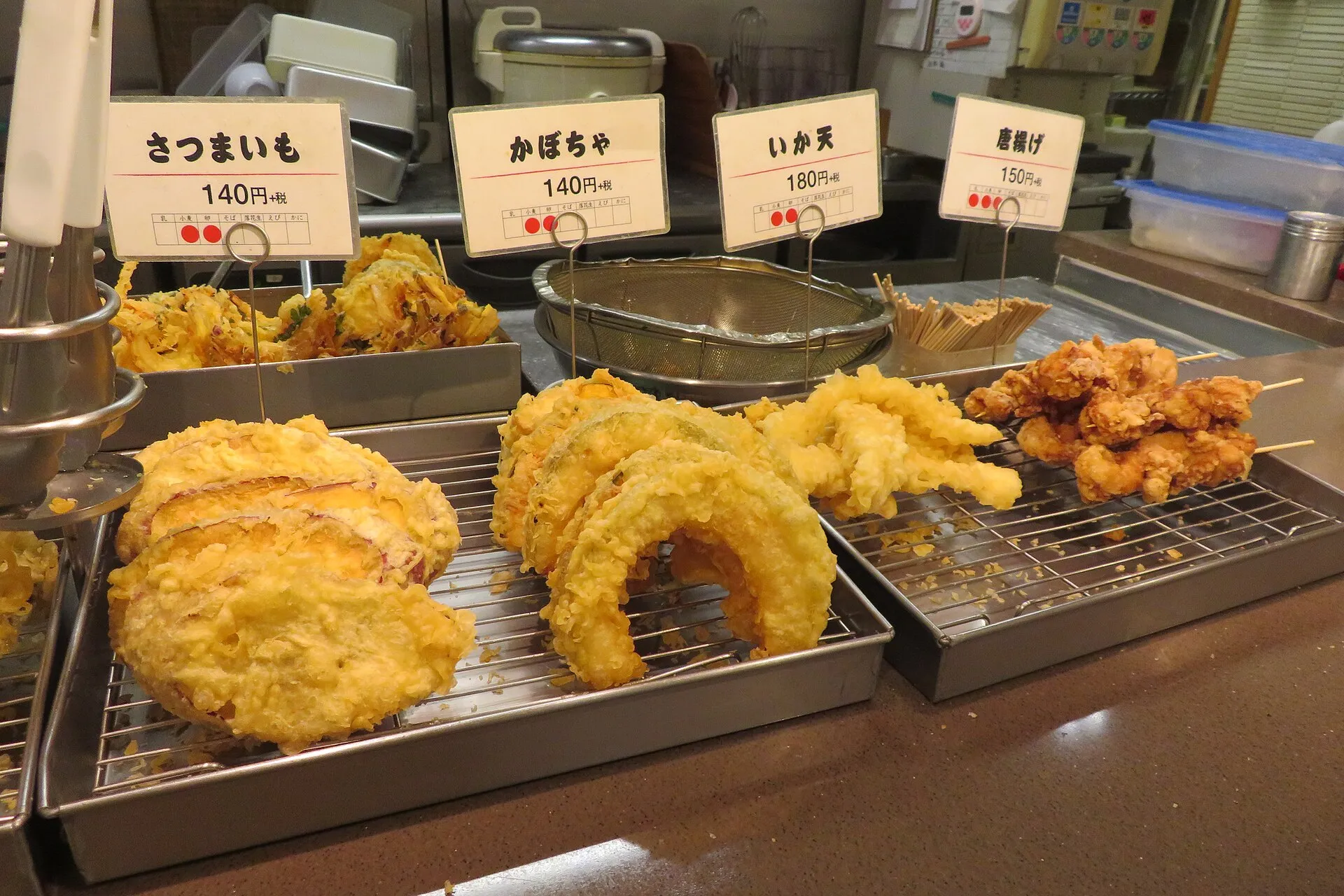
"天ぷら" by Blake Handley, CC BY 2.0, via Wikimedia Commons
This is where things change. The rules depend on whether the food is in a package.
Packed in the store: labeled. Food made in the shop and packed there, such as deli packs or bakery bags with a printed sticker, may leave out the full ingredient list, but allergen labeling is still required [10] [9].
Not packed: no labeling duty. Food sold loose or by weight, restaurant food and delivery are outside the labeling rules [3]. The same goes for bento and side dishes sold over the counter without a package: there is no legal duty to give allergen information [11]. The CAA’s English leaflet for visitors tells you to ask staff about restaurant food, bread at bakeries, and cakes in display cases [13].
Some shops and restaurants share allergen information anyway, on cards, menus or charts. The CAA points out that this voluntary information may be incomplete or out of date, and that shops cover different items (only milk, egg and wheat at some, 9 or 29 items at others) [11]. It also says a staff member’s “it’s not in there” may not be reliable, and suggests asking a manager or someone who knows about allergies [11].
Chain websites. Some chains publish allergen tables online. McDonald’s Japan, for example, has one with an English page [15]. Check the date on any table: when we looked, that one still used the older 28-item grouping, with cashew listed as recommended [15].
Cross-contact while cooking. The CAA notes that in kitchens, allergens can get into food in ways that are hard to rule out, such as shared cutting boards, tongs, drink nozzles, or flour in the air [11]. It says people with food allergies should follow their doctor’s advice about eating out, and that the final decision rests with the person or family, not the shop [11].
How do you ask staff? (the CAA sheet and a few phrases)
The CAA publishes a free Food Allergy Communication Sheet in English and Japanese. You tick your child’s allergens and show the screen to staff [14] [12]. It includes a question about whether products made on the same line contain the allergen [14]. Download it to your phone before you use it, because the tick boxes may not work otherwise [12]. A printable version is on the last page of the CAA’s English leaflet for visitors [13].
- CAA Food Allergy Communication Sheet (English, smartphone version, PDF)
- CAA leaflet: Japan’s Food Labelling System, for overseas visitors (English, PDF)
- CAA page with the leaflet and sheet in other languages (Japanese page)
The CAA’s materials also use picture symbols (pictograms) for each allergen. They can’t be copied without permission [13], so we don’t show them here. You’ll find them in the PDFs above.
If you’d like a few lines to show or say as well, these are ready to use. Replace 〇〇 with the Japanese word from the chart (for example 小麦 for wheat).
子どもに食物アレルギーがあります。
〇〇は入っていますか。
Kodomo ni shokumotsu arerugī ga arimasu. 〇〇 wa haitte imasu ka? (“My child has a food allergy. Does this contain 〇〇?”)
アレルギーに詳しい方に確認していただけますか。Arerugī ni kuwashii kata ni kakunin shite itadakemasu ka? (“Could you check with someone who knows about allergies?”)
アレルギーの一覧表はありますか。Arerugī no ichiranhyō wa arimasu ka? (“Do you have an allergen chart?”)
同じ調理器具を使っていますか。Onaji chōri kigu o tsukatte imasu ka? (“Do you use the same cooking utensils?”)
In Japan, asking about allergens at a counter or restaurant is an ordinary question. Nobody will think you’re being difficult. If the staff member needs to go and check, give them a moment.
What should you sort out with your doctor before you go?
Some questions you could take to that appointment, based on the labeling rules above:
- Your child’s allergen is not on Japan’s list of 29, or is only on the recommended list. How should you handle packaged food where it might not be named?
- What do trace amounts, shared-factory notes and the absence of such notes mean for your child?
- Are there words in the chart above (for example 乳酸 or 乳化剤) that your doctor wants you to treat with caution?
- What should you do if your child reacts while you are away from home?
If there is a reaction after eating, the CAA’s communication sheet says to consult a medical facility [14] [13]. For how to find a doctor or get emergency help in Japan, see our guide to what to do if your baby gets sick in Japan.
For background: in the CAA’s latest survey of immediate-type food allergy cases (6,033 cases), the most common causes were egg (26.7%), walnut (15.2%), cow’s milk (13.4%), wheat (8.1%) and peanut (7.0%) [2]. These are national figures. They say nothing about your own child.
Before you shop: a quick checklist
Before you leave home
- Talk to your child’s doctor or allergist about the trip, including allergens that Japan does not require on labels.
- Download the CAA communication sheet and English leaflet to your phone.
- Save or print the chart above.
At the shelf
- Find 原材料名 (ingredients) and read the whole box, including additives after the slash.
- Look for (〇〇を含む) after ingredients, or (一部に〇〇を含む) at the end.
- Check the alternative spellings for your child’s allergen, not just the main word.
- Remember that recommended items, and cashew on older stock until March 2028, may not be named.
- Keep the outer bag of multipacks.
At deli counters, bakeries and restaurants
- Packed in the store with a sticker: look for the allergen label.
- Unpackaged or restaurant food: ask, ideally a manager, and show the CAA sheet.
- Check the date on any chain’s online allergen table.
Questions parents ask
- Is sesame always labeled in Japan?
- No. Sesame is on Japan's recommended list, not the required list, so a maker may leave it off the label even when the food contains it. Ask the maker or the shop, and talk to your child's doctor or allergist about how to handle this.
- Are mustard, celery or hazelnut labeled in Japan?
- They are not on Japan's list of 29 items, so you should not expect to see them called out as allergens. Read the full ingredient list, ask the maker or shop, and plan with your child's doctor or allergist before you travel.
- Do convenience store (konbini) foods have allergen labels?
- Packaged foods at convenience stores follow the same national rules as packaged foods anywhere else. We did not find a separate rule for convenience stores. Each chain's own website is the place to check for more detail.
- Do Japanese labels say 'may contain'?
- Vague 'may contain' wording is not allowed. Instead, makers are encouraged (not required) to write a specific note, such as that the factory also makes products containing a named allergen.
- 食物アレルギー表示に関する情報 — Consumer Affairs Agency, Japan
- アレルギー表示とは(令和8年4月時点) — Consumer Affairs Agency, Japan
- 加工食品の食物アレルギー表示ハンドブック(事業者用)(令和8年4月) — Consumer Affairs Agency, Japan
- アレルゲンを含む食品に関する表示について(令和8年4月1日事務連絡) — Consumer Affairs Agency, Japan
- アレルゲンを含む食品に関する表示について(令和6年3月28日事務連絡) — Consumer Affairs Agency, Japan
- くるみの特定原材料への追加及びその他の木の実類の取扱いについて(令和5年3月9日事務連絡) — Consumer Affairs Agency, Japan
- 食物アレルギーの表示について(令和8年4月1日~) — Yamanashi Prefecture
- 食品の表示(事業者の方向け) — City of Nagoya
- 容器包装に入れられた一般用加工食品の表示 — Osaka Prefecture
- 各食品取扱い店 店長様向け 啓発資料(令和7年2・3月号) — Tokyo Metropolitan Government, Islands Public Health Center
- 食物アレルギーの患者さん・ご家族の方へ 外食・中食を利用するときに気をつけること(令和8年7月版) — Consumer Affairs Agency, Japan
- 食品表示に関するパンフレット等 — Consumer Affairs Agency, Japan
- JAPAN'S FOOD LABELLING SYSTEM (For overseas visitors to Japan) — Consumer Affairs Agency, Japan
- FOOD ALLERGY COMMUNICATION SHEET (English, smartphone version) — Consumer Affairs Agency, Japan
- アレルギー情報 一覧表 — McDonald's Japan