If Your Baby Gets Sick in Japan: Emergency Numbers, Clinics, Insurance and Paying
"Fastest possible" by Takashi Hososhima, CC BY-SA 2.0, via Wikimedia Commons
This page contains affiliate links. If you book through them, we may earn a commission at no extra cost to you. How this works
- In an emergency, call 119 for an ambulance. The call is free, the service is open to visitors, and most fire departments can bring in an English interpreter.
- For non-emergency questions, there are official phone lines: #8000 for children (every prefecture, mostly evenings and weekends) and #7119 in some areas. We found no foreign-language service stated for either.
- To find a doctor, use the government's search tools or the 24-hour JNTO hotline. Small clinics are often cash only, so sort out travel insurance before you go and talk to your pediatrician or pharmacist about medicines.
Nobody wants to plan for this part. But a fever at 11 p.m. in a hotel room, in a country where you can’t read the signs, is a lot easier to handle when the numbers are already saved in your phone.
This article is a map of the official help available in Japan: who to call, how to find a doctor, how paying works, and what to know about medicine. We built it from the websites of Japan’s Fire and Disaster Management Agency, the Ministry of Health, the Japan Tourism Agency, the Japan National Tourism Organization (JNTO) and local governments. It can’t tell you whether your child needs a doctor, or how urgent something is. That is for a doctor, a nurse on an official advice line, or your pediatrician or pharmacist.
What number do you call in an emergency in Japan?
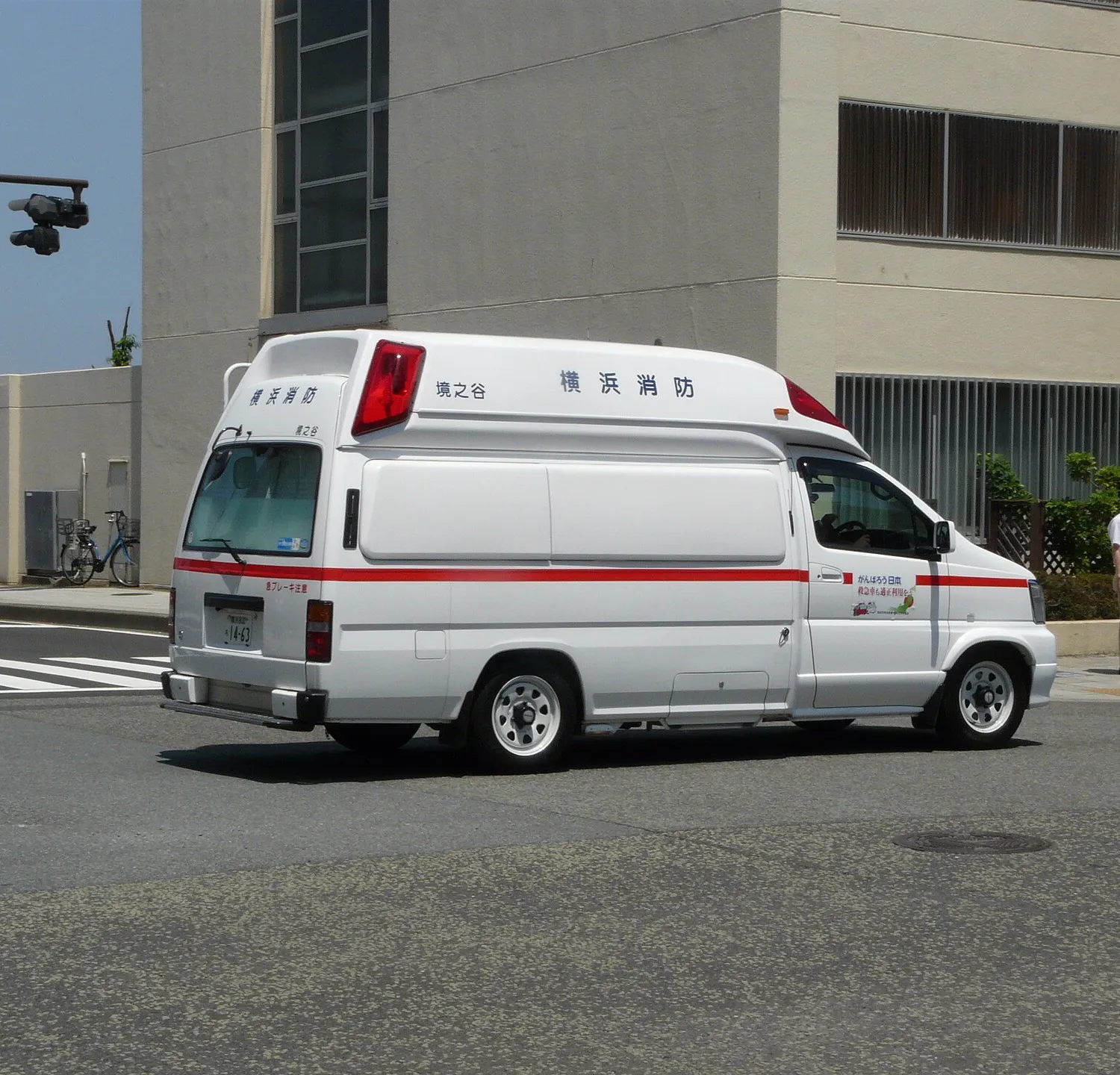
Photo by Piotrus, CC BY-SA 3.0, via Wikimedia Commons, cropped
119 is the number for an ambulance (and for fire). 110 is the police [1] [13]. Both are available 24 hours, and calling them costs nothing [7].
The ambulance service is available to anyone in Japan who has a sudden illness or injury, and that includes visitors [1].
Is the ambulance itself free? We could not find a national government page that states this outright, so here is what the official sources do say. Calling 119 is free [7]. Some hospitals may charge an extra fee when someone arrives by ambulance and the call was judged not urgent. In Ibaraki Prefecture, for example, hospitals (23 as of 2026) have charged this fee (called sentei ryōyōhi, 選定療養費) since December 2024, between ¥2,200 and ¥13,200 depending on the hospital, paid at checkout. The prefecture says this is not a charge for the ambulance, and that it does not apply when the call is recognized as urgent, even if the illness turns out to be minor [6]. Treatment at the hospital is paid for at the hospital [1] (see the section on paying below).
What will the 119 operator ask?
The Fire and Disaster Management Agency (FDMA) explains the questions in order [1]:
- Is it a fire or a medical emergency? Say 救急です (kyūkyū desu, “it’s a medical emergency”).
- Where are you? Give the address, or a nearby landmark. 住所は○○です (jūsho wa ○○ desu, “the address is ○○”).
- What happened?
- The person’s age.
- Your name and a phone number.
If the situation is urgent, the ambulance is sent before all the questions are answered [1]. The FDMA also says it helps if someone goes out to guide the ambulance to you [1].
Can you call 119 in English? Most fire departments in Japan connect an interpreter to the call through a phone interpretation center (a three-way call). As of January 1, 2025, 673 of Japan’s 720 fire departments (93.5%) had this, and all of them cover English, Chinese and Korean. Other languages depend on the department [3] [4]. In Tokyo, the Tokyo Fire Department has English-speaking staff at its dispatch centers at all times, and uses interpreters for Chinese, Korean, Portuguese, Spanish and other languages where possible [5].
If someone nearby speaks Japanese, such as hotel staff, ask them to help make the call [1] [14]. JNTO suggests showing this line to a Japanese speaker [14] [19]:
救急車を呼んでください。Kyūkyūsha o yonde kudasai. (“Please call an ambulance.”)
What should you have ready when the ambulance comes?
The FDMA lists these for visitors [1]:
- Passports (your child’s too)
- Cash or a credit card, to pay at the hospital
- Any medicines your child takes now
- A written note of your child’s health history, if you have one
You can’t choose which hospital the ambulance takes you to [14] [19].
The FDMA publishes a Guide for Ambulance Services for visitors in 16 languages, as a pamphlet and a one-page flyer, and a longer ambulance manual in Japanese, English, Chinese and Korean [1] [2]. Both are worth downloading to your phone before you fly:
- FDMA Guide for Ambulance Services (all languages)
- FDMA ambulance use manual (Japanese page with English, Chinese and Korean PDFs)
What are #8000 and #7119, and can you use them in English?
Japan has official phone lines where a nurse or doctor gives advice when you’re not sure what to do. They don’t diagnose. They help you decide what to do next and where to go.
#8000: the children’s medical phone line (kodomo iryō denwa sōdan, 子ども医療電話相談). This is a program listed by the Ministry of Health, Labour and Welfare (MHLW). It runs in all 47 prefectures, each with its own hours and regular-line number [10] [2]. Pediatricians and nurses answer (in some prefectures also public health nurses or midwives). They advise on what to do and where to go; they do not diagnose or treat [11] [12]. Advice is free, but you pay for the call [12].
Hours differ by prefecture. Most lines run mainly in the evenings, overnight, and on weekends and holidays. All 47 run past midnight, and a few run 24 hours, such as Ibaraki, Saitama, Shizuoka and Kagawa [10]. Who can use it also differs. Shimane takes calls about children under 15 from anywhere in the prefecture; Shiga says its line is for children aged 15 and under who live in Shiga [11] [12]. So whether a visitor can use it depends on the prefecture.
#7119: the emergency advice line (kyūkyū anshin sentā, 救急安心センター). Doctors, nurses and paramedics give advice on whether to call an ambulance or where to get care, and transfer the call to 119 if it is urgent. It is not nationwide: it runs in 42 areas (as of around July 2026) [8]. Some areas take calls for all ages, 24 hours, including Tokyo, Kanagawa, Kyoto, Osaka, Hyogo, Nara, Fukuoka and Okinawa. Others are only for people aged about 15 and over, and there, children’s questions go to #8000 [8]. In Tokyo, #7119 runs 24 hours a day, every day, and can also be reached on 03-3212-2323 [9].
Languages. On the official pages we checked for #8000 (the MHLW national table, Shiga and Shimane) and #7119 (the FDMA and the Tokyo Fire Department), we did not find any mention of foreign-language support [10] [12] [11] [8] [9]. If you don’t speak Japanese, a Japanese speaker at your hotel may be able to help, and the English-language options below are worth having too.
The FDMA also has an official free app called Q-Suke (Q助) [2].
| Number | What it's for | Hours | Languages | Cost | Source |
|---|---|---|---|---|---|
| 119 | Ambulance and fire | 24 hours | Japanese; interpreter for English, Chinese and Korean at 673 of 720 fire departments (Jan 2025); English-speaking staff at all times in Tokyo | Free call | [7] [3] [5] |
| 110 | Police | 24 hours | Not stated | Free call | [7] |
| #8000 | Advice about a child's sudden illness (nurses, pediatricians) | Differs by prefecture; mainly evenings, nights, weekends and holidays; some 24 hours | No foreign-language support found on the official pages we checked | Advice free in the prefectures we checked; you pay for the call | [10] [12] [11] |
| #7119 | Advice on whether to call an ambulance or where to go (42 areas only) | Differs by area; 24 hours in Tokyo | No foreign-language support found on the official pages we checked | Not stated | [8] [9] |
| 050-3816-2787 | JNTO Japan Visitor Hotline: illness, accidents, disasters, tourist information | 24 hours, 365 days | English, Chinese, Korean | Not stated | [13] |
| 03-5285-8181 | Tokyo "Himawari" service: Tokyo hospitals that can see you in your language | Daily 9:00–20:00 | English, Chinese, Korean, Thai, Spanish | Advice free; you pay for the call | [23] |
#8000 regular-line numbers for some popular areas
Some phones can’t dial # numbers. The MHLW lists a regular phone number for each prefecture’s #8000 line [10] [11]. Here are a few, from the MHLW table dated May 22, 2026. Hours change, so check the MHLW #8000 page (Japanese) before your trip.
| Prefecture | Hours | Regular number | Source |
|---|---|---|---|
| Tokyo | Mon–Fri 18:00–8:00; Sat, Sun and holidays 8:00–8:00 (next day) | 03-5285-8898 | [10] |
| Osaka | Every day 19:00–8:00 | 06-6765-3650 | [10] |
| Kyoto | Every day 19:00–8:00 (Sat from 15:00) | 075-661-5596 | [10] |
| Hokkaido | 19:00–8:00 | 011-232-1599 | [10] |
| Fukuoka | Mon–Fri 19:00–7:00; Sat 12:00–7:00; Sun and holidays 7:00–7:00 (next day) | 092-731-4119 | [10] |
| Okinawa | Mon–Fri 19:00–8:00; Sat, Sun and holidays 8:00–8:00 (next day) | 098-888-5230 | [10] |
In the MHLW table, “holidays” include the New Year holidays. [10]
For Tokyo’s #7119, the regular number is 03-3212-2323 [9].
Who can help you in English?
The JNTO Japan Visitor Hotline: 050-3816-2787 (from a phone that isn’t Japanese, +81-50-3816-2787). It runs 24 hours a day, 365 days a year, in English, Chinese and Korean, and covers illness and accidents as well as disasters and general tourist questions [13] [18]. As a rule, the hotline does not interpret three-way calls between you and a hospital, and it does not make bookings for you [14] [15]. Think of it as the place to ask “where can we go?”, in English.
In Tokyo: the “Himawari” medical information service, 03-5285-8181. Run by the Tokyo Metropolitan Government, daily 9:00–20:00, in English, Chinese, Korean, Thai and Spanish. It tells you which Tokyo hospitals and clinics can see you in your language, and explains how the Japanese medical system works. The advice is free; you pay for the call [23].
How do you find a doctor or hospital that speaks English?
In Japan, the word to look for is 小児科 (shōnika, pediatrics). The Japan Tourism Agency’s guide for visitors lists “children’s illnesses” under pediatrics [19].
The Japan Tourism Agency describes the usual pattern: during normal hours, go to a clinic or hospital; outside them, use the local after-hours service; emergency hospitals are open 24 hours [19]. Hours and services differ from place to place, so check each clinic’s own information or use the search tools below.
1. JNTO’s medical institution search. JNTO’s “Guide for when you are feeling ill” lets you search for hospitals and clinics by area, language, medical department, accepted credit cards, and whether they handle emergencies around the clock. It works in English, Japanese, Chinese and Korean [14] [17].
The list behind it is put together by the MHLW and the Japan Tourism Agency, and each prefecture chooses which hospitals and clinics to include [16]. There are two groups: Category 1 hospitals can admit foreign patients who need emergency inpatient care; Category 2 covers medical institutions that accept foreign patients, including clinics and dental clinics [15]. The MHLW published its latest list on June 30, 2026, with partial updates since, and says the JNTO search will be updated later [16]. So the search may not show the very latest changes.
2. The MHLW’s Iryō Jōhō Net, “Navii” (医療情報ネット, iryō jōhō netto, medical information network). A nationwide search of hospitals, clinics and pharmacies, run by the ministry and unified across Japan since April 2024 [21]. You can switch it to English, Chinese or Korean. The detailed search has options for foreign languages and for children, and there are quick searches for places open now and for holiday and night care, including from your current location [22]. Some pages are only in Japanese [22].
3. People who can help. The Japan Tourism Agency suggests asking your hotel front desk or concierge, a tourist information center, or your travel insurer’s assistance line [19].
A line you can show at the front desk:
子どもの具合が悪いので、近くの小児科を教えていただけますか。Kodomo no guai ga warui node, chikaku no shōnika o oshiete itadakemasu ka? (“Our child isn’t feeling well. Could you tell us a pediatric clinic nearby?”)
英語が話せるお医者さんはいますか。Eigo ga hanaseru oisha-san wa imasu ka? (“Is there a doctor who speaks English?”)
How does paying work, and do you need travel insurance?
Japan’s public health insurance won’t cover you. People staying in Japan on a short-term (temporary visitor) status cannot join Japan’s National Health Insurance [24]. Without travel insurance that pays the hospital directly, you may be charged the full amount [14] [15].
Cash or card? According to the Japan Tourism Agency and JNTO, credit cards are mainly accepted at major hospitals, and clinics are generally cash only [19] [14]. You can ask at reception for a rough idea of the cost before you’re seen. The payment at the counter covers the treatment up to that point [19] [15].
Medicine is a separate bill. If the doctor prescribes medicine, you usually collect and pay for it at a pharmacy. Some hospitals and clinics give you the medicine themselves [19] [14].
Insurance. The Japan Tourism Agency encourages visitors to consider private medical insurance with enough cover, ideally before they travel, because medical costs can be high [18] [17]. JNTO strongly recommends travel insurance for all visitors [20]. A few points from those pages:
- With cashless cover, you may not need to pay at the hospital, but the conditions differ by insurer, so check before you go [14] [19]. Other policies have you pay first and claim later [20].
- If you’re relying on insurance that comes with a credit card, check what it covers [20].
- Insurance you can buy after arriving in Japan also exists [20] [17].
- Keep your insurer’s emergency contact number with you [20].
Unpaid bills matter. Foreign visitors who leave medical bills unpaid may be refused entry to Japan in the future [18] [20].
Claim paperwork. Ask your insurer before you travel which documents they need from a Japanese hospital, and in what language. If they want a receipt, the Japanese word is 領収書 (ryōshūsho).
How do medicines and pharmacies work in Japan?
Photo by 運転太郎, CC BY 3.0, via Wikimedia Commons
For something that doesn’t need a doctor, the Japan Tourism Agency suggests talking to the pharmacist at a pharmacy or drugstore [19]. Japan’s over-the-counter (OTC) medicines come in groups that decide who can sell them [25]:
| Group | Japanese | Who sells it | Source |
|---|---|---|---|
| Requires-guidance drugs | 要指導医薬品 (yō-shidō iyakuhin) | Pharmacist, with an explanation | [25] |
| Class 1 OTC drugs | 第1類医薬品 (dai-ichi-rui) | Pharmacist, with an explanation | [25] |
| Class 2 and Class 3 OTC drugs | 第2類・第3類医薬品 (dai-ni-rui, dai-san-rui) | Pharmacist or registered seller (登録販売者, tōroku hanbaisha) | [25] |
In practice, this means some medicines can’t be bought when no pharmacist is on duty, for example at night [19]. Since May 1, 2026, some cold and cough medicines have tighter rules: large packs are not sold to under-18s, and staff ask about the buyer’s age and other medicines [25].
We don’t give medicine names or doses here. Children’s medicine is a question for the pharmacist. Tell them your child’s age and any medicines they already take, and talk to your pediatrician before you go about what to bring.
子ども用の薬について、薬剤師さんに相談したいです。Kodomo-yō no kusuri ni tsuite, yakuzaishi-san ni sōdan shitai desu. (“I’d like to ask the pharmacist about medicine for my child.”)
Bringing your child’s medicine into Japan
The MHLW sets amounts you can bring for personal use without applying for anything [26]:
| Type | Up to | Source |
|---|---|---|
| Prescription medicine | 1 month's supply | [26] |
| Non-prescription medicine and quasi-drugs | 2 months' supply | [26] |
| External-use items (such as creams), other than the above | 24 per item | [26] |
| Injectables | Only pre-filled syringes or self-injection kits, 1 month's supply | [26] |
If you need more than this, apply online for an Import Confirmation before you leave home [26]. Narcotics, psychotropic drugs and stimulant raw materials have separate rules: some need advance permission and some are not allowed at all, so check the MHLW guidance if your child takes anything in those groups [26]. Your pediatrician or pharmacist at home can tell you which group a medicine is in.
For what else to pack, see our Japan with a baby packing list.
What should you sort out before you fly?
Insurance
- Buy travel or medical insurance that covers your baby, and check whether it pays hospitals directly (cashless) or you pay and claim.
- Save the insurer’s emergency number and your policy number in your phone, and keep a paper copy.
- Ask the insurer which documents they need from a Japanese hospital for a claim.
Numbers to save
- 119 (ambulance and fire), 110 (police)
- JNTO Japan Visitor Hotline: 050-3816-2787 (+81-50-3816-2787)
- The #8000 regular-line number for each prefecture you’re visiting (from the MHLW table)
- #7119 for the areas you’re visiting, if it runs there
- In Tokyo: Himawari, 03-5285-8181
Papers
- Passports for everyone, including the baby.
- A short note in English of your child’s health history, allergies, regular medicines, and vaccinations. A translation app can turn it into Japanese.
- Your hotel addresses written in Japanese, so you can read them out or show them.
- Your pediatrician’s contact details at home.
Downloads
- The FDMA Guide for Ambulance Services in your language.
- The JNTO “Guide for when you are feeling ill” page, bookmarked.
- Iryō Jōhō Net (Navii), bookmarked.
Money and medicine
- Some cash in yen, for clinics and pharmacies.
- Your child’s regular medicines, within the MHLW limits.
Questions parents ask
- Is calling an ambulance free in Japan?
- Calling 119 costs nothing, and the ambulance service is open to anyone in Japan with a sudden illness or injury, including visitors. In Ibaraki Prefecture, for example, certain hospitals charge an extra fee at checkout when an ambulance call is judged not urgent, and the prefecture says it is not a charge for the ambulance. Treatment is paid for at the hospital, so bring cash or a card.
- Can I call #8000 in English?
- We did not find any foreign-language service mentioned on the official #8000 pages we checked. Who can use it and when also differ by prefecture. For help in English, the JNTO Japan Visitor Hotline (050-3816-2787) runs 24 hours in English, Chinese and Korean.
- Do clinics in Japan take credit cards?
- The Japan Tourism Agency says credit cards are mainly accepted at major hospitals, and clinics are generally cash only. Carry some cash, and ask at reception for a rough idea of the cost.
- 訪日外国人のための救急車利用ガイド (Guide for Ambulance Services, English pamphlet) — Fire and Disaster Management Agency (FDMA), Japan
- 救急車利用マニュアル (A guide for ambulance services) — Fire and Disaster Management Agency (FDMA), Japan
- 電話通訳センターを介した三者間同時通訳~119番多言語対応の導入状況~ — Fire and Disaster Management Agency (FDMA), Japan
- 外国人・障害者に円滑に対応するための取組 — Fire and Disaster Management Agency (FDMA), Japan
- 119番通報のしくみ — Tokyo Fire Department
- 救急搬送における選定療養費の徴収について — Ibaraki Prefecture
- Welcome to Japan. Travel safely. We are here to help. (leaflet) — Japan Tourism Agency
- 救急安心センター事業(♯7119)ってナニ? — Fire and Disaster Management Agency (FDMA), Japan
- 救急相談センター — Tokyo Fire Department
- 子ども医療電話相談事業(♯8000)について — Ministry of Health, Labour and Welfare (MHLW), Japan
- 子ども医療電話相談(#8000) — Shimane Prefecture
- 小児救急電話相談(#8000)について — Shiga Prefecture
- Japan Visitor Hotline | Travel Japan | JNTO — Japan National Tourism Organization (JNTO)
- For safe travels in Japan - Guide for when you are feeling ill — Japan National Tourism Organization (JNTO) / Japan Tourism Agency
- 日本を安心して旅していただくために―具合が悪くなったときに役立つガイド — Japan National Tourism Organization (JNTO) / Japan Tourism Agency
- 「外国人患者を受け入れる医療機関の情報を取りまとめたリスト」について — Ministry of Health, Labour and Welfare (MHLW), Japan
- 外国人患者受入体制の充実及び医療費不払の防止 — Japan Tourism Agency
- Information on illnesses, injuries, and disasters — Japan Tourism Agency
- For safe travels in Japan - Guidebook for when you are feeling ill — Japan Tourism Agency
- Travel Insurance in Japan — Japan National Tourism Organization (JNTO)
- 外国人患者向け医療情報サービス — Tokyo Metropolitan Government, Bureau of Public Health
- 外国籍のかたの国民健康保険の加入 — Meguro City, Tokyo
- 市販薬(OTC医薬品)の販売ルールが変わりました — Shiga Prefecture
- Information for those who are bringing medicines for personal use into Japan — Ministry of Health, Labour and Welfare (MHLW), Japan