Onsen and Public Baths with a Baby in Diapers: Rules, Private Baths and Etiquette
"高峰温泉露天風呂" by Komoro no kaze, CC BY-SA 4.0, via Wikimedia Commons, cropped
This page contains affiliate links. If you book through them, we may earn a commission at no extra cost to you. How this works
- At the places we checked that state a rule, children still in diapers are asked to stay out of the shared bath tubs, or out of the shared bath entirely. Rules differ, so ask before you book.
- To bathe together as a family, look for a room with its own bath or a private bath (kashikiri) you can reserve.
- The official Japanese onsen guidance we found does not cover babies. Ask your pediatrician before putting your baby in hot-spring water.
You came to Japan, maybe in part, for the hot springs. Then you read the fine print and found out your baby may not be allowed in. If that feels like a small heartbreak, it’s a very normal one.
The good news is that there are real ways for the whole family to enjoy an onsen. Here’s what the rules actually say at the places we checked, how private and in-room baths work, the etiquette in short, and what Japan’s official guidance does and doesn’t say.
Can babies in diapers use an onsen or public bath in Japan?
"Sento6225" by Mariemon, CC BY-SA 3.0, via Wikimedia Commons, cropped
At four of the six places we checked, children in diapers can’t use the shared tubs or the shared bath. Every official page we found that mentions diapers asks families to keep children in diapers out of the shared tubs, or out of the shared bath entirely. The exact rule differs, and many places say nothing at all, so always ask.
| Place | Children in diapers in the shared bath | What they suggest instead | Source |
|---|---|---|---|
| Hotel Okada (onsen hotel, Hakone-Yumoto) | Not in the tubs | Use the baby bath in the washing area; baby gear kept in the bath | [1] |
| Hakone Kowakien Ten-yu (onsen inn, Hakone) | Not in the tubs | Washing area only, or your room's open-air bath | [2] |
| Hotel Emion Tokyo Bay (city hotel with a large bath, near Tokyo Disney Resort) | Asked not to use the large bath | Not stated | [4] |
| Hakone Yuryo (day-use onsen, Hakone-Yumoto) | Anyone using diapers may not bathe | Under-school-age children are directed to private bath rooms | [5] |
| Kinugawa Onsen Asaya Hotel | Not stated | Not stated (a private bath can be reserved) | [7] [6] |
| Seizan Yamato (onsen inn, Ito) | Not stated | You may bring the inn's baby bath into the shared bath; private bath | [8] [9] |
At Hakone Yuryo, a day-use onsen, people using diapers may not bathe, and children under elementary school age can’t use the large-bath building and are pointed to the private bath rooms instead [5].
Is there a national rule? Not about diapers. Japan’s national guidelines for public baths and for the shared baths at inns cover things like not admitting people with diarrhea or infectious illness, and washing before getting in. We found nothing specific about diapers or infants [10]. The diaper rules come from each facility.
What about swim diapers? None of the official bath rules we read mention swim diapers as allowed. If you’re hoping to use one, ask the inn directly before you book.
Some baths are set up for babies, even if the tubs aren’t. Hotel Okada keeps a baby bath, baby bath chair, bath toys, a baby bed, a diaper bin and baby toiletries in its large bath for free [1]. Seizan Yamato keeps a baby bath chair and a baby bed in its large baths, and you can bring its baby bath in [9]. That means one parent can wash the baby in the bath area while the other soaks, then swap.
What are private baths (kashikiri) and in-room baths?
"露天風呂" by Jeremy Hall, CC BY 2.0, via Wikimedia Commons
These are the easiest ways for the whole family to bathe together.
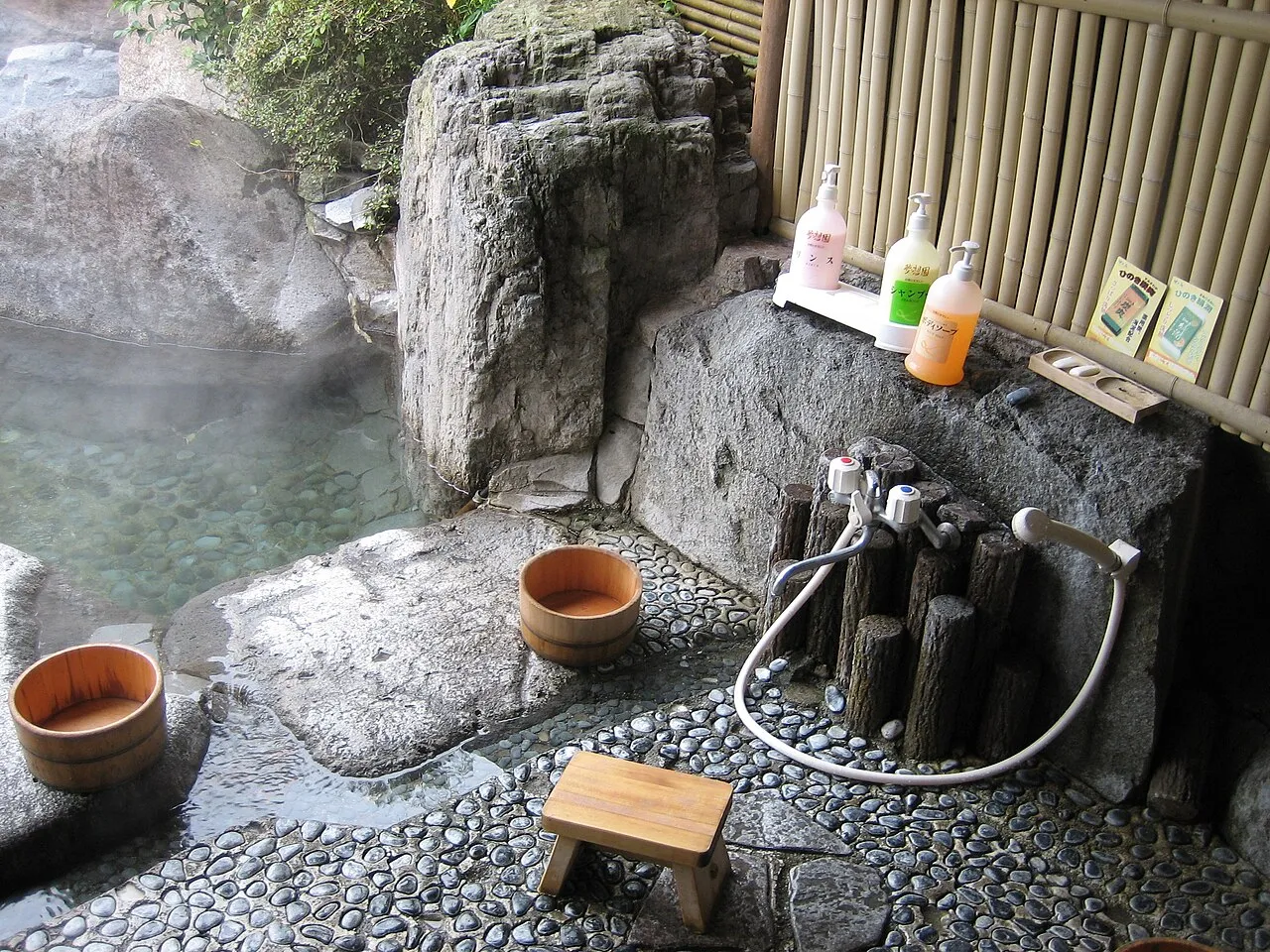
Private bath (kashikiri-buro, 貸切風呂). A bath you reserve for a set time, just for your family. JNTO notes that these almost always cost extra and need to be booked, either in advance or at the front desk [14]. Some examples:
| Place | Price and time | How to book | Source |
|---|---|---|---|
| Kinugawa Onsen Asaya Hotel | ¥4,000 (tax included) for 50 min; 2 pm to midnight, last entry 11 pm; up to 5 people including children | Slots before 8 pm at check-in; after 8 pm by phone in advance; not through the booking notes | [6] |
| Seizan Yamato (Ito) | ¥1,650 for 50 min, free if you book your stay on the inn's site or by phone; slots 2–5:50 pm, 9–11:50 pm, 6–9:50 am | Call the inn after booking to request a time | [8] [9] |
| Hakone Yuryo (day-use onsen) | Private open-air bath rooms, 120 min, ¥10,400 to ¥15,400 (tax included) by room size and day | Online booking; diapers not allowed | [5] |
In-room bath (kyakushitsu rotenburo, 客室露天風呂, or a room with its own bath). Some rooms come with their own hot-spring bath, included in the room price. JNTO says many inns have such rooms [14]. Every room at Ten-yu has its own open-air hot-spring bath [3], and Ten-yu suggests it for children in diapers [2]. Hotel Okada and Seizan Yamato have some rooms with an open-air bath [1] [8]. At Seizan Yamato, the regular bathrooms in other rooms use heated tap water, not hot-spring water [8], so check the room type if the onsen water matters to you.
Words to search for on booking sites:
- “private onsen” or “private bath” (貸切風呂, kashikiri-buro)
- “room with open-air bath” (露天風呂付き客室, rotenburo-tsuki kyakushitsu)
- “family bath” (家族風呂, kazoku-buro)
How do you take turns at the big bath?
With a baby, taking turns is often the simplest way to enjoy the big bath, and that’s fine. It may even be the most relaxing hour of your day.
Check the bath hours when you arrive. They vary a lot:
- Ten-yu: 5 am to midnight (last entry 11:30 pm). The men’s and women’s baths swap during the midnight cleaning [2].
- Seizan Yamato: two baths that swap. One is the women’s bath from 2 pm to 3 am and the men’s bath from 4 am to 10 am; the other is the reverse. Cleaning is from 3 to 4 am [8].
Because baths can swap overnight, the bath you visit in the morning may be a different one from the night before, which means two different baths to try in one stay.
Can a parent take a young child into the other bath? Changing rooms are always separated by gender, and most baths are too [13]. Japan’s national guidelines say boys and girls aged about 7 or older should not bathe in the other sex’s bath, down from about 10 before December 2020 [10] [12]. Actual limits are set locally. For public baths, Tokyo moved to age 7 in January 2022 [11], and Shizuoka in October 2023 [12]. At the places we checked:
- Asaya Hotel and Seizan Yamato allow children up to age 6 in the other sex’s bath with a parent [7] [8]. Asaya notes that mixed bathing from age 7 is prohibited by Tochigi Prefecture’s ordinance [7].
- Hotel Emion Tokyo Bay asks that children aged 7 or older, or taller than 120 cm, not go into the other sex’s bath [4].
Bathing etiquette in a Japanese onsen (the short version)
"Onsen-1-Clothes" by Onsen, CC BY-SA 3.0, via Wikimedia Commons
If you’ve never been to an onsen, here’s what JNTO and Japan’s Environment Ministry ask of bathers:
- Wash first. Wash and rinse off all soap at the washing area before getting into the tub [13]. Pour some water over yourself first, starting from your hands and feet, to get used to the temperature [15].
- No swimsuits. You bathe without clothing, including swimsuits [13].
- Keep the small towel out of the water, and tie up long hair [13] [15].
- Keep it calm. Keep your voice down, and no swimming or splashing. That’s worth explaining to a toddler before you go in [13].
- No phones or cameras in the bath [13].
- Don’t stay in too long, and avoid bathing after drinking alcohol [13] [15].
JNTO also says many onsen welcome families with children, but suggests checking the rules in advance [13].
Tattoos are a separate topic: some onsen refuse guests with tattoos, and a private bath is one option [13] [14]. JNTO’s guide covers this in more detail.
What do Japan’s authorities say about bathing young children?
The official onsen guidance we found doesn’t address babies. The Environment Ministry’s standard bathing notice, the one posted at hot springs, says older people, children and people with disabilities should preferably not bathe alone. It also advises drinking water before and after bathing, starting with 3 to 10 minutes in the water, and avoiding baths right before or after meals [15]. The ministry’s guide for the public explains that the reason not to bathe alone is the risk of drowning or falling [16]. Neither document gives guidance specific to infants.
Two pieces of advice from Japan’s Consumer Affairs Agency are worth knowing. They were written for baby baths and for bathing at home, so treat them as general safety points:
- Baby baths: use water at about 38 to 40 °C, a little cooler than adult bath water, and check it with a bath thermometer, not your hand. Don’t set a baby bath on top of a bathtub lid, and stay within arm’s reach the whole time, because babies can drown in very little water [17].
- Drowning (advice about bathing at home): among children, drowning in the bath is most common at ages 0 to 1, often when an adult looks away for a moment. Take your child out of the tub while you wash your hair, and never let young children bathe alone. Children can drown without making a sound [18].
These are general safety points, not advice on onsen water. For your baby, your pediatrician is the right person to ask.
What to ask the inn (copy-and-paste message)
Hello,

We have a reservation for [date] under [your name], and we are traveling
with a [age]-month-old baby who wears diapers.

Could you please tell us:
- Can our baby use the large bath (the tub or only the washing area)?
- Do you have a private bath (kashikiri) we can reserve? How much is it,
  and how do we book a time?
- Does our room have its own bath? Is it hot-spring water?
- Can we borrow a baby bath or a baby bath chair?

Thank you very much.
[Your name]
A short line in Japanese for the front desk:
おむつが取れていない子どもがいます。大浴場を使えますか。貸切風呂はありますか。Omutsu ga torete inai kodomo ga imasu. Daiyokujō o tsukaemasu ka? Kashikiri-buro wa arimasu ka? (“We have a child who isn’t out of diapers. Can we use the large bath? Do you have a private bath?”)
Before you book: a checklist
- What is the inn’s rule for children in diapers: the tubs, the washing area, or not at all?
- Is there a private bath? Price, time, and how to reserve it?
- Does our room have its own bath, and is it hot-spring water?
- Can we borrow a baby bath or baby bath chair, and is there a baby bed in the changing area?
- What are the large-bath hours, and do the baths swap?
- Up to what age can a child go into the other parent’s bath?
- Have we asked our pediatrician about bathing our baby in hot-spring water?
For more on choosing an inn, see our guide to staying at a ryokan with a baby.
Questions parents ask
- Can my baby wear a swim diaper in the onsen?
- None of the official pages we checked say swim diapers are allowed in a bath. Where a place states a rule, children in diapers are asked to stay out of the shared tubs or the shared bath. Ask the inn, and plan on an in-room or private bath.
- Can a father take a young daughter into the men's bath?
- Only while she is young. Japan's national guideline says boys and girls aged about 7 or older shouldn't bathe in the other sex's bath. Two inns we checked allow children up to age 6 with a parent, and one hotel says no to children aged 7 or older or taller than 120 cm. Exact limits differ by prefecture and by place, so check.
- What is a kashikiri bath?
- Kashikiri-buro (貸切風呂) is a private bath you reserve for a set time, so your family can bathe together. It usually costs extra and needs booking. Examples we found at onsen inns: ¥4,000 for 50 minutes at one, and ¥1,650 for 50 minutes at another (free if you book your stay directly with that inn).
- Are tattoos a problem at onsen?
- Some onsen refuse guests with tattoos. A private bath or a room with its own bath is an option. See JNTO's guide for more.
- 赤ちゃん向けサービス | ホテルおかだ【公式】 — Hotel Okada
- よくあるご質問|箱根小涌園 天悠【公式】 — Fujita Kanko
- 箱根小涌園 天悠【公式】 — Fujita Kanko
- よくあるご質問「大浴場について」|ホテル エミオン 東京ベイ — Hotel Emion Tokyo Bay
- 料金・営業時間|箱根湯寮 — Hakone Yuryo
- 貸切風呂 | 鬼怒川温泉あさやホテル【公式】 — Kinugawa Onsen Asaya Hotel
- よくあるご質問 | 鬼怒川温泉あさやホテル【公式】 — Kinugawa Onsen Asaya Hotel
- よくあるご質問|伊東温泉の旅館・ホテル「青山やまと」 — Seizan Yamato
- おもてなし|赤ちゃんと一緒の温泉旅 - 青山やまと — Seizan Yamato
- 公衆浴場における衛生等管理要領等の改正について(令和2年12月10日) — Ministry of Health, Labour and Welfare, Japan
- よくある質問(公衆浴場)|東京都保健医療局 — Tokyo Metropolitan Government
- 公衆浴場における混浴制限年齢の引き下げについて — Shizuoka Prefecture
- Guide to Bathing in Japan | Travel Japan — Japan National Tourism Organization
- Onsen Hot Springs - On Tattoos and Etiquette — Japan National Tourism Organization
- 温泉法第18条第1項の規定に基づく禁忌症及び入浴又は飲用上の注意の掲示等の基準(平成26年) — Ministry of the Environment, Japan
- あんしん・あんぜんな温泉利用のいろは(平成31年3月) — Ministry of the Environment, Japan
- Vol.646 ベビーバス使用時の事故にご注意を! — Consumer Affairs Agency, Japan
- 御家庭内での子どもの溺水事故に御注意ください! — Consumer Affairs Agency, Japan