Sleeping Arrangements for Babies in Japanese Hotels: Cribs, Futons and Twin Beds
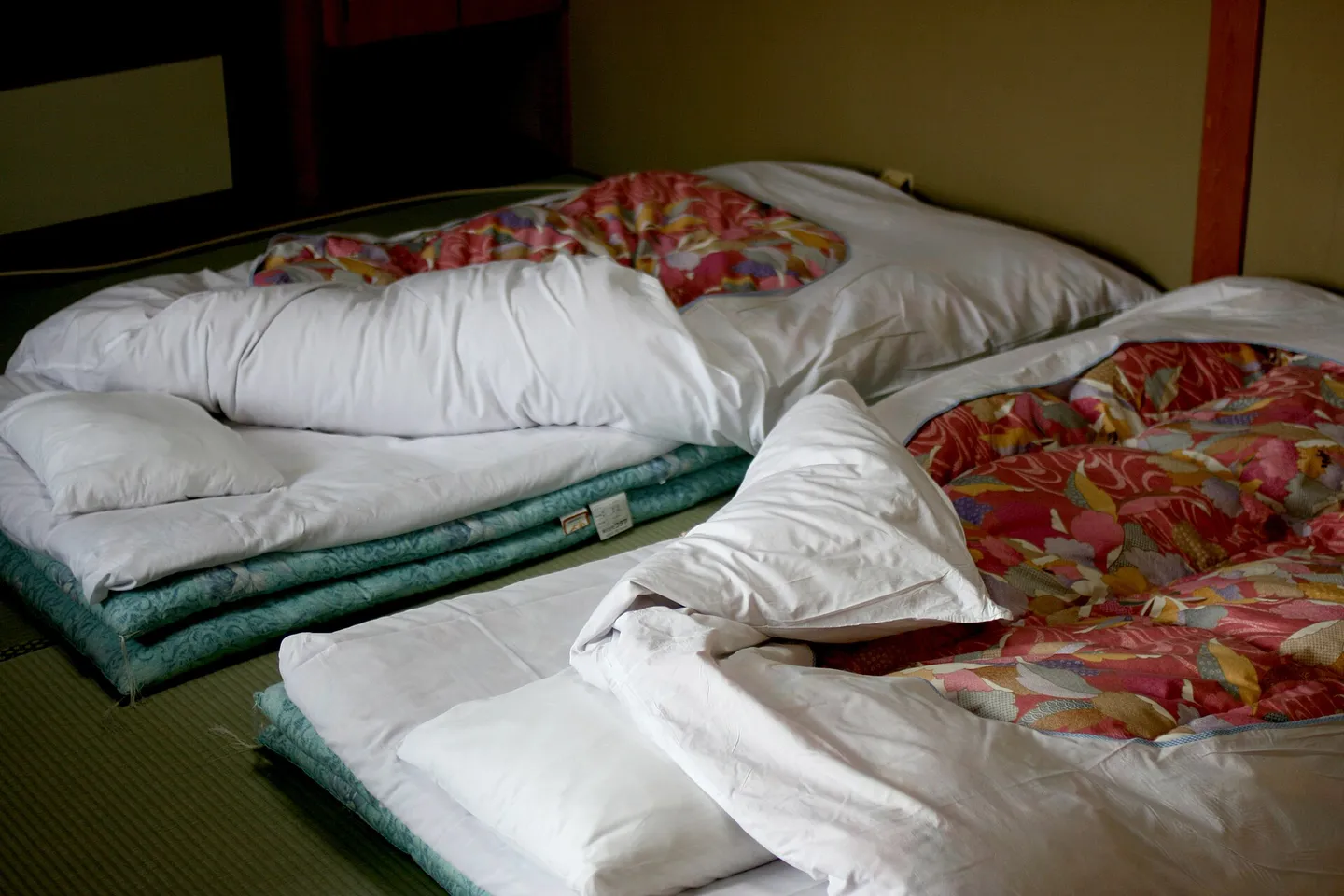
"Futons in a Ryokan - 2" by Christian Kadluba, CC BY-SA 2.0, via Wikimedia Commons
This page contains affiliate links. If you book through them, we may earn a commission at no extra cost to you. How this works
- The hotels we checked in Japan lend cribs, but the fee, age limit and room types differ by hotel and stock is often limited, so request one as soon as you book.
- A Japanese-style room (washitsu) or Japanese-Western room (wayoshitsu) with futon bedding on the floor is another option worth asking about.
- For how your baby should sleep, read Japan's official safety guidance and your own country's, and talk to your pediatrician.
If you’re lying awake before the trip wondering where your baby will actually sleep in a Japanese hotel room, you’re in good company. It’s one of the first things to sort out, and the answer really does differ from hotel to hotel.
So we went through official hotel pages and Japan’s government guidance for you. Here is how cribs work, how to ask for one, how to check the beds before you book, and what a futon room is.
Can you get a crib at a Japanese hotel?
At the hotels we checked, yes, but the rules differ by hotel. The four hotels below all lend cribs, yet each has its own fee, age limit and room restrictions, and three of them say stock is limited.
In Japan a crib is usually called a bebī beddo (ベビーベッド, “baby bed”). It is the same thing a British or Australian hotel would call a cot.
Here is what four hotels in Tokyo, Maihama (the Tokyo Disney Resort area) and Osaka say on their official Japanese-language pages:
| Hotel | Crib fee | Who it is for | Stock and booking ahead | Source |
|---|---|---|---|---|
| Hotel New Otani Tokyo | Not stated | Under 18 months only (for safety reasons) | Limited; contact the reservations team | [1] |
| Hotel New Otani Osaka | Free | Under 1 year and not yet pulling up to stand | Not stated | [2] |
| Sunshine City Prince Hotel (Ikebukuro, Tokyo) | Not stated | Two sizes: under 10 months and not yet standing, or under 2 years | Limited; ask in advance. Not usable in some rooms | [3] |
| 1955 Tokyo Bay by Hoshino Resorts (Maihama) | Free | Not stated | Limited; cannot be reserved in advance. Some room types cannot take a crib | [5] |
Three things stand out:
- Age limits vary a lot. One hotel has a crib size for children under 2 [3], while another lends cribs only to babies under 1 year who are not yet pulling up to stand [2]. Tell the hotel your child’s age when you ask.
- The room type matters, not only the hotel. Some room types cannot fit a crib [3] [5]. Ask whether the room you booked can take one.
- Not every hotel holds a crib for you. 1955 Tokyo Bay says its baby items cannot be reserved in advance [5]. Other hotels ask you to contact them ahead [1] [3]. Because stock is limited at most of these hotels, request a crib as soon as you book.
Whether a crib works for your family is your call. The safety section below links to Japan’s official guidance on where babies should sleep.
How do you ask for a crib? (copy-and-paste message)
Send a short message right after you book, through the booking site’s message box or by email to the hotel, and ask for a written reply. Then check at check-in that the crib is in your room.
In Japan, asking the hotel for baby items ahead of time is completely normal. Nobody will think you’re being demanding. It helps the staff get the room ready for you.
You can copy this message and fill in the brackets:
Subject: Crib request – [Your name], check-in [date]

Hello,

I have a reservation under the name [your name], confirmation number [number],
checking in on [date] for [number] nights.

We are traveling with a baby who will be [age] months old at check-in.

Could you please:
- reserve a crib (baby bed) for our room,
- tell us whether there is a fee, and
- confirm that our room type has space for a crib?

We would also like to know if you can lend the following:
- a diaper bin
- a baby bathtub
[Only if your child is 18 months or older:] - a bed guard for the adult bed

Could you please reply to confirm? Thank you very much.

[Your name]
You can also add a short line in Japanese. This one asks for a crib and gives your baby’s age:
ベビーベッドの貸し出しをお願いします。子どもは〇か月です。
料金と、予約した部屋にベビーベッドを置けるかどうかを教えてください。
(Replace 〇 with your baby’s age in months.)
At the front desk, you can say:
ベビーベッドをお願いしています。部屋に用意されていますか。Bebī beddo o onegai shite imasu. Heya ni yōi sarete imasu ka? (“I requested a crib. Is it set up in our room?”)
A few tips:
- Keep the reply. Save the hotel’s answer so you can show it at check-in.
- Ask about bed guards with your child’s age. Some hotels state an age range for the bed guards they lend for adult beds. At Hotel New Otani Tokyo it is 18 to 60 months [1]. Japan’s Consumer Affairs Agency says this kind of bed guard should never be used for babies under 18 months [8].
- If the hotel does not hold items in advance, ask at check-in, and have a plan B ready (see the checklist at the end).
How do you check the beds before you book?
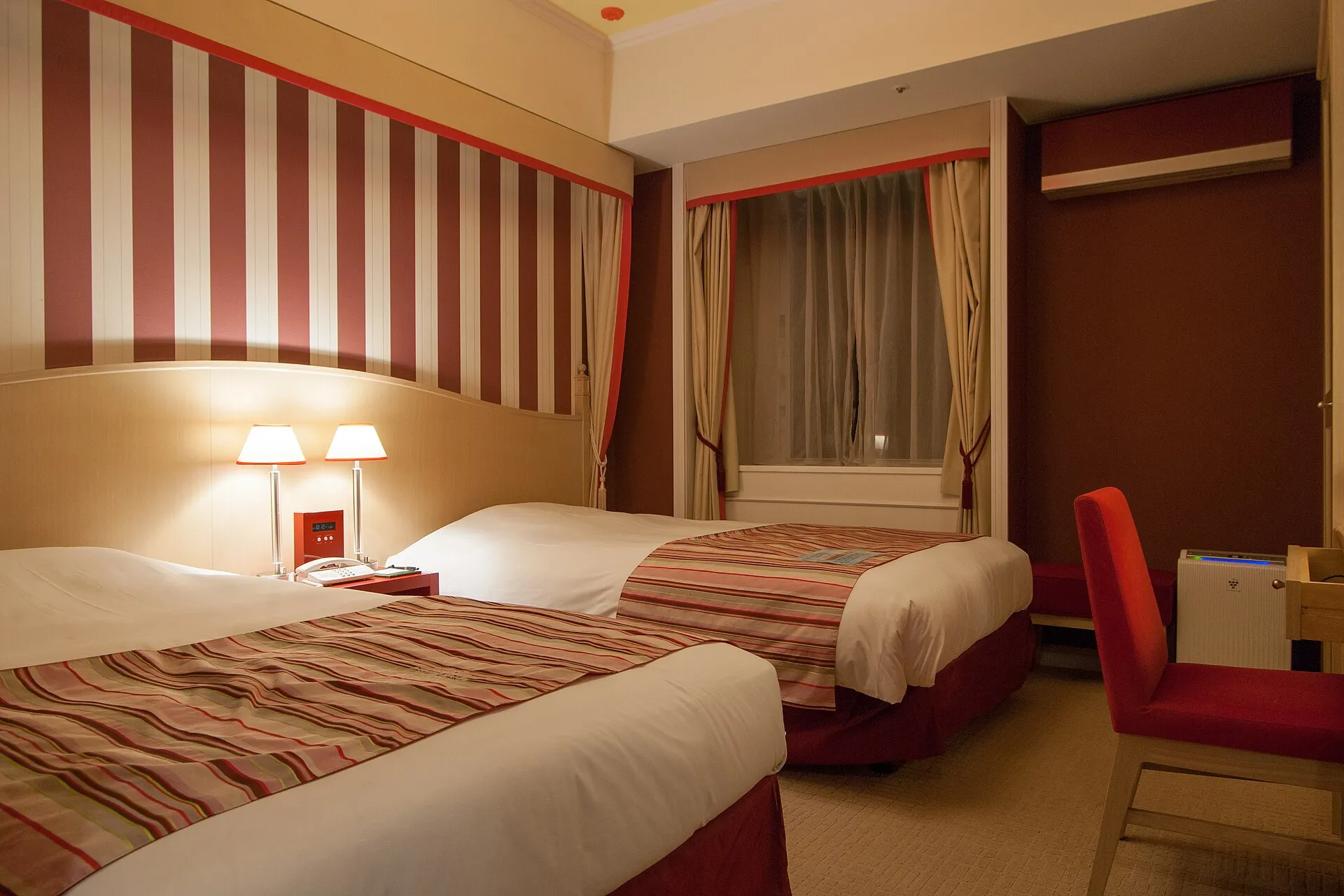
Photo by J o, CC BY-SA 4.0, via Wikimedia Commons
Look at the official room page for the room type you want. It only takes a few minutes, and it can save you a long first night. Some hotels list the number of beds and their width there, so you can see before booking how wide the beds are.
For example, Sunshine City Prince Hotel’s Japanese-Western room page lists two beds, each 140 cm wide and 195 cm long [4].
If the room page you are looking at does not show bed sizes, ask the hotel before you book.
In a room with separate beds, two things to check are how high the beds are off the floor and whether there is a gap between them. Japan’s Consumer Affairs Agency notes that falls from adult beds that are not very high have caused serious head injuries in babies [8]. You can also ask the hotel whether the beds in your room type can be moved. Whether any bed setup is safe for your baby is a separate question: read the official guidance in the safety section below and talk to your pediatrician.
What is a Japanese-style room (washitsu) or futon room?
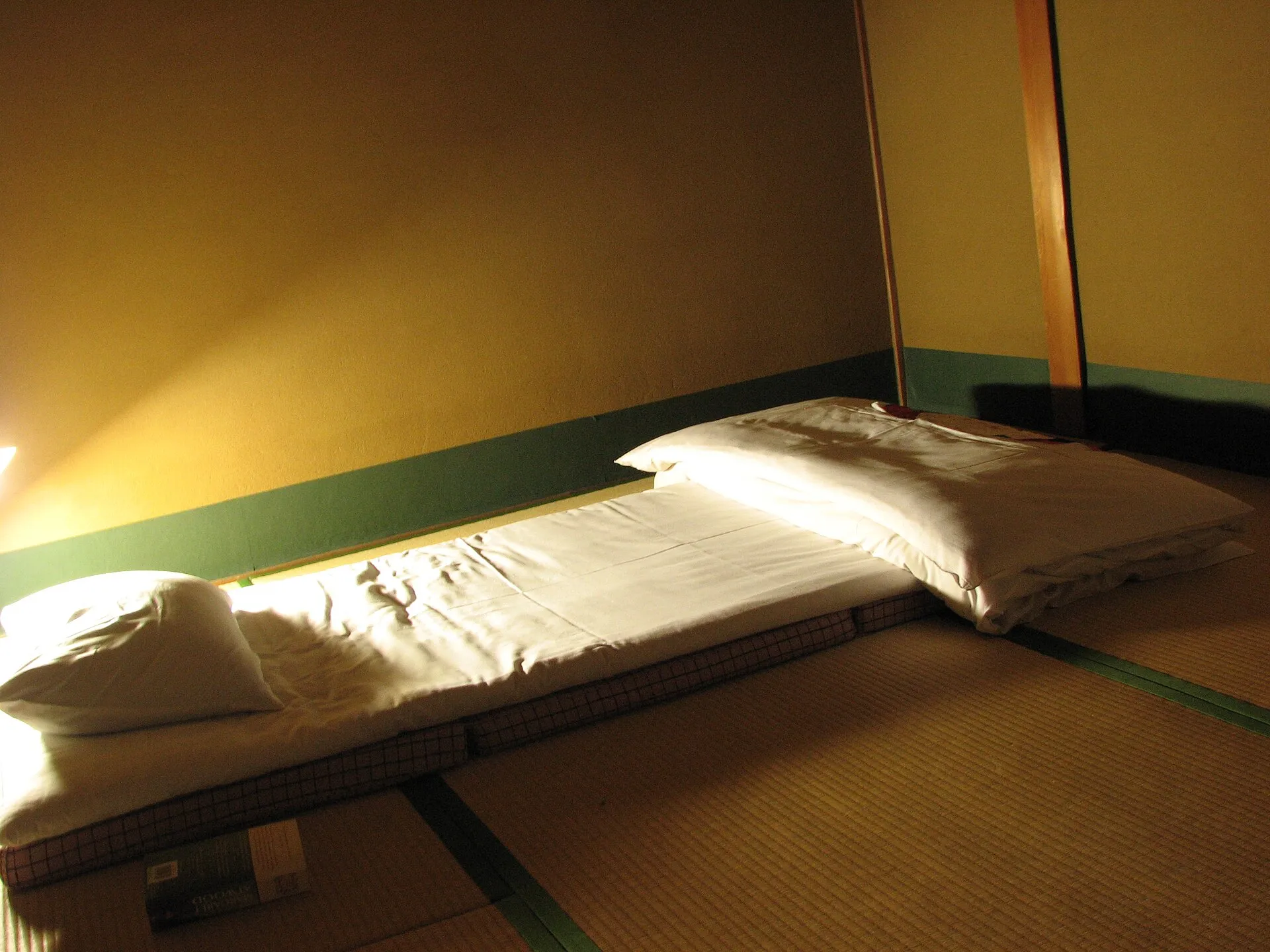
"Ryokan bedding" by Tim Herrick, CC BY 2.0, via Wikimedia Commons
A Japanese-style room (washitsu, 和室) has a floor of tatami (woven straw mats), and you sleep on futon bedding laid on the floor [6]. A Japanese-Western room (wayōshitsu, 和洋室) has both a tatami area and beds [4].
Ryokan (traditional Japanese inns). JNTO, Japan’s national tourism organization, describes a ryokan room as one open tatami-mat space where staff lay out futon bedding on the floor [6]. Ryokan rates are usually per person and include dinner and breakfast [6]. Tatami floors, futon bedding and the yukata robe are common features, and staff will explain customs such as taking your shoes off indoors [7].
Japanese-Western rooms in hotels. Some city hotels have rooms that combine the two. At Sunshine City Prince Hotel, the Japanese-Western room is a 10-tatami Japanese room plus a twin room, 75 m² in total, for up to six people [4].
Shoes-off and low-bed rooms. A few hotels design rooms around small children. 1955 Tokyo Bay says all its rooms are shoes-off, and it has rooms with a low sleeping platform for children aged 0 to 3 [5]. This differs by hotel, so check each hotel’s own page.
One thing to check in these rooms: whether there is a step between the tatami area and the entrance or the rest of the room.
Words to search for on booking sites:
- “Japanese-style room” (和室, washitsu)
- “Japanese-Western style room” (和洋室, wayōshitsu)
- “futon” or “tatami”
Ryokan and futon rooms are covered in more detail in our guide to staying at a ryokan with a baby.
What do Japan’s safety authorities say about baby sleep?
Japan’s Children and Families Agency and Consumer Affairs Agency both publish advice on how babies should sleep, and the Consumer Affairs Agency specifically mentions sleeping away from home. Below is a short summary with links. Read the original pages, check your own country’s guidance, and talk to your pediatrician about your baby.
Sleeping away from home. The Consumer Affairs Agency notes that when you stay somewhere other than home, a crib may not be available and the bedding may differ from what you use at home (for example, how firm the mattress is or how heavy the covers are). It asks parents to set up the sleep space with falls and suffocation in mind [8].
Falls. The same agency’s advice is:
- Where possible, put your baby to sleep in a crib, and keep the crib side rail up at all times [8] [9].
- Avoid adult beds as much as possible, and do not put a baby to sleep on a sofa [8]. The agency reports serious head injuries from falls off beds that are not very high, including a 7-month-old who fell from an adult bed about 70 cm high [8].
- Never use a toddler bed guard attached to an adult bed for babies under 18 months. Babies have suffocated in the gap between the bed and the guard [8].
- If a baby is on an adult bed, push the bed against the wall so there is no gap, and do not surround the baby with very soft cushions, even to prevent falls [8].
Suffocation and SIDS. The Children and Families Agency’s page for parents of babies under 1 says:
- Put your baby to sleep on their back until age 1, unless a doctor has advised otherwise for medical reasons [10] [9].
- Use firm, flat bedding, and keep anything that could cover the mouth and nose or wrap around the neck, such as soft toys, towels and cords, out of the sleep space [10] [9].
- Until age 1, do not use a top blanket (kakebuton, 掛け布団). Adjust warmth with a sleep sack, clothing or air conditioning instead, and avoid overheating [10].
- Give your baby their own sleep space in the same room as the adults. Bed-sharing is especially dangerous when an adult has taken medicine that causes drowsiness or has drunk alcohol, or when the baby was born preterm or at a low birth weight [10].
- Choose cribs and bed rails that have passed Japan’s national safety standard, and check the target age and instructions [10].
- Smoking around a baby raises the risk of SIDS, and breastfeeding where possible lowers it [10].
The agency notes that these points are preventive measures, not prohibitions [10].
The Children and Families Agency lists the American Academy of Pediatrics’ 2022 recommendations and UNICEF UK materials among its references [10]. Your own country’s health authority or pediatric association will have similar guidance. Read it before you travel, and talk to your pediatrician about how to apply it in a hotel room or on a futon.
Official pages (in Japanese; your browser’s translate function works on them):
- Children and Families Agency: helping babies sleep safely
- Consumer Affairs Agency: preventing falls during sleep
- Consumer Affairs Agency: preventing suffocation during sleep
Do Japanese hotels provide pajamas for kids?
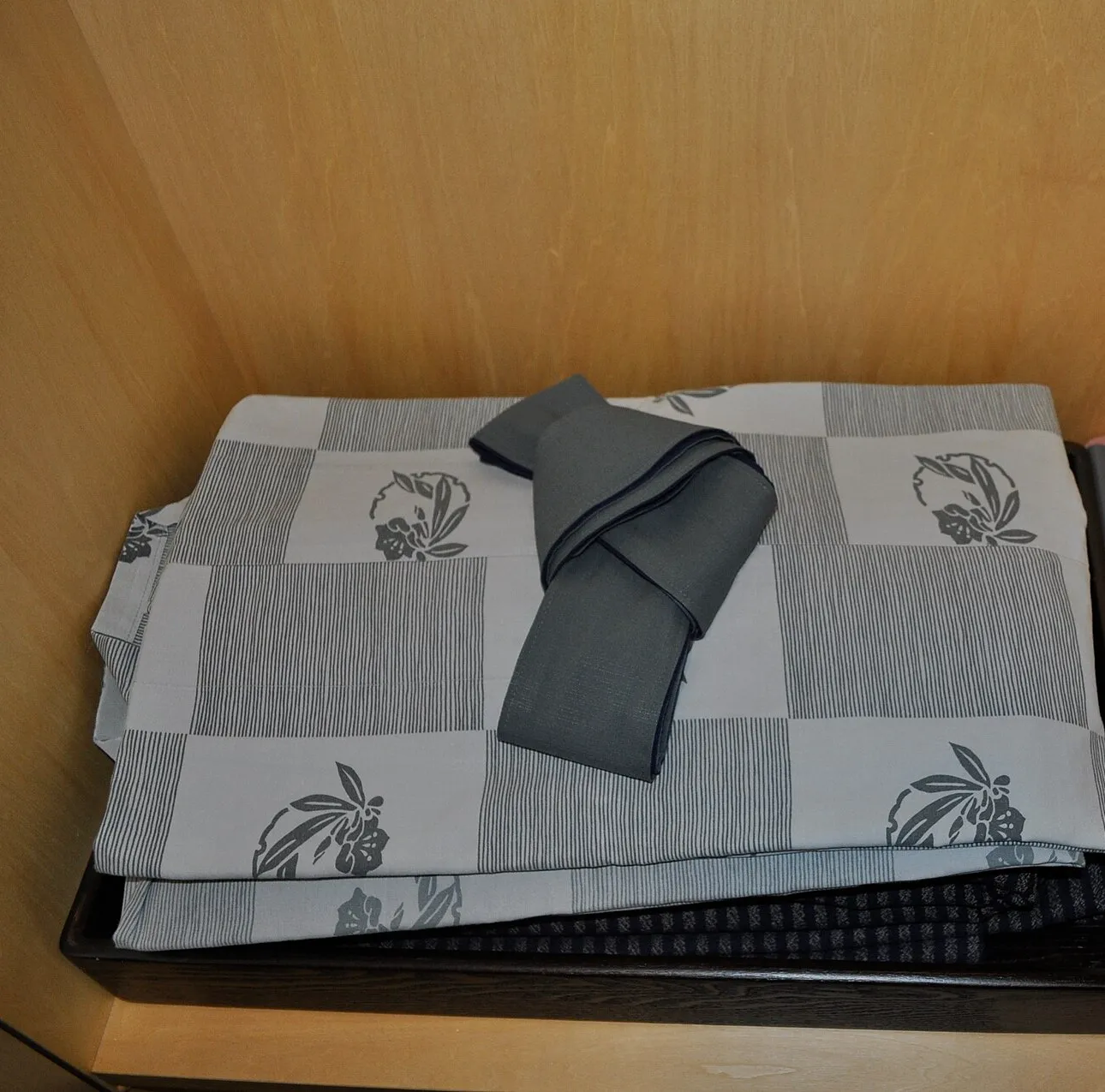
Photo by David McKelvey, CC BY 2.0, via Wikimedia Commons, cropped
Some do, but the sizes we found were for children, not babies. Plan to bring your baby’s own sleepwear.
For adults, ryokan provide a yukata, a cotton robe you can also wear around the inn [7].
Children’s sizes depend on the hotel. Examples from official pages:
- Sunshine City Prince Hotel: kids’ yukata in one size, for about 100 to 120 cm tall [3]
- Hotel New Otani Tokyo: kids’ yukata in two sizes, the smaller one for about 100 to 110 cm [1]
- Hotel New Otani Osaka: kids’ yukata in two sizes, for about 110 cm and 130 cm [2]
- 1955 Tokyo Bay: kids’ pajamas [5]
The smallest size we found on these pages was for a child about 100 cm tall, and we did not find baby-size sleepwear on any official hotel page. Consider packing your baby’s usual sleepwear or sleep sack.
Before you book: a quick checklist
You don’t need to ask every question below. Pick the ones that matter for your baby’s age and your room, and use them when you compare rooms or message a hotel or ryokan:
Crib
- Do you lend cribs? Is there a fee?
- What age or height is the crib for? (Give your baby’s age.)
- Can the crib be reserved in advance, or only requested at check-in?
- Does the room type we booked have space for a crib?
- Can we bring our own travel cot, and is there floor space for it?
Beds and room type
- How many beds are in the room, and how wide are they? (Check the official room page.)
- How high are the beds, and is there a gap between them?
- Can the beds be moved?
- Do you have a Japanese-style room (washitsu) or Japanese-Western room (wayōshitsu)?
Futon rooms and ryokan
- Do staff lay out the futon, and at what time?
- Is there a step between the tatami area and the entrance or other floors?
- Do you lend cribs at this ryokan?
Rates and extras
- Is a baby sleeping in our bed or futon (soine, 添い寝) free, and up to what age? This differs by hotel [1] [5]. See our guide to child rates and co-sleeping at Japanese hotels.
- Do you lend a diaper bin, a baby bathtub, or a bed guard (with the age range)?
- Do you provide sleepwear in children’s sizes?
Sleep safety
- Have you read Japan’s official guidance (linked above) and your own country’s, and talked to your pediatrician about sleeping in a hotel bed, crib or futon?
Questions parents ask
- Is a crib free at Japanese hotels?
- It depends on the hotel. Some hotels say on their official site that cribs are free; others don't state a fee at all. Ask about the fee when you request the crib, and get the answer in writing.
- Can I bring my own travel cot?
- We could not find an official hotel page that answers this, so ask the hotel directly before you pack one. Also ask whether your room type has floor space for it.
- Do ryokan (Japanese inns) have cribs?
- We could not confirm this from official ryokan pages. Ask the ryokan before booking, and ask how the futon bedding is set up in the room.
- What does soine mean on a Japanese hotel rate?
- Soine (添い寝) means a child sleeps in a parent's bed or futon without an extra bed. Whether that is free, and up to what age, differs by hotel. See our guide to child rates and co-sleeping at Japanese hotels.
- お子さま連れに関するよくあるご質問|ホテルニューオータニ(東京) — Hotel New Otani Tokyo
- サービスガイド|ホテルニューオータニ大阪 — Hotel New Otani Osaka
- 客室貸し出し備品のご案内|池袋 サンシャインシティプリンスホテル — Sunshine City Prince Hotel
- 和洋室|シティフロア|客室一覧|池袋 サンシャインシティプリンスホテル — Sunshine City Prince Hotel
- 1955 東京ベイ 未就学のお子さま連れに優しいサービス|1955 東京ベイ by 星野リゾート【公式】 — Hoshino Resorts
- Accommodation in Japan | Travel Japan | JNTO — Japan National Tourism Organization
- Japanese Ryokan Guide | Travel Japan — Japan National Tourism Organization
- Vol.577 就寝時の転落事故に注意しましょう。 — Consumer Affairs Agency, Japan
- Vol.640 就寝時の窒息事故に注意しましょう — Consumer Affairs Agency, Japan
- 赤ちゃんが安全に眠れるように ~1歳未満の赤ちゃんを育てるみなさまへ~ — Children and Families Agency, Japan