Pack Light, Buy in Japan: Kids' and Adults' Clothes at Uniqlo
"Clothing display 2017" by bangdoll, CC BY-SA 2.0, via Wikimedia Commons
This page contains affiliate links. If you book through them, we may earn a commission at no extra cost to you. How this works
- We compared four identical Uniqlo items (same product code) on the official Japan, US and UK sites on November 4, 2026. Prices are shown in yen, dollars and pounds as listed, not converted.
- Since November 1, 2026, tax-free shopping in Japan works as a refund: you pay the tax-included price, then get the tax back after a customs check when you leave (5,000 yen or more before tax, same store, same day).
- Packing fewer clothes and buying basics in Japan can lighten your bags, but check today's prices and the store's refund method before you count on savings.
Every parent who has packed for a long trip knows the moment: the suitcase is full, and half of it is small clothes. Spare tops for spills, extra layers in case it’s colder than the forecast, one more pair of tights because the last pair got a hole.
Japan can be a good place to pack a bit less, because you can buy basics after you land. Uniqlo, for example, sells many of the same items in Japan and abroad under the same product code. We compared official prices for four identical Uniqlo items in Japan, the US and the UK, and read the government pages on Japan’s tax-free system, which changed on November 1, 2026. Here’s what we found, and where the limits of that comparison are.
Why buy clothes in Japan instead of packing them?
"Clothing shop in Ueno" by ivva, CC BY-SA 2.0, via Wikimedia Commons
Mostly for your back and your sanity. A few reasons we’d think about:
- Kids go through clothes fast. Food, puddles, diaper leaks, the train floor. We’d plan on a change or two of tops and bottoms for each day out, and wash on the road rather than packing a fresh outfit for every day.
- Children grow. If your toddler is between sizes, buying the next size up in Japan means it may actually fit by the time you’re home.
- The weather can surprise you. It’s easier to pack for the middle of the forecast and buy a warmer layer if you need it. For what to expect each month, see our Japan weather by month guide for babies.
- Space for the way home. If you leave some room in the suitcase, the clothes you buy fill it, and you don’t need an extra bag.
The trade-off is time. Shopping with a tired toddler is not a relaxing hour, and you may not find the exact size or color you want. We’d pack enough to get through the first two or three days without shopping, so a store visit is a nice extra, not an emergency.
For what to bring and what to buy after you land, including diapers and formula, see our Japan with a baby packing list.
How do Uniqlo prices in Japan compare with the US and UK?
We matched items by the product code in the page address (the “E” plus six digits), which was the same across the three countries’ official stores. We picked four winter basics that were listed in all three countries on November 4, 2026: three kids’ items and one adult item.
| Item (product code) | Japan (yen, tax included) | US (USD, listed price) | UK (GBP, listed price) | Notes |
|---|---|---|---|---|
| Kids HEATTECH Extra Warm cotton crew neck T-shirt, long sleeve (E478628) | ¥1,290 [1] | $14.90 [2] | £12.90 [3] | Regular listed price in all three |
| Kids HEATTECH Ultra Warm crew neck T-shirt, long sleeve (E478634) | ¥1,990 [4] | $14.90 [5] | £14.90 [6] | US price was a limited-time offer (until 11/4). The US regular price was not shown on the page |
| Kids HEATTECH ribbed knit tights (E478176) | ¥1,290 [7] | $12.90 [8] | £9.90 [9] | Regular listed price in all three |
| Men's HEATTECH crew neck T-shirt (E461003) | ¥1,290 [10] | $19.90 [11] | £14.90 [12] | Sold as 9/10-length sleeve in Japan and long sleeve in the UK and US. Some colors and sizes were reduced to ¥990 in Japan's product listing |
How to read this table:
- We didn’t convert currencies. Whether the yen price is lower than what you’d pay at home depends on the exchange rate on the day you pay, and on your card’s fees. Put the numbers into your own currency on the day you shop.
- Tax works differently. Japanese stores must show prices with consumption tax included [13], so the yen prices above are tax-included. For the US and UK, we’ve shown the price each site listed. We didn’t find a tax note on those pages, so we haven’t said whether tax is included or added later.
- One US price was a short-term offer. The US price for the kids’ Ultra Warm T-shirt was marked as a limited-time offer ending November 4 [5]. Treat that line as a snapshot, not the usual price.
- Prices change. Sales, seasonal price changes and new product codes happen all the time. Check the product page in both countries before you decide what to buy where.
Within each country, a couple of things stand out from these four items. In Japan, the kids’ Extra Warm T-shirt, the kids’ tights and the men’s HEATTECH T-shirt were all ¥1,290 [1] [7] [10], while the kids’ Ultra Warm T-shirt was ¥1,990 [4]. In the US, the men’s T-shirt was listed at $19.90, five dollars more than the kids’ Extra Warm T-shirt at $14.90 [11] [2].
That’s as far as we’d go. Four items on one day is not enough to say “everything is cheaper in Japan.” If you’re curious about a specific item, look up its product code on the Japanese site and on your home site, and compare on the day.
What about sizes?
Uniqlo Japan lists kids’ sizes as heights in centimeters, such as 100 (ages 3–4) up to 160 (age 14), rather than by age alone [1]. We didn’t compare the size charts for this article, so open the size guide on the product page for the country you’re buying in, and measure your child before you go. If your child is between sizes, we’d go one size up.
How does tax-free shopping work now?
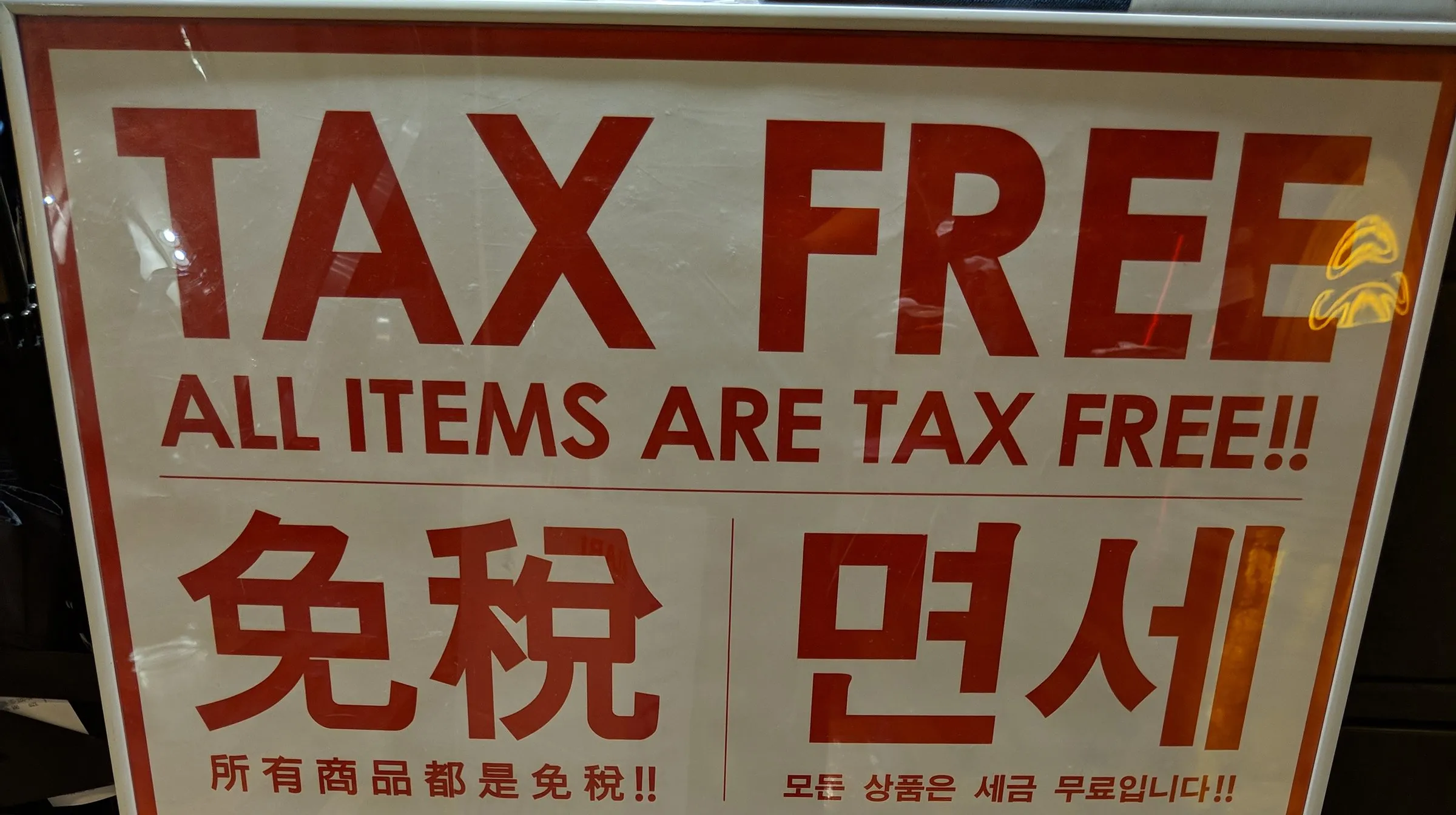
A tax-free sign photographed in 2018. The rules changed in November 2026. · "Japan Trip 2018 1856" by Michael Ocampo, CC BY 2.0, via Wikimedia Commons, cropped
Japan’s tax-free system for visitors changed on November 1, 2026. It is now a refund system [14] [23]. If you’ve shopped tax-free in Japan before, or read older guides, the steps are different now.
Before: up to October 31, 2026, eligible visitors paid the price without consumption tax at the store [23].
Now: you pay the tax-included price at a tax-free shop. When you leave Japan, customs confirms you’re taking the items out, and then the consumption tax amount is refunded [15] [17]. There was no overlap period between the two systems [15].
You may still see old tax-free signs in shops, like the one in our photo from 2018. The conditions printed on older signs don’t apply anymore [15].
Who can use it?
Non-residents of Japan. Foreign nationals qualify if they entered Japan less than six months ago [18]. Short-term visitors show their passport at the shop [19] [15]. Japanese nationals who live abroad can also use it if they’ve lived outside Japan for two years or more, are within six months of arriving on a temporary visit home, and can prove it with their passport and a supporting document [19] [18].
What are the conditions?
| Condition | What the official pages say | Source |
|---|---|---|
| Minimum spend | 5,000 yen or more before tax, at the same store on the same day | [17] [23] [15] |
| At the store | Show your passport, pay the tax-included price, register your refund details and choose a refund method | [20] [19] |
| How much you can buy | Only what you can carry out of Japan yourself | [16] [21] |
| Deadline | Customs check when you leave, within 90 days of purchase (counted from the day after; bought November 1, the last day is January 30) | [15] |
| Where | Tax-free kiosk at the airport or port, before you check your bags | [16] [17] |
| Missing items | Checked receipt by receipt. If even one item from a receipt is missing, nothing on that receipt is refunded | [15] [17] |
| Food, cosmetics and other consumables | Not refunded if used or eaten in Japan | [21] [23] |
| How the refund is paid | Differs by store. Examples given include bank transfer, card, app or cash at the port; the store explains at purchase | [14] [22] |
A few changes are worth knowing because older guides still mention them. The split between “general goods” and “consumables,” the 500,000-yen cap on consumables, the special sealed packaging for consumables, and the rule that items had to be “for daily use” were all dropped [15] [18].
What happens at the airport?
- Before you check your bags, go to a tax-free kiosk in the departure area and scan your passport [16] [20]. Once your bags are checked, the items can’t be confirmed [16].
- Green or red. If the kiosk shows green, you’re done. If it shows red, customs checks your items at an inspection point [17]. Keep your tax-free purchases where you can show them if asked [16].
- The refund comes from the store side after the customs check, by the method you chose [20] [22].
At seven airports (Narita, Haneda, Kansai, Chubu, Fukuoka, New Chitose and Naha), short-term visitors can also do the customs procedure online through Visit Japan Web [17] [23]. If you fly a domestic flight first and connect to an international one, do the procedure at the last airport you leave Japan from [17].
Customs-confirmed tax-free items have to leave Japan with you. If they don’t, the tax is collected and penalties can apply [16]. Some stores can ship items directly or export them for you, but that depends on the store [21].
With a baby on your hip, the kiosk step is easy to forget in the rush to drop bags. We’d write “tax-free kiosk first” on the top of your departure-day list.
Can you wear tax-free clothes during your trip?
We couldn’t find an answer on the official pages. What they do say: everything on the receipt has to be with you when you leave [15], consumables such as food and cosmetics used in Japan aren’t refunded [21], and the “for daily use” requirement is gone [15]. None of that says whether wearing clothes in Japan is fine, so we won’t guess.
Ask at the till when you buy. If you’re unsure, we’d keep it simple: buy what your family will wear on the trip as a normal purchase, and use tax-free for the things that go straight into the suitcase.
How to ask at the store
It’s normal to ask these things at the till. These lines are ready to show on your phone:
免税でお願いします。Menzei de onegaishimasu. (“Tax-free, please.”)
返金の方法と時期を教えてください。Henkin no hōhō to jiki o oshiete kudasai. (“Could you tell me how and when the refund is paid?”)
免税で買った服を、日本にいる間に着てもいいですか。Menzei de katta fuku o, Nihon ni iru aida ni kite mo ii desu ka? (“Can I wear clothes I bought tax-free while I’m still in Japan?”)
Keep every tax-free receipt together, in one envelope or pocket of your bag, until you’ve passed the kiosk.
Is it worth it for a family trip?
Here’s how we’d think about it:
- Buying to pack light: worth it if you’re traveling in cold months and don’t want to bring bulky layers, or if your child is about to grow out of everything. The convenience matters more than a small price difference.
- Buying to save money: check first. Compare the product page in Japan and at home on the day, in your own currency.
- Tax-free on top: it only applies from 5,000 yen before tax at one store on one day, and it adds steps at the airport [17] [16]. A few kids’ basics may not reach that. A bigger shop for the whole family might.
A quick checklist before you shop
Before the trip
- Pack two or three days of clothes per person, plus one spare outfit for each child in your day bag.
- Leave some room in the suitcase for what you’ll buy.
- Measure your child and note it on your phone.
At the store
- Check the size guide on the product page.
- Planning to shop tax-free? Bring your passport, check the store’s refund method, and decide which items you’ll wear in Japan.
- Keep tax-free receipts together.
On departure day
- Go to the tax-free kiosk before checking your bags, and keep every item from each receipt with you.
For the rest of your list, including what’s easy to buy in Japan and what’s better to bring, see our Japan with a baby packing list.
Questions parents ask
- Is Uniqlo cheaper in Japan?
- We can only speak for the four items we checked on November 4, 2026, and we didn't convert currencies. The Japanese prices include consumption tax, and the US and UK prices are the sites' listed prices. Whether Japan works out cheaper for you depends on the exchange rate on the day you pay, any sale running in either country, and whether you claim a tax-free refund. Check the product pages before you shop.
- Do I need my passport to shop tax-free?
- Yes. Foreign visitors staying short-term show their passport at the tax-free shop, and you show it again at the airport or port kiosk when you leave Japan. Japanese nationals living abroad need their passport plus a supporting document.
- Can I wear tax-free clothes while I'm still in Japan?
- The official pages we read don't say. They say you must take everything on the receipt out of Japan, that consumables such as food and cosmetics used in Japan aren't refunded, and that the old 'for daily use' requirement has been dropped. Clothes worn during the trip aren't addressed, so ask the store when you buy.
- What happens if I lose one item from a tax-free receipt?
- Customs checks purchases receipt by receipt. If even one item from a receipt is missing when you leave, none of the items on that receipt can be refunded.
- Do Japanese kids' sizes match US or UK sizes?
- Not directly. Uniqlo Japan lists kids' sizes as heights in centimeters, such as 100 (ages 3–4) up to 160 (age 14). We didn't compare size charts for this article, so use the size guide on each product page.
- 極暖ヒートテックコットンクルーネックTシャツ(キッズ)| ユニクロ — Uniqlo (Japan)
- Kids HEATTECH Extra Warm Cotton Crew Neck T-Shirt | Uniqlo US — Uniqlo (US)
- Kids HEATTECH Extra Warm Crew Neck T-Shirt | Uniqlo UK — Uniqlo (UK)
- 超極暖ヒートテッククルーネックTシャツ(キッズ)| ユニクロ — Uniqlo (Japan)
- Kids HEATTECH Ultra Warm Crew Neck T-Shirt | Uniqlo US — Uniqlo (US)
- Kids HEATTECH Ultra Warm Crew Neck T-Shirt | Uniqlo UK — Uniqlo (UK)
- GIRLS ヒートテックニットタイツ/リブ(キッズ)| ユニクロ — Uniqlo (Japan)
- Kids HEATTECH Ribbed Knit Tights | Uniqlo US — Uniqlo (US)
- Kids HEATTECH Ribbed Knitted Tights | Uniqlo UK — Uniqlo (UK)
- ヒートテッククルーネックT(9分袖)| ユニクロ — Uniqlo (Japan)
- Men's HEATTECH Crew Neck T-Shirt (Long Sleeve) | Uniqlo US — Uniqlo (US)
- Men's HEATTECH Crew Neck T-Shirt (Long Sleeve) | Uniqlo UK — Uniqlo (UK)
- No.6902 「総額表示」の義務付け | 国税庁 — National Tax Agency, Japan
- 輸出物品販売場制度のリファンド方式への見直し | 国税庁 — National Tax Agency, Japan
- Tax-Free Shopping System will be shifted to the Refund Method from November 2026 — National Tax Agency, Japan
- Notice to Foreign Travelers Who Purchase Tax-Free Goods (From November 2026) — National Tax Agency / Japan Customs / Japan Tourism Agency
- 旅行者向け特設ページ | 消費税免税店サイト — Japan Tourism Agency
- 免税店とは | 消費税免税店サイト — Japan Tourism Agency
- 【旅行者向け】免税購入対象者一覧 — Japan Tourism Agency
- The Tax-Free Shopping System Has Changed to a Refund Method — Japan Tourism Agency / METI / National Tax Agency / Japan Customs
- 購入時について(旅行者向けQ&A)| 消費税免税店サイト — Japan Tourism Agency
- 返金について(旅行者向けQ&A)| 消費税免税店サイト — Japan Tourism Agency
- Tax Exemption (Refund) Program for Foreign Visitors | Japan Customs — Japan Customs, Ministry of Finance