Japan Weather by Month for Babies: Rainy Season, Summer Heat and Winter Wind
This page contains affiliate links. If you book through them, we may earn a commission at no extra cost to you. How this works
- Japan's weather changes a lot by month and by region: in January, Sapporo averages -3.2°C while Naha averages 17.3°C, according to Japan's official climate normals.
- The rainy season (tsuyu) runs from about May in Okinawa to July in most of mainland Japan, and the hottest stretch is July to September. For heat, check the official Heat Stroke Alert from the Ministry of the Environment and the Japan Meteorological Agency.
- Our clothing ideas for each season are suggestions, not medical advice. For how heat or cold affects your own baby, talk to your pediatrician.
Picking dates for a trip to Japan with a baby is a lot of guessing. Will it be too hot for the stroller? Will it rain all week? Do we need a snowsuit? It’s a lot to weigh on top of everything else, and it’s normal to feel unsure.
So we went through the official numbers from the Japan Meteorological Agency (JMA) and the heat-safety pages of Japan’s government, and put them in one place. Below: what each month is like in four cities, when the rainy season and typhoons tend to come, how Japan’s heatstroke alerts work, and our suggestions for dressing a baby in each season.
All temperatures are in Celsius. To convert, multiply by 1.8 and add 32 (so 30°C is 86°F, and 0°C is 32°F).
What is the weather like in Japan each month?
It depends a lot on where you go. Japan stretches a long way from north to south. In January, the normal mean temperature is -3.2°C in Sapporo, 5.4°C in Tokyo and 17.3°C in Naha, Okinawa [5] [1] [6]. That is the difference between snow boots and a light jacket in the same week.
The tables below show JMA’s “normals” (heinenchi, 平年値): averages for the 30 years from 1991 to 2020. They are a good guide for packing, but any single year can be hotter, colder or wetter.
Tokyo and Osaka (where most first trips start):
| Month | Tokyo high / low (°C) | Tokyo rain (mm) | Osaka high / low (°C) | Osaka rain (mm) |
|---|---|---|---|---|
| Jan | 9.8 / 1.2 | 59.7 | 9.7 / 3.0 | 47.0 |
| Feb | 10.9 / 2.1 | 56.5 | 10.5 / 3.2 | 60.5 |
| Mar | 14.2 / 5.0 | 116.0 | 14.2 / 6.0 | 103.1 |
| Apr | 19.4 / 9.8 | 133.7 | 19.9 / 10.9 | 101.9 |
| May | 23.6 / 14.6 | 139.7 | 24.9 / 16.0 | 136.5 |
| Jun | 26.1 / 18.5 | 167.8 | 28.0 / 20.3 | 185.1 |
| Jul | 29.9 / 22.4 | 156.2 | 31.8 / 24.6 | 174.4 |
| Aug | 31.3 / 23.5 | 154.7 | 33.7 / 25.8 | 113.0 |
| Sep | 27.5 / 20.3 | 224.9 | 29.5 / 21.9 | 152.8 |
| Oct | 22.0 / 14.8 | 234.8 | 23.7 / 16.0 | 136.0 |
| Nov | 16.7 / 8.8 | 96.3 | 17.8 / 10.2 | 72.5 |
| Dec | 12.0 / 3.8 | 57.9 | 12.3 / 5.3 | 55.5 |
Sapporo and Naha (the far north and the far south):
| Month | Sapporo high / low (°C) | Sapporo precipitation (mm) | Naha high / low (°C) | Naha rain (mm) |
|---|---|---|---|---|
| Jan | -0.4 / -6.4 | 108.4 | 19.8 / 14.9 | 101.6 |
| Feb | 0.4 / -6.2 | 91.9 | 20.2 / 15.1 | 114.5 |
| Mar | 4.5 / -2.4 | 77.6 | 21.9 / 16.7 | 142.8 |
| Apr | 11.7 / 3.4 | 54.6 | 24.3 / 19.1 | 161.0 |
| May | 17.9 / 9.0 | 55.5 | 27.0 / 22.1 | 245.3 |
| Jun | 21.8 / 13.4 | 60.4 | 29.8 / 25.2 | 284.4 |
| Jul | 25.4 / 17.9 | 90.7 | 31.9 / 27.0 | 188.1 |
| Aug | 26.4 / 19.1 | 126.8 | 31.8 / 26.8 | 240.0 |
| Sep | 22.8 / 14.8 | 142.2 | 30.6 / 25.8 | 275.2 |
| Oct | 16.4 / 8.0 | 109.9 | 28.1 / 23.5 | 179.2 |
| Nov | 8.7 / 1.6 | 113.8 | 25.0 / 20.4 | 119.1 |
| Dec | 2.0 / -4.0 | 114.5 | 21.5 / 16.8 | 110.0 |
A few things in these numbers that surprised us:
- June isn’t Tokyo’s wettest month. On average, September (224.9 mm) and October (234.8 mm) get more rain than June (167.8 mm) [1]. If you’re booking an autumn trip, pack the rain cover too.
- Summer is humid as well as hot. Tokyo’s normal relative humidity is 74 to 76% from June to September, compared with 51 to 52% in January and February [1].
- Sapporo gets real snow. The normal total snowfall is 113 cm in December, 137 cm in January and 116 cm in February [5]. In winter, that is a city for boots and a stroller that can handle it, or a carrier.
- Okinawa is warm all year, but June (284.4 mm) and September (275.2 mm) are its wettest months, with May (245.3 mm) close behind [6].
When is the rainy season (tsuyu), and when do typhoons come?
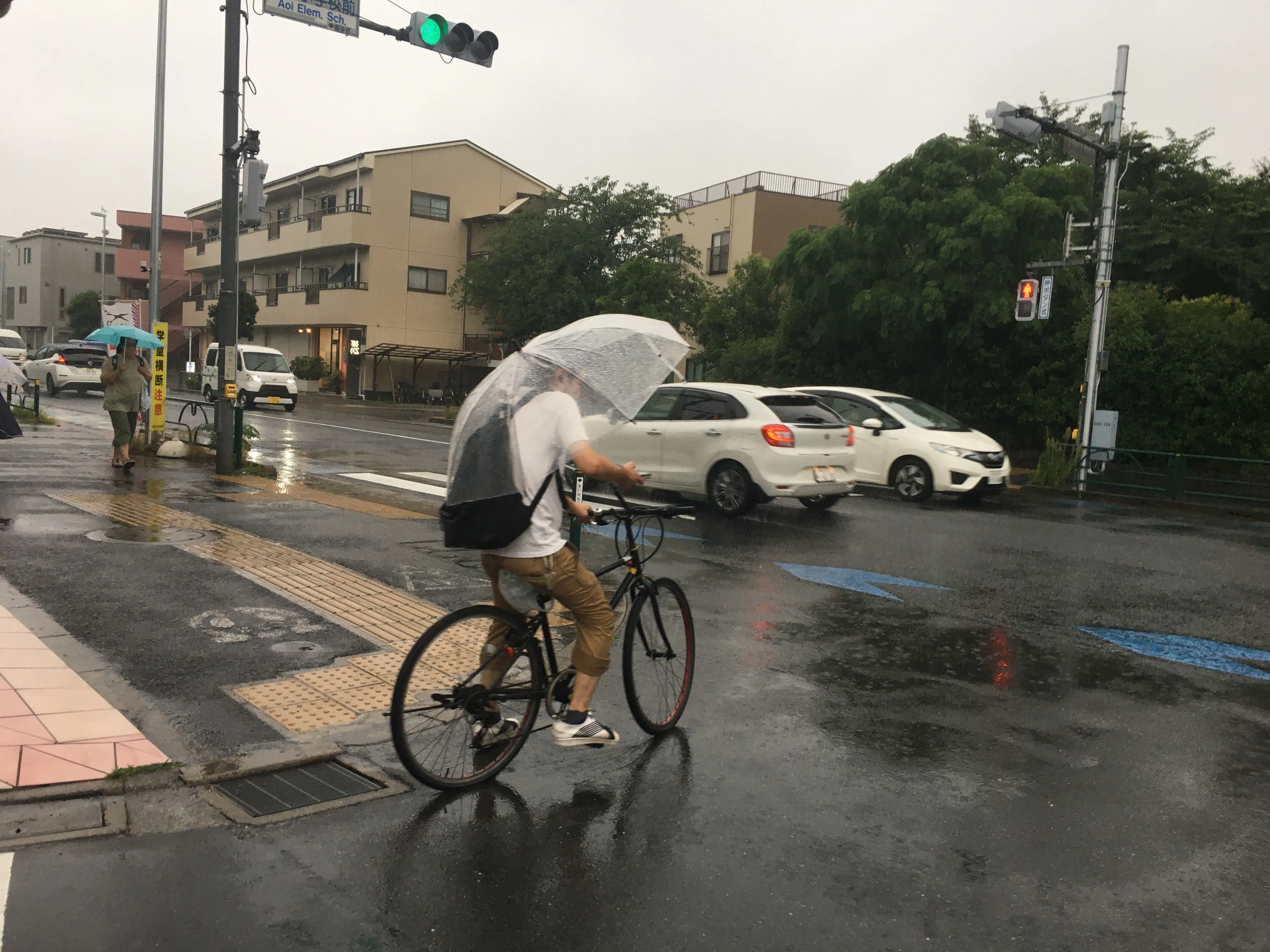
The rainy season
The rainy season, tsuyu (梅雨), is a stretch of the year between spring and summer with more rain and less sunshine [9]. It doesn’t mean rain all day, every day, but you can expect a lot of grey, damp days.
It moves from south to north. Here are JMA’s normal start and end dates for the regions most visitors go to [8]:
| Region (example cities) | Starts around | Ends around |
|---|---|---|
| Okinawa (Naha) | May 10 | June 21 |
| Southern Kyushu (Kagoshima) | May 30 | July 15 |
| Northern Kyushu (Fukuoka) | June 4 | July 19 |
| Kinki (Osaka, Kyoto) | June 6 | July 19 |
| Tokai (Nagoya) | June 6 | July 19 |
| Kanto-Koshin (Tokyo) | June 7 | July 19 |
| Hokuriku (Kanazawa) | June 11 | July 23 |
| Southern Tohoku (Sendai) | June 12 | July 24 |
| Northern Tohoku | June 15 | July 28 |
| Hokkaido (Sapporo) | Not treated as having a rainy season | - |
Two things to know about these dates:
- They are approximate. JMA says there is a transition of about five days at the start and end, and the date given is roughly the middle of it [8]. Real years move around. In 2026, for example, the preliminary dates for Kanto-Koshin were June 7 to July 20, while Hokuriku and Tohoku ended around August 4 [8].
- Hokkaido is the exception. JMA announces the rainy season for 12 regions and leaves out Hokkaido, because its rainy-season front tends to be unclear and the weather differs a lot from year to year [10].
Our suggestion: plan rainy-season days around places with a roof, such as indoor play areas, museums, aquariums and shopping centers. Pack quick-drying clothes, a hands-free rain poncho for whoever is carrying the baby, and a stroller rain cover from home.
Typhoons
On average, 11.7 typhoons a year come close to Japan, most often in August and September (3.3 each), followed by July (2.1) and October (1.7) [11]. JMA counts a typhoon as “approaching” when its center comes within 300 km of one of its observing stations. A “landfall” means the center reaches the coast of Hokkaido, Honshu, Shikoku or Kyushu, and that happens about 3.0 times a year on average [11].
Okinawa sees the most. Here is the normal number of approaches by month for a few regions:
| Region | Jun | Jul | Aug | Sep | Oct | Year |
|---|---|---|---|---|---|---|
| All of Japan | 0.8 | 2.1 | 3.3 | 3.3 | 1.7 | 11.7 |
| Okinawa | 0.6 | 1.5 | 2.2 | 1.9 | 1.1 | 7.7 |
| Kinki (Osaka, Kyoto) | 0.3 | 0.6 | 0.7 | 1.1 | 0.7 | 3.4 |
| Kanto-Koshin (Tokyo) | 0.2 | 0.4 | 0.8 | 1.2 | 0.7 | 3.3 |
Source: [11]
If your trip falls between July and October, especially in Okinawa, we’d keep the plans flexible: book refundable rooms where you can, and keep a day or two loose in case flights or outdoor plans have to move.
How hot does summer get, and what is a Heat Stroke Alert?
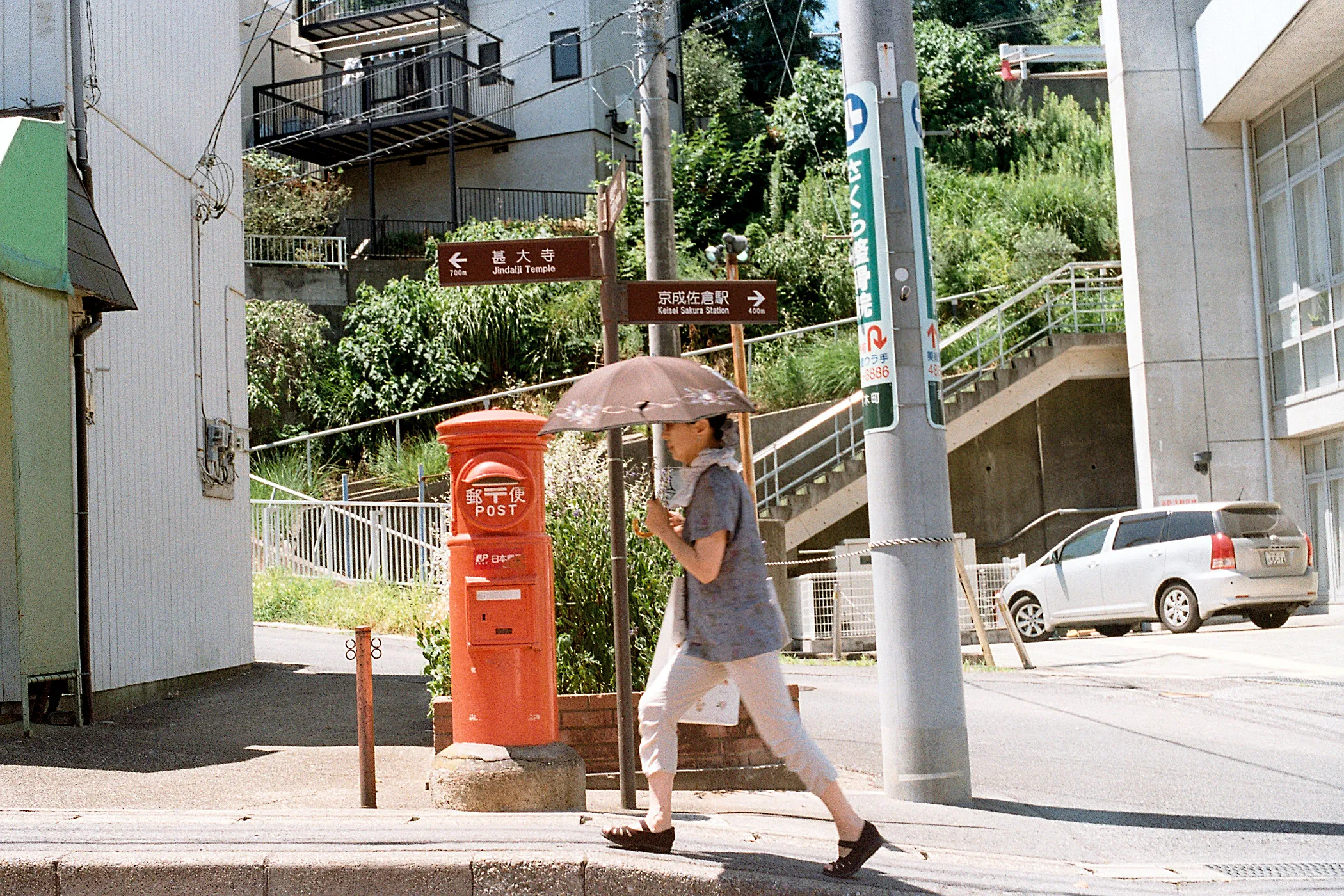
"Post box and woman with parasol in Sakura, Chiba, Japan" by Toomore Chiang, CC BY 2.0, via Wikimedia Commons
Japan’s words for hot days
You’ll hear these words on Japanese weather forecasts [12]:
- Natsubi (夏日, “summer day”): high of 25°C (77°F) or more
- Manatsubi (真夏日, “midsummer day”): high of 30°C (86°F) or more
- Mōshobi (猛暑日, “extremely hot day”): high of 35°C (95°F) or more
- Kokushobi (酷暑日): high of 40°C (104°F) or more
How many hot days to expect
| Month | Tokyo: high 30°C+ | Tokyo: high 35°C+ | Osaka: high 30°C+ | Osaka: high 35°C+ |
|---|---|---|---|---|
| Jun | 3.6 | 0.1 | 7.9 | 0.1 |
| Jul | 16.8 | 1.4 | 22.6 | 3.7 |
| Aug | 22.6 | 3.0 | 28.3 | 9.9 |
| Sep | 8.2 | 0.3 | 14.4 | 0.8 |
| Whole year | 52.1 | 4.8 | 74.9 | 14.5 |
Nights stay warm too. The number of days when even the daily low stays at 25°C or above is 17.8 a year in Tokyo (9.9 of them in August) and 41.5 a year in Osaka (21.4 in August) [2] [4]. In other words, in an average August in Osaka, on most days it never cools down below 25°C. Remember that these are 30-year averages, so a given summer can be hotter.
The Heat Stroke Alert
When dangerous heat is forecast, Japan’s Ministry of the Environment (MOE) and JMA issue a joint warning [13]. Its official name is Necchūshō Keikai Jōhō (熱中症警戒情報), and it is usually called the Heat Stroke Alert (熱中症警戒アラート, necchūshō keikai arāto) [14].
- When it’s issued: when the forecast daily maximum WBGT (see below) reaches 33 at any point in the forecast area [13] [14].
- What time: at about 5 p.m. the day before and about 5 a.m. on the day [13].
- What season: every year from late April to late October (from the fourth Wednesday of April to the fourth Wednesday of October). In 2026 it ran from April 22 to October 21 [13] [17].
There is also a stronger Special Heat Stroke Alert (Necchūshō Tokubetsu Keikai Jōhō, 熱中症特別警戒情報), created in April 2024 [21]. It is issued in cases such as when the next day’s maximum WBGT is forecast to reach 35 at every observation point in a prefecture. When it is out, cooling shelters designated by the local city or town, such as community centers, libraries and shopping centers, are opened [15].
What is WBGT? WBGT (atsusa shisū, 暑さ指数, “heat index”) combines humidity, heat from the sun and the ground, and air temperature. It is not the same number as the temperature [16]. The ministry uses these levels [14]:
| WBGT | Level (Japanese) | Level (English) |
|---|---|---|
| 31 or more | 危険 (kiken) | Danger |
| 28 to under 31 | 厳重警戒 (genjū keikai) | Severe warning |
| 25 to under 28 | 警戒 (keikai) | Warning |
| Under 25 | 注意 (chūi) | Caution |
Source: [14]
You can check it in English. The ministry’s heat site has an English version with Heat Stroke Alerts and WBGT forecasts, plus Chinese and Korean versions [18]. There is also a short English leaflet with key points [19], and alerts can be received through the ministry’s LINE account and by email [19] [23].
Source: Ministry of the Environment, Heat Illness Prevention Information website (https://www.wbgt.env.go.jp/).
If you’d like to ask at the front desk, you can show this line:
今日、このあたりに熱中症警戒アラートは出ていますか。Kyō, kono atari ni necchūshō keikai arāto wa dete imasu ka? (“Is there a Heat Stroke Alert for this area today?”)
What Japan’s government says about babies and heat
Japan’s Ministry of the Environment, Children and Families Agency and Consumer Affairs Agency all publish advice on children and heat. In short:
- Children’s bodies release heat less easily. Their sweating is not fully developed and they have a large body surface for their weight, so in hot sun their body temperature can rise faster than an adult’s [20] [21].
- Strollers sit close to hot ground. Being short, or riding in a stroller, puts children nearer to heat coming off the ground [21] [22]. In one example from the ministry, when the air in central Tokyo was 32.3°C, it was over 35°C at 50 cm above the ground and 36°C or more at 5 cm [20].
- Babies can’t tell you. Adults should watch for changes in sweating, body temperature, face color and the way the baby cries [21] [22].
- Never leave a child alone in a car, even for a short time or while they’re asleep [21] [22]. Among children aged 0 to 4, heatstroke deaths in Japan from 1995 to 2016 were most common at ages 0 and 1, and reported cases include children left in cars [20].
- It can happen indoors and at night. Use the air conditioning [21] [19].
- When an alert is out: stay in cool, air-conditioned places, rest often and take in water and salt. Older people and children are at higher risk [14] [13].
- It starts before high summer. In recent years, heat-related emergency transports have started around May [21], and the Consumer Affairs Agency notes that cases among children rise from around June [22]. The period right after the rainy season ends needs extra care [21].
If you’re worried your child has heatstroke, the official first-aid steps are to move them to a cool place, loosen their clothing and cool the neck, armpits and groin [22]. If the child does not respond when you call them, or cannot drink on their own, do not force fluids. Call an ambulance or get medical care right away [21] [22] [23]. Before you travel, ask your pediatrician what signs to watch for in your own baby.
Our suggestion: plan summer days around the heat. Do outdoor sights early in the morning or toward evening, and spend the hottest hours somewhere indoors and air-conditioned. We’d also keep long outdoor queues with a baby to a minimum in summer.
Are the mountains cooler in summer?
Yes, at least at night. Karuizawa, a highland resort in Nagano, has a normal August low of 17.1°C (about 63°F), compared with 23.5°C (about 74°F) in Tokyo [7] [1].
That’s welcome after a hot day in the city, but it also means a highland evening can feel chilly if you’ve packed only for Tokyo. Our suggestion: bring one warm layer per person, baby included, for a summer trip to the mountains.
What should a baby wear in each season?
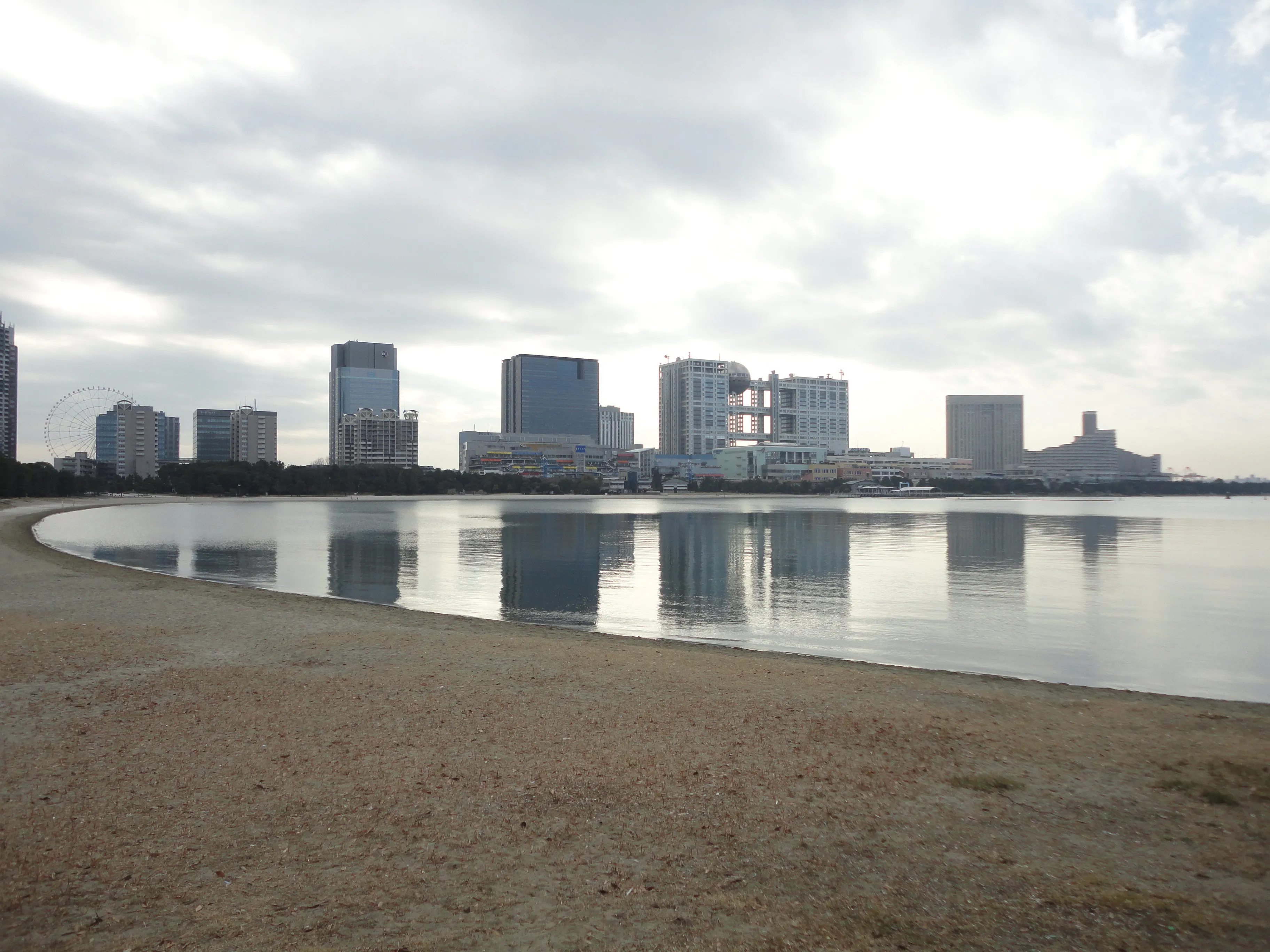
"お台場海浜公園" by kanesue, CC BY 3.0, via Wikimedia Commons
For hot weather, the official advice is clear. Japan’s agencies recommend light-colored, breathable clothes that don’t trap heat, adding or removing layers to match the heat, a hat outdoors, and shade such as a parasol (higasa, 日傘) [21] [22] [23]. The Ministry of the Environment also notes that, for young children, it is the parents who choose their clothing [20].
For cold weather, we did not find official Japanese guidance on how many layers a baby should wear at a given temperature. So the cold-weather rows below are our suggestions only.
| Season (Tokyo high / low) | What the weather is like | What to pack |
|---|---|---|
| Dec to Feb (about 10-12°C / 1-4°C) | Cold mornings and evenings, dry air | Our suggestion: warm layers you can take off indoors, a hat, a coat or snowsuit, and a cover for the stroller or carrier |
| Mar to May (about 14-24°C / 5-15°C) | Warming up; mornings can still be cool | Our suggestion: light layers, a thin jacket, a sun hat by May |
| Jun to early Jul (about 26-30°C / 19-22°C) | Rainy season on most of the main islands; humid | Our suggestion: quick-drying clothes, spare outfits, a stroller rain cover, a rain poncho for the adult |
| Mid-Jul to Sep (about 28-31°C / 20-24°C) | Hot and humid; typhoon season | Official advice: light-colored, breathable clothes, a hat, shade or a parasol, layers to adjust. Our suggestion: plenty of spare outfits |
| Oct to Nov (about 17-22°C / 9-15°C) | Mild; October is one of Tokyo's wettest months | Our suggestion: layers for cool evenings, a rain cover |
Sources for temperatures and rainfall: [1]. Official clothing advice for heat: [21] [22] [23].
Waterfront days in winter. Wind by the sea can make a winter day feel colder than the forecast temperature. We could not find official wind figures for specific waterfront areas, so take this as a general tip. Our suggestion: if you’re spending a winter day by the water, around Tokyo Bay for example, pack a windproof layer for everyone and a stroller cover that can block the wind.
Further north, Sapporo’s normal January high is -0.4°C (about 31°F) and low -6.4°C (about 20°F) [5], so plan for snow and real winter clothing there.
What about air conditioning and dry air indoors?
In summer, Japan’s government asks people to use air conditioning, including at night, because heatstroke also happens indoors [21] [19]. If your hotel room feels hot, don’t hesitate to turn the air conditioning on or ask the front desk how it works.
In winter, the air is drier. Tokyo’s normal relative humidity is about 51 to 52% in January and February [1], and heated rooms can feel drier still. Some families like to run a humidifier. Whether a hotel can lend one differs by hotel, so ask when you book or at check-in. In Japanese, a humidifier is a kashitsuki (加湿器):
加湿器を貸していただけますか。Kashitsuki o kashite itadakemasu ka? (“Could we borrow a humidifier?”)
In English: “Do you have a humidifier we could borrow for our room? We are traveling with a baby.”
How warm or cool to keep the room for your baby to sleep is a question for your pediatrician.
A quick weather checklist before you go
- Look up your cities in the tables above. If you’re going to more than one region, pack for the coldest and the hottest.
- Traveling between May and July? Check the rainy-season dates for each region, and pack a stroller rain cover.
- Traveling between July and October? Keep plans flexible for typhoons.
- Traveling between late April and late October? Bookmark the Ministry of the Environment’s English heat site and check the Heat Stroke Alert each morning.
- Going to the mountains in summer? Pack one warm layer each.
- Before you leave, talk to your pediatrician about heat, cold and what signs to watch for in your baby.
Questions parents ask
- When is the best time to visit Japan with a baby?
- There is no single answer, but if mild weather is your priority, the official climate normals for Tokyo and Osaka show daily highs of roughly 19 to 25°C in April and May, and roughly 17 to 24°C in October and November. Those months avoid both the summer heat and the winter cold on the main island. Crowds and prices are a separate question.
- Is Japan too hot for a baby in summer?
- That depends on your baby and your plans, so talk to your pediatrician. What the numbers say: Tokyo averages about 23 days with a high of 30°C or more in August, and Osaka about 28. Japan's government asks parents to take extra care with young children in the heat and publishes a Heat Stroke Alert you can check in English.
- What is tsuyu?
- Tsuyu (梅雨) is Japan's rainy season, a stretch of wetter, cloudier weather between spring and summer. On average it starts in early May in Okinawa and in early June in Tokyo and Osaka, and ends in late June to late July depending on the region. Hokkaido is not treated as having one.
- Do I need a winter coat for my baby in Tokyo?
- Tokyo's January normals are a high of 9.8°C and a low of 1.2°C, so we would pack warm layers and a coat or a stroller and carrier cover. That is our suggestion, not medical advice. Ask your pediatrician how to keep your baby at a comfortable temperature.
- 東京(東京都) 平年値(年・月ごとの値) 主な要素 — Japan Meteorological Agency
- 東京(東京都) 平年値(年・月ごとの値) 詳細(気温・蒸気圧・湿度) — Japan Meteorological Agency
- 大阪(大阪府) 平年値(年・月ごとの値) 主な要素 — Japan Meteorological Agency
- 大阪(大阪府) 平年値(年・月ごとの値) 詳細(気温・蒸気圧・湿度) — Japan Meteorological Agency
- 札幌(石狩地方) 平年値(年・月ごとの値) 主な要素 — Japan Meteorological Agency
- 那覇(沖縄県) 平年値(年・月ごとの値) 主な要素 — Japan Meteorological Agency
- 軽井沢(長野県) 平年値(年・月ごとの値) 主な要素 — Japan Meteorological Agency
- 令和8年の梅雨入りと梅雨明け(速報値) — Japan Meteorological Agency
- 昭和26年(1951年)以降の梅雨入りと梅雨明け(確定値) — Japan Meteorological Agency
- 梅雨について(よくある質問) — Japan Meteorological Agency
- 台風の平年値 — Japan Meteorological Agency
- 気温、湿度(予報用語) — Japan Meteorological Agency
- 熱中症警戒アラート — Japan Meteorological Agency
- 熱中症警戒情報とは — Ministry of the Environment, Japan
- 熱中症特別警戒情報とは — Ministry of the Environment, Japan
- 暑さ指数とは? — Ministry of the Environment, Japan
- よくある質問(Q7-9 暑さ指数情報が提供される期間) — Ministry of the Environment, Japan
- Heat Illness Prevention Information provided by MoE — Ministry of the Environment, Japan
- Heat illness is on the rise - Key points for prevention — Ministry of the Environment, Japan
- 熱中症環境保健マニュアル2022 Ⅲ-2 高齢者と子どもの注意事項 — Ministry of the Environment, Japan
- みんなで見守り「こどもの熱中症」を防ぎましょう! — Children and Families Agency, Japan
- Vol.593 子どもの熱中症対策を心がけましょう! — Consumer Affairs Agency, Japan
- Vol.687 夏本番に向けて熱中症予防を始めましょう! — Consumer Affairs Agency, Japan